
J. Mater. Sci. Technol. ›› 2021, Vol. 80: 163-170.DOI: 10.1016/j.jmst.2020.11.056
• Research Article • Previous Articles Next Articles
Qiu-Jie Chena,b, Shang-Yi Maa,*( ), Shao-Qing Wanga
Received:2020-10-27
Accepted:2020-11-16
Published:2020-12-24
Online:2020-12-24
Contact:
Shang-Yi Ma
About author:*E-mail address: hyma@imr.ac.cn (S.-Y. Ma).Qiu-Jie Chen, Shang-Yi Ma, Shao-Qing Wang. The assisting and stabilizing role played by ω phase during the $~\left\{ 112 \right\}{{111}_{\beta }}$ twinning in Ti-Mo alloys: A first-principles insight[J]. J. Mater. Sci. Technol., 2021, 80: 163-170.
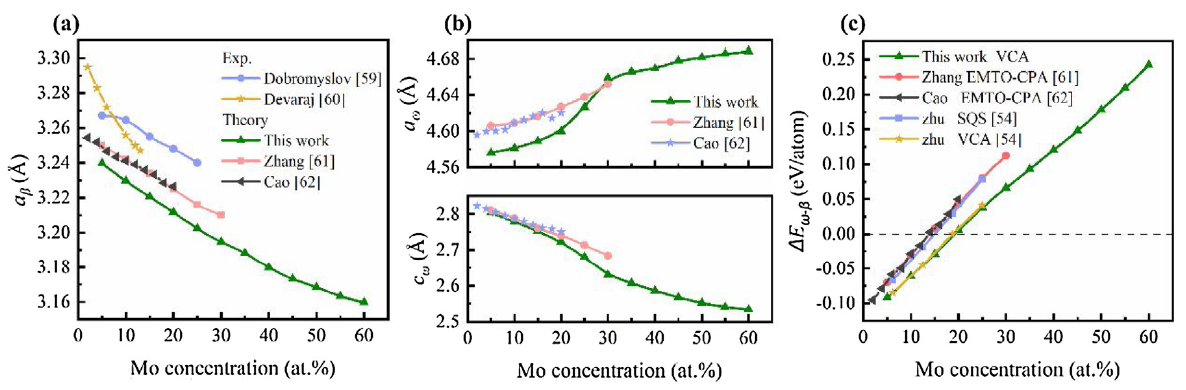
Fig. 1. Lattice parameters of (a) β and (b) ω phases functioned with Mo concentrations. (c) The energy difference between ω and β phase functioned with Mo concentrations.

Fig. 2. The configuration of ${{(112)}_{\beta }}/{{(10\bar{1}0)}_{\omega }}$ interface model. Yellow and black spheres represent β and ω phases, respectively.
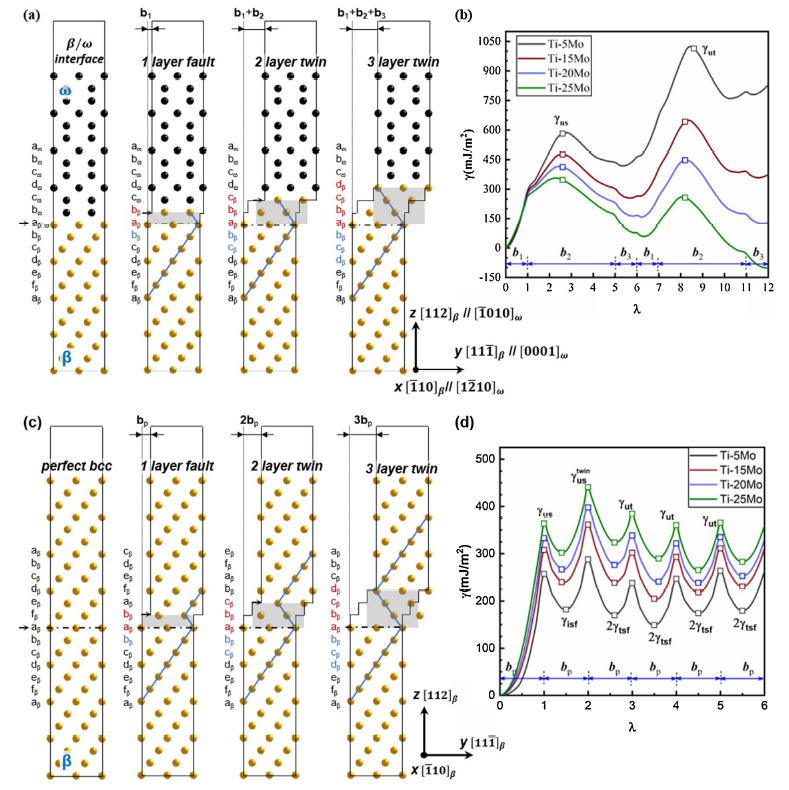
Fig. 3. Successive slipping of partial dislocations on (a) ${{\left( 10\bar{1}0 \right)}_{\omega }}$ and (c) ${{(112)}_{\beta }}$ planes. The GPFE curves of $\left\{ 112 \right\}{{111}_{\beta }}$ twinning nucleation following (b) the ω-assisted and (d) the conventional modes in Ti-Mo alloy with different Mo concentrations. The 1 × 2 × 1 original configurations of ${{(112)}_{\beta }}/{{(10\bar{1}0)}_{\omega }}$ interface model and ${{(112)}_{\beta }}$ BCC model are projected on $\left( \bar{1}10 \right)$ plane. Yellow and black spheres represent β and ω phase, respectively.
| Alloy (at.%) | Mode | γus (mJ/m2) | γut (mJ/m2) |
|---|---|---|---|
| Ti-5Mo | ω-assisted | 581.06 | 1013.15 |
| conventional | 256.97 | 287.74 | |
| Ti-15Mo | ω-assisted | 475.13 | 642.00 |
| conventional | 307.76 | 361.18 | |
| Ti-20Mo | ω-assisted | 411.66 | 446.91 |
| conventional | 332.54 | 397.81 | |
| Ti-25Mo | ω-assisted | 354.80 | 256.48 |
| conventional | 363.37 | 440.91 |
Table 1 The values of unstable stacking fault energy (γus) and unstable twin fault energy (γut) for the ω-assisted and conventional $\left\{ 112 \right\}{{111}_{\beta }}$ twinning modes.
| Alloy (at.%) | Mode | γus (mJ/m2) | γut (mJ/m2) |
|---|---|---|---|
| Ti-5Mo | ω-assisted | 581.06 | 1013.15 |
| conventional | 256.97 | 287.74 | |
| Ti-15Mo | ω-assisted | 475.13 | 642.00 |
| conventional | 307.76 | 361.18 | |
| Ti-20Mo | ω-assisted | 411.66 | 446.91 |
| conventional | 332.54 | 397.81 | |
| Ti-25Mo | ω-assisted | 354.80 | 256.48 |
| conventional | 363.37 | 440.91 |

Fig. 4. The $(112){{\left[ 11\bar{1} \right]}_{\beta }}$ twinning growth process for Ti-25Mo. (a) The atom configuration of initial twin nucleus. The intermediate (b-c) and the final (d) atom configurations of twin. The four atom layers of ω phase adjacent to the vacuum were fixed during the relaxations. Yellow and black spheres represent β and ω phases, respectively.

Fig. 5. The radial distribution functions of ideal β crystal and final relaxed structure.
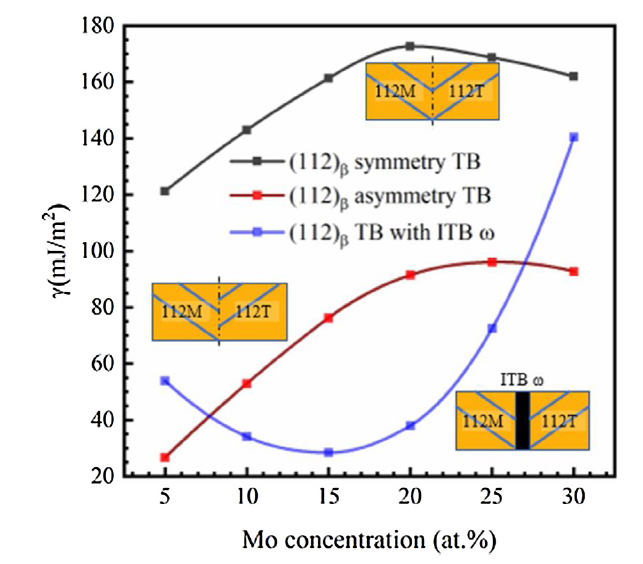
Fig. 6. The interface energy curves of three $\left( 112 \right){{\left[ 11\bar{1} \right]}_{\beta }}$ TB configurations.

Fig. 7. Schematic illustration of the formation of ITB ω phase through atomic displacements from the initial symmetrical $\left( 112 \right){{\left[ 11\bar{1} \right]}_{\beta }}$ TB in Ti-15Mo. Open circles and solid spheres represent the initial symmetrical $\left( 112 \right){{\left[ 11\bar{1} \right]}_{\beta }}$ TB and the relaxed $\left( 112 \right){{\left[ 11\bar{1} \right]}_{\beta }}$ TB plus ITB ω phase, respectively. Yellow and black spheres represent β and ω phase, respectively.
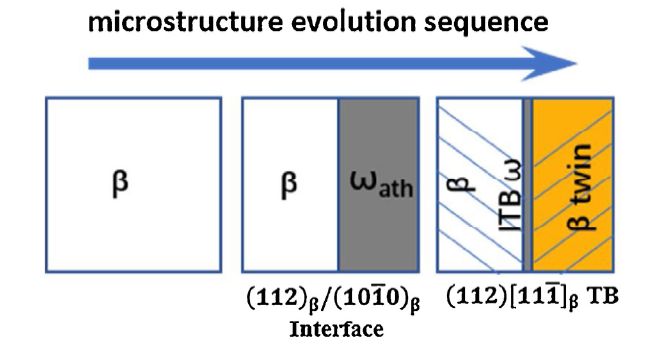
Fig. 8. Schematic illustration of the microstructure evolution sequence in Ti-Mo alloys under external conditions.
| [1] |
E.O. Ezugwu, Z.M. Wang, J. Mater, Process. Technol. 68 (1997) 262-274.
DOI URL |
| [2] |
D. Banerjee, J.C. Williams, Acta Mater. 61 (2013) 844-879.
DOI URL |
| [3] |
P. Gao, M. Fu, M. Zhan, Z. Lei, Y. Li, J. Mater. Sci. Technol. 39 (2020) 56-73.
DOI URL |
| [4] |
C. Lan, Y. Wu, L. Guo, H. Chen, F. Chen, J. Mater. Sci. Technol. 34 (2018) 788-792.
DOI URL |
| [5] | X. Zhang, T. Dong, H. Ma, D. Li, C. Ying, C. Liu, F. Wang, J. Mol, Graphics Modell. 96 (2020), 107509. |
| [6] |
I. Weiss, S.L. Semiatin, Mater. Sci. Eng. A 243 (1998) 46-65.
DOI URL |
| [7] |
J.C. Williams, E.A. Starke, Acta Mater. 51 (2003) 5775-5799.
DOI URL |
| [8] |
F. Sun, J.Y. Zhang, M. Marteleur, C. Brozek, E.F. Rauch, M. Veron, P. Vermaut, P.J. Jacques, F. Prima, Scr. Mater. 94 (2015) 17-20.
DOI URL |
| [9] |
M. Marteleur, F. Sun, T. Gloriant, P. Vermaut, P.J. Jacques, F. Prima, Scr. Mater. 66 (2012) 749-752.
DOI URL |
| [10] |
M. Ahmed, D. Wexler, G. Casillas, D.G. Savvakin, E.V. Pereloma, Acta Mater. 104 (2016) 190-200.
DOI URL |
| [11] |
X.H. Min, K. Tsuzaki, S. Emura, K. Tsuchiya, Mater. Sci. Eng. A 528 (2011) 4569-4578.
DOI URL |
| [12] |
J. Gao, Y. Huang, D. Guan, A.J. Knowles, L. Ma, D. Dye, W.M. Rainforth, Acta Mater. 152 (2018) 301-314.
DOI URL |
| [13] |
F. Sun, J.Y. Zhang, M. Marteleur, T. Gloriant, P. Vermaut, D. Laille, P. Castany, C. Curfs, P.J. Jacques, F. Prima, Acta Mater. 61 (2013) 6406-6417.
DOI URL |
| [14] |
J. Hernandez, S.J. Li, E. Martinez, L.E. Murr, X.M. Pan, K.N. Amato, X.Y. Cheng, F. Yang, C.A. Terrazas, S.M. Gaytan, Y.L. Hao, R. Yang, F. Medina, R.B. Wicker, J. Mater. Sci. Technol. 29 (2013) 1011-1017.
DOI URL |
| [15] | P.D. Frost, W.M. Parris, L.L. Hirsch, J.R. Doig, C.M. Schwartz, Trans. Am. Soc. Met. 46 (1954) 231-256. |
| [16] |
W. Chen, J.Y. Zhang, S. Cao, Y. Pan, M.D. Huang, Q.M. Hu, Q.Y. Sun, L. Xiao, J. Sun, Acta Mater. 117 (2016) 68-80.
DOI URL |
| [17] | M.K. Koul, J.F. Breedis, Metall. Trans. 1 (1970) 1451. |
| [18] | M.J. Blackburn, J.C. Williams, Trans. Met. Soc. AIME 242 (1968) 2461. |
| [19] |
T.W. Duerig, G.T. Terlinde, J.C. Williams, Metall. Trans. A 11 (1980) 1987-1998.
DOI URL |
| [20] |
F. Prima, P. Vermaut, G. Texier, D. Ansel, T. Gloriant, Scr. Mater. 54 (2006) 645-648.
DOI URL |
| [21] |
S. Nag, R. Banerjee, R. Srinivasan, J.Y. Hwang, M. Harper, H.L. Fraser, Acta Mater. 57 (2009) 2136-2147.
DOI URL |
| [22] |
Y.F. Zheng, R.E.A. Williams, D. Wang, R.P. Shi, S. Nag, P. Kami, J.M. Sosa, R. Banerjee, Y.Z. Wang, H.L. Fraser, Acta Mater. 103 (2016) 850-858.
DOI URL |
| [23] |
R. Shi, Y. Zheng, R. Banerjee, H.L. Fraser, Y. Wang, Scr. Mater. 171 (2019) 62-66.
DOI URL |
| [24] |
S. Azimzadeh, H.J. Rack, Metall. Mater. Trans. A 29 (1998) 2455-2467.
DOI URL |
| [25] |
R. Dong, J. Li, H. Kou, J. Fan, B. Tang, J. Mater. Sci. Technol. 35 (2019) 48-54.
DOI URL |
| [26] |
M. Tane, T. Nakano, S. Kuramoto, M. Niinomi, N. Takesue, H. Nakajima, Acta Mater. 61 (2013) 139-150.
DOI URL |
| [27] |
M. Tane, Y. Okuda, Y. Todaka, H. Ogi, A. Nagakubo, Acta Mater. 61 (2013) 7543-7554.
DOI URL |
| [28] |
M.J. Lai, T. Li, D. Raabe, Acta Mater. 151 (2018) 67-77.
DOI URL |
| [29] |
M.J. Lai, C.C. Tasan, D. Raabe, Acta Mater. 100 (2015) 290-300.
DOI URL |
| [30] |
S.A. Mantri, D. Choudhuri, T. Alam, V. Ageh, F. Sun, F. Prima, R. Banerjee, Scr. Mater. 130 (2017) 69-73.
DOI URL |
| [31] |
D.H. Ping, C.Y. Cui, F.X. Yin, Y. Yamabe-Mitarai, Scr. Mater. 54 (2006) 1305-1310.
DOI URL |
| [32] |
R.J. Talling, R.J. Dashwood, M. Jackson, D. Dye, Acta Mater. 57 (2009) 1188-1198.
DOI URL |
| [33] |
S.Q. Wu, D.H. Ping, Y. Yamabe-Mitarai, W.L. Xiao, Y. Yang, Q.M. Hu, G.P. Li, R. Yang, Acta Mater. 62 (2014) 122-128.
DOI URL |
| [34] |
B. Chen, W. Sun, J. Alloys. Compd. 766 (2018) 123-130.
DOI URL |
| [35] |
A.H. Cottrell, B.A. Bilby, Philos. Mag. 42 (1951) 573-581.
DOI URL |
| [36] |
K.P.D. Lagerlof, Acta Metall. Mater. 41 (1993) 2143-2151.
DOI URL |
| [37] |
J.W. Christian, S. Mahajan, Prog. Mater. Sci. 39 (1995) 1-157.
DOI URL |
| [38] |
K.P.D. Lagerlof, J. Castaing, P. Pirouz, A.H. Heuer, Philos. Mag. A 82 (2002) 2841-2854.
DOI URL |
| [39] |
B.B. Jiang, A.D. Tu, H. Wang, H.C. Duan, S.Y. He, H.Q. Ye, K. Du, Acta Mater. 155 (2018) 56-68.
DOI URL |
| [40] |
W. Chen, S. Cao, W.J. Kou, J.Y. Zhang, Y. Wang, Y. Zha, Y. Pan, Q.M. Hu, Q.Y. Sun, J. Sun, Acta Mater. 170 (2019) 187-204.
DOI |
| [41] |
M.J. Lai, C.C. Tasan, J. Zhang, B. Grabowski, L.F. Huang, D. Raabe, Acta Mater. 92 (2015) 55-63.
DOI URL |
| [42] | H. Xing, J. Sun, Appl. Phys. Lett. 93 (2008) 3. |
| [43] |
N. Hafeez, S. Liu, E. Lu, L. Wang, R. Liu, W. lu, L.-C. Zhang, J. Alloys. Compd. 790 (2019) 117-126.
DOI URL |
| [44] |
Y. Yang, P. Castany, E. Bertrand, M. Cornen, J.X. Lin, T. Gloriant, Acta Mater. 149 (2018) 97-107.
DOI URL |
| [45] |
E. Sukedai, M. Shimoda, H. Nishizawa, Y. Nako, Mater. Trans. 52 (2011) 324-330.
DOI URL |
| [46] |
Q.L. Liang, Z. Kloenne, Y.F. Zheng, D. Wang, S. Antonov, Y.P. Gao, Y.L. Hao, R. Yang, Y.Z. Wang, H.L. Fraser, Scr. Mater. 177 (2020) 181-185.
DOI URL |
| [47] |
J.Y. Chen, X.D. Zhang, D.Z. Li, C. Liu, H. Ma, C.H. Ying, F. Wang, Ceram. Int. 46 (2020) 4595-4601.
DOI URL |
| [48] |
J.Y. Chen, X.D. Zhang, C.H. Ying, H. Ma, J. Li, F. Wang, H. Guo, Ceram. Int. 46 (2020) 10992-10999.
DOI URL |
| [49] |
Q.J. Chen, S.Y. Ma, S.Q. Wang, Metals 9 (2019) 1202.
DOI URL |
| [50] |
P. Giannozzi, S. Baroni, N. Bonini, M. Calandra, R. Car, C. Cavazzoni, D. Ceresoli, G.L. Chiarotti, M. Cococcioni, I. Dabo, A. Dal Corso, S. de Gironcoli, S. Fabris, G. Fratesi, R. Gebauer, U. Gerstmann, C. Gougoussis, A. Kokalj, M. Lazzeri, L. Martin-Samos, N. Marzari, F. Mauri, R. Mazzarello, S. Paolini, A. Pasquarello, L. Paulatto, C. Sbraccia, S. Scandolo, G. Sclauzero, A.P. Seitsonen, A. Smogunov, P. Umari, R.M. Wentzcovitch, J. Phys. Condens. Matter 21 (2009), 395502.
DOI PMID |
| [51] |
J.P. Perdew, K. Burke, M. Ernzerhof, Phys. Rev. Lett. 77 (1996) 3865-3868.
PMID |
| [52] |
D.R. Hamann, Phys. Rev. B 88 (2013), 085117.
DOI URL |
| [53] |
L. Bellaiche, D. Vanderbilt, Phys. Rev. B 61 (2000) 7877-7882.
DOI URL |
| [54] |
J.L. Zhu, S. Cao, Y.Z. Wang, R. Yang, Q.M. Hu, Comput. Mater. Sci. 155 (2018) 524-533.
DOI URL |
| [55] | J.Y. Yan, H. Ehteshami, P.A. Korzhavyi, A. Borgenstam, Phys. Rev. Mater. 1 (2017), 023602. |
| [56] |
D. Scheiber, V.I. Razumovskiy, P. Puschnig, R. Pippan, L. Romaner, Acta Mater. 88 (2015) 180-189.
DOI URL |
| [57] |
H.J. Monkhorst, J.D. Pack, Phys. Rev. B 13 (1976) 5188-5192.
DOI URL |
| [58] |
J.D. Pack, H.J. Monkhorst, Phys. Rev. B 16 (1977) 1748-1749.
DOI URL |
| [59] |
A.V. Dobromyslov, V.A. Elkin, Scr. Mater. 44 (2001) 905-910.
DOI URL |
| [60] |
A. Devaraj, S. Nag, R. Srinivasan, R.E.A. Williams, S. Banerjee, R. Banerjee, H.L. Fraser, Acta Mater. 60 (2012) 596-609.
DOI URL |
| [61] |
S.Z. Zhang, H. Cui, M.M. Li, H. Yu, L. Vitos, R. Yang, Q.M. Hu, Mater. Des. 110 (2016) 80-89.
DOI URL |
| [62] |
P. Cao, F. Tian, Y. Wang, J. Phys. Condens. Matter 29 (2017), 435703.
DOI URL |
| [63] |
J.H. Gao, Y.H. Huang, D.K. Guan, A.J. Knowles, L. Ma, D. Dye, W.M. Rainforth, Acta Mater. 152 (2018) 301-314.
DOI URL |
| [64] |
L.M. Hsiung, D.H. Lassila, Acta Mater. 48 (2000) 4851-4865.
DOI URL |
| [65] |
M. Ahmed, A.A. Gazder, A.A. Saleh, D. Wexler, E.V. Pereloma, Metall. Mater. Trans. A 48 (2017) 2791-2800.
DOI URL |
| [66] |
S. Hanada, O. Izumi, Metall. Trans. A 11 (1980) 1447-1452.
DOI URL |
| [67] |
M. Ahmed, D. Wexler, G. Casillas, O.M. Ivasishin, E.V. Pereloma, Acta Mater. 84 (2015) 124-135.
DOI URL |
| [68] | P.D. Bristowe, A.G. Crocker, Philos. Mag. 31 (1975) 503-517. |
| [69] | M. Mrovec, T. Ochs, C. Elsasser, V. Vitek, D. Nguyen-Manh, D.G. Pettifor, Z. Metallk 94 (2003) 244-249. |
| [70] |
A. Ojha, H. Sehitoglu, L. Patriarca, H.J. Maier, Modell. Simul. Mater. Sci. Eng. 22 (2014), 075010.
DOI URL |
| [71] | J.W. Wang, Z. Zeng, M.R. Wen, Q.N. Wang, D.K. Chen, Y. Zhang, P. Wang, H.T. Wang, Z. Zhang, S.X. Mao, T. Zhu, Sci. Adv. 6 (2020), eaay2792. |
| [72] |
Y.M. Zhu, S.M. Zhu, J.F. Nie, Philos. Mag. Lett. 96 (2016) 280-285.
DOI URL |
| [1] | Zhihong Wu, Hongchao Kou, Nana Chen, Zhixin Zhang, Fengming Qiang, Jiangkun Fan, Bin Tang, Jinshan Li. Microstructural influences on the high cycle fatigue life dispersion and damage mechanism in a metastable β titanium alloy [J]. J. Mater. Sci. Technol., 2021, 70(0): 12-23. |
| [2] | Yanli Lu, Yi Wang, Yifan Wang, Meng Gao, Yao Chen, Zheng Chen. First-principles study on the mechanical, thermal properties and hydrogen behavior of ternary V-Ni-M alloys [J]. J. Mater. Sci. Technol., 2021, 70(0): 83-90. |
| [3] | Yujie Cui, Kenta Aoyagi, Huakang Bian, Yuichiro Hayasaka, Akihiko Chiba. Effects of the aluminum concentration on twin boundary motion in pre-strained magnesium alloys [J]. J. Mater. Sci. Technol., 2021, 73(0): 116-127. |
| [4] | Baoxian Su, Binbin Wang, Liangshun Luo, Liang Wang, Yanqing Su, Fuxin Wang, Yanjin Xu, Baoshuai Han, Haiguang Huang, Jingjie Guo, Hengzhi Fu. The corrosion behavior of Ti-6Al-3Nb-2Zr-1Mo alloy: Effects of HCl concentration and temperature [J]. J. Mater. Sci. Technol., 2021, 74(0): 143-154. |
| [5] | Yifan Wang, Yanli Lu, Jing Zhang, Wenchao Yang, Changlin Yang, Pan Wang, Xiaoqing Song, Zheng Chen. Investigation of the 12 orientations variants of nanoscale Al precipitates in eutectic Si of Al-7Si-0.6Mg alloy [J]. J. Mater. Sci. Technol., 2021, 67(0): 186-196. |
| [6] | Luyan Yang, Shuangming Li, Kai Fan, Yang Li, Yanhui Chen, Wei Li, Deli Kong, Pengfei Cao, Haibo Long, Ang Li. Twin crystal structured Al-10 wt.% Mg alloy over broad velocity conditions achieved by high thermal gradient directional solidification [J]. J. Mater. Sci. Technol., 2021, 71(0): 152-162. |
| [7] | S. Bancora, C. Binetruy, S. Advani, S. Comas-Cardona. Inverse methodology as applied to reconstruct local textile features from measured pressure field [J]. J. Mater. Sci. Technol., 2021, 71(0): 241-247. |
| [8] | Bingqiang Wei, Song Ni, Yong Liu, Min Song. Structural characterization of the {11$\overline 2$2} twin boundary and the corresponding stress accommodation mechanisms in pure titanium [J]. J. Mater. Sci. Technol., 2021, 72(0): 114-121. |
| [9] | Ziqi Guan, Jing Bai, Jianglong Gu, Xinzeng Liang, Die Liu, Xinjun Jiang, Runkai Huang, Yudong Zhang, Claude Esling, Xiang Zhao, Liang Zuo. First-principles investigation of B2 partial disordered structure, martensitic transformation, elastic and magnetic properties of all-d-metal Ni-Mn-Ti Heusler alloys [J]. J. Mater. Sci. Technol., 2021, 68(0): 103-111. |
| [10] | X. Luo, L.H. Liu, C. Yang, H.Z. Lu, H.W. Ma, Z. Wang, D.D. Li, L.C. Zhang, Y.Y. Li. Overcoming the strength-ductility trade-off by tailoring grain-boundary metastable Si-containing phase in β-type titanium alloy [J]. J. Mater. Sci. Technol., 2021, 68(0): 112-123. |
| [11] | B.N. Du, Z.Y. Hu, L.Y. Sheng, D.K. Xu, Y.X. Qiao, B.J. Wang, J. Wang, Y.F. Zheng, T.F. Xi. Microstructural characteristics and mechanical properties of the hot extruded Mg-Zn-Y-Nd alloys [J]. J. Mater. Sci. Technol., 2021, 60(0): 44-55. |
| [12] | Yu Han, Huabing Li, Hao Feng, Kemei Li, Yanzhong Tian, Zhouhua Jiang. Simultaneous enhancement in strength and ductility of Fe50Mn30Co10Cr10 high-entropy alloy via nitrogen alloying [J]. J. Mater. Sci. Technol., 2021, 65(0): 210-215. |
| [13] | Bo Song, Zhiwen Du, Ning Guo, Qingshan Yang, Fang Wang, Shengfeng Guo, Renlong Xin. Effect of free-end torsion on microstructure and mechanical properties of AZ31 bars with square section [J]. J. Mater. Sci. Technol., 2021, 69(0): 20-31. |
| [14] | Junyuan Bai, Hongbo Xie, Xueyong Pang, Guo Yuan, Lei Wang, Yuping Ren, Gaowu Qin. Nucleation and growth mechanisms of γ’’ phase with single-unit-cell height in Mg-RE-Zn(Ag) series alloys: a first-principles study [J]. J. Mater. Sci. Technol., 2021, 79(0): 133-140. |
| [15] | Shixing Huang, Qinyang Zhao, Yongqing Zhao, Cheng Lin, Cong Wu, Weiju Jia, Chengliang Mao, Vincent Ji. Toughening effects of Mo and Nb addition on impact toughness and crack resistance of titanium alloys [J]. J. Mater. Sci. Technol., 2021, 79(0): 147-164. |
| Viewed | ||||||
|
Full text |
|
|||||
|
Abstract |
|
|||||
 WeChat
