
J. Mater. Sci. Technol. ›› 2021, Vol. 69: 42-47.DOI: 10.1016/j.jmst.2020.08.012
• Research Article • Previous Articles Next Articles
Zhuwei Lva, Chenchen Yuana,*( ), Haibo Keb, Baolong Shena,*()
Received:2020-04-26
Revised:2020-05-15
Accepted:2020-06-10
Published:2021-04-10
Online:2021-05-15
Contact:
Chenchen Yuan,Baolong Shen
About author:blshen@seu.edu.cn (B. Shen).Zhuwei Lv, Chenchen Yuan, Haibo Ke, Baolong Shen. Defects activation in CoFe-based metallic glasses during creep deformation[J]. J. Mater. Sci. Technol., 2021, 69: 42-47.
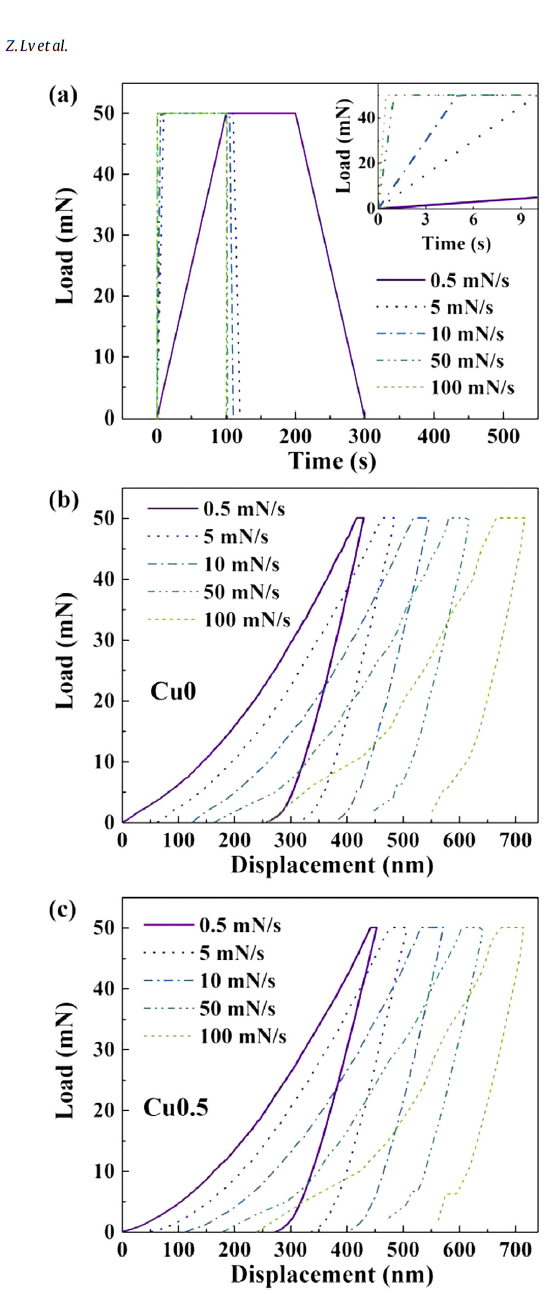
Fig. 1. (a) Load-time scheme for creep tests on CoFe-based MGs with different loading rates; the typical load-displacement (P-h) curves of Cu0 (b) and Cu0.5 (c) MGs at different loading rates under a maximum load of 50 mN.
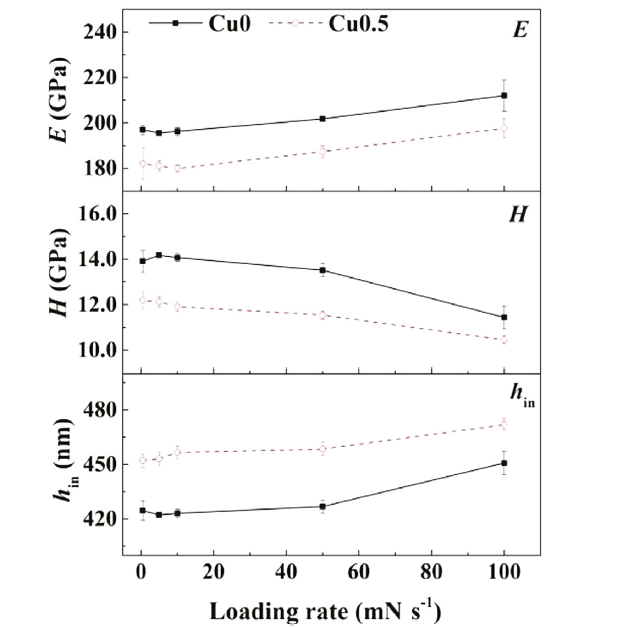
Fig. 2. Elastic modulus E, hardness H, and the maximum indentation creep hin of Cu0 and Cu0.5 MGs measured at different loading rates.
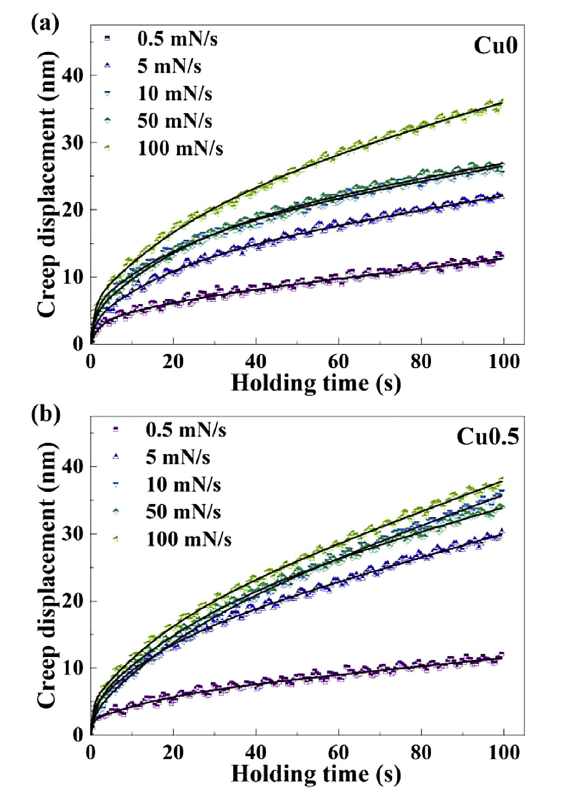
Fig. 3. Experimental and fitting creep curves of Cu0 (a) and Cu0.5 (b) MGs at different loading rates.
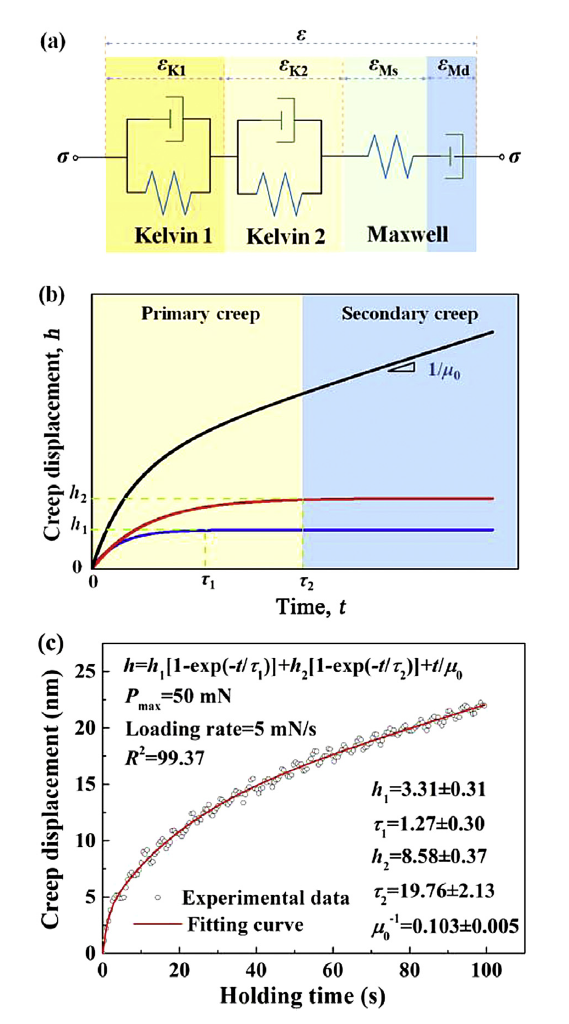
Fig. 4. (a) The Maxwell-Voigt model used for analyzing creep curves; (b) the schematic diagram of the h-t curve during the holding stage; (c) the typically fitted creep curve of Cu0 MG at a loading rate of 5 mN/s under a maximum load of 50 mN.
| Alloy | Loading rate (mN s-1) | h1 (nm) | τ1 (s) | h2 (nm) | τ2 (s) | μ0-1(nm s- 1) |
|---|---|---|---|---|---|---|
| Cu0 | 0.5 | 2.7 ± 0.6 | 1.8 ± 0.7 | 2.6 ± 0.5 | 13.8 ± 5.2 | 0.075 ± 0.004 |
| 5 | 3.3 ± 0.3 | 1.3 ± 0.3 | 8.6 ± 0.4 | 19.8 ± 2.1 | 0.103 ± 0.005 | |
| 10 | 5.3 ± 0.3 | 1.2 ± 0.2 | 10.6 ± 0.5 | 22.2 ± 2.4 | 0.107 ± 0.007 | |
| 50 | 4.1 ± 0.3 | 1.0 ± 0.2 | 12.9 ± 0.7 | 23.5 ± 2.2 | 0.127 ± 0.016 | |
| 100 | 5.9 ± 0.3 | 0.9 ± 0.2 | 13.0 ± 0.8 | 24.7 ± 2.5 | 0.172 ± 0.009 | |
| Cu0.5 | 0.5 | 2.1 ± 0.3 | 0.5 ± 0.3 | 3.3 ± 0.3 | 15.4 ± 3.3 | 0.062 ± 0.004 |
| 5 | 3.8 ± 0.3 | 0.6 ± 0.2 | 8.7 ± 0.3 | 16.2 ± 1.3 | 0.176 ± 0.004 | |
| 10 | 2.9 ± 0.3 | 1.0 ± 0.3 | 10.8 ± 0.5 | 22.1 ± 2.1 | 0.222 ± 0.007 | |
| 50 | 4.6 ± 0.3 | 1.4 ± 0.3 | 13.0 ± 0.9 | 26.6 ± 3.0 | 0.166 ± 0.010 | |
| 100 | 4.6 ± 0.2 | 0.6 ± 0.1 | 10.7 ± 0.4 | 18.5 ± 1.4 | 0.227 ± 0.005 |
Table 1 The fitting parameters of creep curves of Cu0 and Cu0.5 based on the Maxwell-Voigt model.
| Alloy | Loading rate (mN s-1) | h1 (nm) | τ1 (s) | h2 (nm) | τ2 (s) | μ0-1(nm s- 1) |
|---|---|---|---|---|---|---|
| Cu0 | 0.5 | 2.7 ± 0.6 | 1.8 ± 0.7 | 2.6 ± 0.5 | 13.8 ± 5.2 | 0.075 ± 0.004 |
| 5 | 3.3 ± 0.3 | 1.3 ± 0.3 | 8.6 ± 0.4 | 19.8 ± 2.1 | 0.103 ± 0.005 | |
| 10 | 5.3 ± 0.3 | 1.2 ± 0.2 | 10.6 ± 0.5 | 22.2 ± 2.4 | 0.107 ± 0.007 | |
| 50 | 4.1 ± 0.3 | 1.0 ± 0.2 | 12.9 ± 0.7 | 23.5 ± 2.2 | 0.127 ± 0.016 | |
| 100 | 5.9 ± 0.3 | 0.9 ± 0.2 | 13.0 ± 0.8 | 24.7 ± 2.5 | 0.172 ± 0.009 | |
| Cu0.5 | 0.5 | 2.1 ± 0.3 | 0.5 ± 0.3 | 3.3 ± 0.3 | 15.4 ± 3.3 | 0.062 ± 0.004 |
| 5 | 3.8 ± 0.3 | 0.6 ± 0.2 | 8.7 ± 0.3 | 16.2 ± 1.3 | 0.176 ± 0.004 | |
| 10 | 2.9 ± 0.3 | 1.0 ± 0.3 | 10.8 ± 0.5 | 22.1 ± 2.1 | 0.222 ± 0.007 | |
| 50 | 4.6 ± 0.3 | 1.4 ± 0.3 | 13.0 ± 0.9 | 26.6 ± 3.0 | 0.166 ± 0.010 | |
| 100 | 4.6 ± 0.2 | 0.6 ± 0.1 | 10.7 ± 0.4 | 18.5 ± 1.4 | 0.227 ± 0.005 |
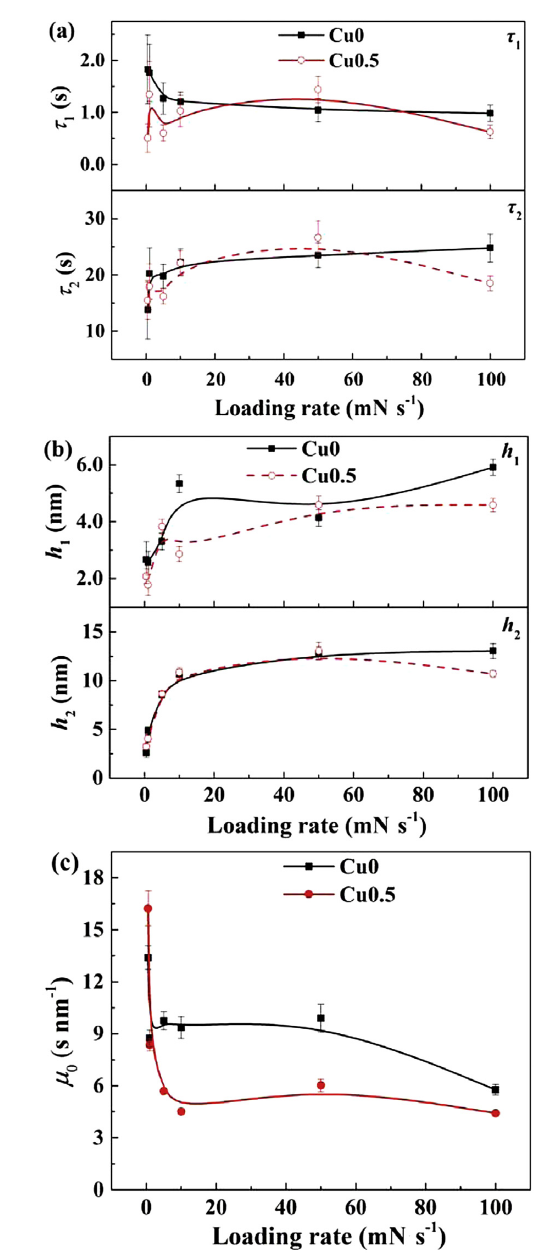
Fig. 5. The characteristic relaxation time τi (a), indentation depth hi (b), and viscosity constant μ0 (c) as a function of the loading rate.
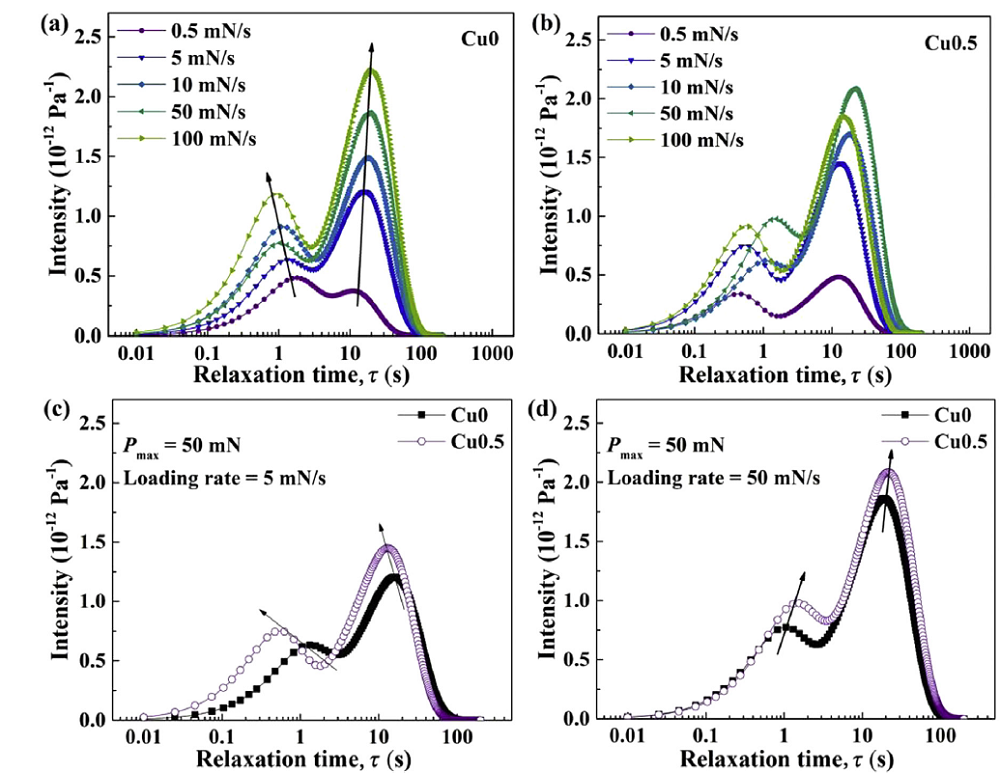
Fig. 6. Relaxation time spectra of Cu0 (a) and Cu0.5 (b) MGs based on the anelastic part of their creep curves with a maximum load of 50 mN at different loading rate; the relaxation spectra of Cu0 and Cu0.5 MGs at the loading rate of 5 mN/s (c) and 50 mN/s (d).
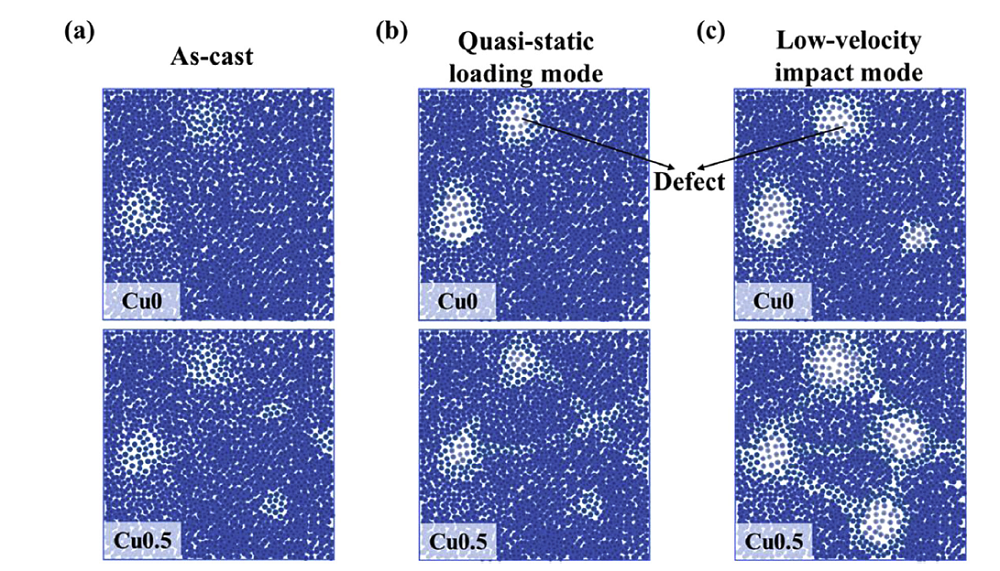
Fig. 7. A schematic diagram for the distribution of defects in Cu0 and Cu0.5 MGs at the as-cast state (a), quasi-static loading mode (b), and low-velocity impact mode (c).
| [1] |
W.L. Johnson, MRS Bull. 24 (2013) 42-56.
DOI URL |
| [2] |
C. Schuh, T. Hufnagel, U. Ramamurty, Acta Mater. 55 (2007) 4067-4109.
DOI URL |
| [3] |
D.D. Xu, B.L. Zhou, Q.Q. Wang, J. Zhou, W.M. Yang, C.C. Yuan, L. Xue, X.D. Fan, L.Q. Ma, B.L. Shen, Corros. Sci. 138 (2018) 20-27.
DOI URL |
| [4] |
A. Castellero, B. Moser, D.I. Uhlenhaut, F. H.D.Torre, J.F. Löffler, Acta Mater. 56 (2008) 3777-3785.
DOI URL |
| [5] |
Y.H. Chen, J.C. Huang, L. Wang, T.G. Nieh, Intermetallics 41 (2013) 58-62.
DOI URL |
| [6] |
B. Shen, H. Men, A. Inoue, Appl. Phys. Lett. 89 (2006), 101915.
DOI URL |
| [7] |
L. Zhang, P. Yu, H. Cheng, H. Zhang, H. Diao, Y. Shi, B. Chen, P. Chen, R. Feng, J. Bai, Q. Jing, M. Ma, P.K. Liaw, G. Li, R. Liu, Metall. Mater. Trans. A 47 (2016) 5871-5875.
DOI URL |
| [8] |
A. Concustell, J. Sort, A.L. Greer, M.D. Baró, Appl. Phys. Lett. 88 (2006), 171911.
DOI URL |
| [9] | V. Ocelík, K. Csach, A. Kasardová, V.Z. Bengus, Mater. Sci. Eng. A 226 (1997) 851-855. |
| [10] |
J.J. Pang, M.J. Tan, K.M. Liew, C. Shearwood, Phys. B 407 (2012) 340-346.
DOI URL |
| [11] |
Y. Ma, G.J. Peng, Y.H. Feng, T.H. Zhang, J. Non-Cryst. Solids 465 (2017) 8-16.
DOI URL |
| [12] |
C.C. Hays, C.P. Kim, W.L. Johnson, Phys. Rev. Lett. 84 (2000) 2901-2904.
DOI URL |
| [13] |
P. Gong, J. Jin, L. Deng, S. Wang, J. Gu, K. Yao, X. Wang, Mater. Sci. Eng. A 688 (2017) 174-179.
DOI URL |
| [14] |
C.C. Yuan, Z.W. Lv, C.M. Pang, W.W. Zhu, X.L. Wang, B.L. Shen, J. Alloys Compd. 806 (2019) 246-253.
DOI URL |
| [15] |
F. Xu, Z.L. Long, X.H. Deng, P. Zhang, Trans. Nonferrous Met. Soc. China 23 (2013) 1646-1651.
DOI URL |
| [16] |
Y.J. Huang, J. Shen, Y.L. Chiu, J.J.J. Chen, J.F. Sun, Intermetallics 17 (2009) 190-194.
DOI URL |
| [17] |
X. Li, H. Kato, K. Yubuta, A. Makino, A. Inoue, Mater. Sci. Eng. A 527 (2010) 2598-2602.
DOI URL |
| [18] |
C.L. Zhao, C.C. Dun, Q.K. Man, B.L. Shen, Intermetallics 32 (2012) 408-412.
DOI URL |
| [19] |
G.L. Zhang, Q.Q. Wang, C.C. Yuan, W.M. Yang, J. Zhou, L. Xue, F. Hu, B.A. Sun, B.L. Shen, J. Alloys Compd. 737 (2018) 815-820.
DOI URL |
| [20] |
Z.Z. Li, A. Wang, C.T. Chang, Y.G. Wang, B.S. Dong, Intermetallics 54 (2014) 225-231.
DOI URL |
| [21] |
F.L. Kong, H. Men, M.X. Zhang, T.C. Liu, G.Q. Xie, B.L. Shen, Appl. Phys. A 108 (2012) 211-215.
DOI URL |
| [22] |
J.S. Blazquez, C.F. Conde, A. Conde, Appl. Phys. A 76 (2003) 571-575.
DOI URL |
| [23] |
Y. Wu, H.X. Li, J.E. Gao, H. Wang, X.J. Liu, M.K. Miller, H. Bei, Y.F. Gao, Z.P. Lu, J. Alloys Compd. 688 (2016) 822-827.
DOI URL |
| [24] |
A. Takeuchi, A. Inoue, Mater. Trans. 46 (2005) 2817-2829.
DOI URL |
| [25] |
M. Heggen, F. Spaepen, M. Feuerbacher, J. Appl. Phys. 97 (2005), 033506.
DOI URL |
| [26] |
C.C. Yuan, Z.W. Lv, C.M. Pang, X.L. Wu, S. Lan, C.Y. Lu, L.G. Wang, H.B. Yu, J.H. Luan, W.W. Zhu, G.L. Zhang, Q. Liu, X.L. Wang, B.L. Shen, J. Alloys Compd. 798 (2019) 517-522.
DOI URL |
| [27] |
H.B. Ke, P. Zhang, B.A. Sun, P.G. Zhang, T.W. Liu, P.H. Chen, M. Wu, H.G. Huang, J. Alloys Compd. 788 (2019) 391-396.
DOI URL |
| [28] |
B.G. Yoo, I.C. Choi, Y.J. Kim, U. Ramamurty, J.I. Jang, Mater. Sci. Eng. A 577 (2013) 101-104.
DOI URL |
| [29] | J.D. Ferry, New York, 1980. |
| [30] |
X.H. Du, J.C. Huang, K.C. Hsieh, Y.H. Lai, H.M. Chen, J.S.C. Jang, P.K. Liaw, Appl. Phys. Lett. 91 (2007), 131901.
DOI URL |
| [31] |
G. Wu, K.C. Chan, L. Zhu, L. Sun, J. Lu, Nature 545 (2017) 80-83.
DOI URL |
| [32] |
P. Tsai, K. Kranjc, K.M. Flores, Acta Mater. 139 (2017) 11-20.
DOI URL |
| [33] |
J.C. Ye, J. Lu, C.T. Liu, Q. Wang, Y. Yang, Nat. Mater. 9 (2010) 619-623.
DOI PMID |
| [1] | Yanxin Qiao, Daokui Xu, Shuo Wang, Yingjie Ma, Jian Chen, Yuxin Wang, Huiling Zhou. Effect of hydrogen charging on microstructural evolution and corrosion behavior of Ti-4Al-2V-1Mo-1Fe alloy [J]. J. Mater. Sci. Technol., 2021, 60(0): 168-176. |
| [2] | M.C. Ri, D.W. Ding, Y.H. Sun, W.H. Wang. Microstructure change in Fe-based metallic glass and nanocrystalline alloy induced by liquid nitrogen treatment [J]. J. Mater. Sci. Technol., 2021, 69(0): 1-6. |
| [3] | Xinyue Tang, Junchao Wang, Jing Li, Xinglai Zhang, Peiqing La, Xin Jiang, Baodan Liu. In-situ growth of large-area monolithic Fe2O3/TiO2 catalysts on flexible Ti mesh for CO oxidation [J]. J. Mater. Sci. Technol., 2021, 69(0): 119-128. |
| [4] | Yeshun Huang, Xinguang Wang, Chuanyong Cui, Zihao Tan, Jinguo Li, Yanhong Yang, Jinlai Liu, Yizhou Zhou, Xiaofeng Sun. Effect of thermal exposure on the microstructure and creep properties of a fourth-generation Ni-based single crystal superalloy [J]. J. Mater. Sci. Technol., 2021, 69(0): 180-187. |
| [5] | Jiang Bi, Zhenglong Lei, Yanbin Chen, Xi Chen, Ze Tian, Nannan Lu, Xikun Qin, Jingwei Liang. Microstructure, tensile properties and thermal stability of AlMgSiScZr alloy printed by laser powder bed fusion [J]. J. Mater. Sci. Technol., 2021, 69(0): 200-211. |
| [6] | Mattia Biesuz, Theo Saunders, Daoyao Ke, Michael J. Reece, Chungfeng Hu, Salvatore Grasso. A review of electromagnetic processing of materials (EPM): Heating, sintering, joining and forming [J]. J. Mater. Sci. Technol., 2021, 69(0): 239-272. |
| [7] | Yoon Hwa, Christopher S. Kumai, Thomas M. Devine, Nancy Yang, Joshua K. Yee, Ryan Hardwick, Kai Burgmann. Microstructural banding of directed energy deposition-additively manufactured 316L stainless steel [J]. J. Mater. Sci. Technol., 2021, 69(0): 96-105. |
| [8] | Dan Liu, Daoxin Liu, Mario Guagliano, Xingchen Xu, Kaifa Fan, Sara Bagherifard. Contribution of ultrasonic surface rolling process to the fatigue properties of TB8 alloy with body-centered cubic structure [J]. J. Mater. Sci. Technol., 2021, 61(0): 63-74. |
| [9] | Baoguo Yuan, Xing Liu, Jiangfei Du, Qiang Chen, Yuanyuan Wan, Yunliang Xiang, Yan Tang, Xiaoxue Zhang, Zhongyue Huang. Effects of hydrogenation temperature on room-temperature compressive properties of CMHT-treated Ti6Al4V alloy [J]. J. Mater. Sci. Technol., 2021, 72(0): 132-143. |
| [10] | Weichao Bao, Stuart Robertson, Jia-Wei Zhao, Ji-Xuan Liu, Houzheng Wu, Guo-Jun Zhang, Fangfang Xu. Structural integrity and damage of ZrB2 ceramics after 4 MeV Au ions irradiation [J]. J. Mater. Sci. Technol., 2021, 72(0): 223-230. |
| [11] | Wen Zhang, Lei Chen, Chenguang Xu, Wenyu Lu, Yujin Wang, Jiahu Ouyang, Yu Zhou. Densification, microstructure and mechanical properties of multicomponent (TiZrHfNbTaMo)C ceramic prepared by pressureless sintering [J]. J. Mater. Sci. Technol., 2021, 72(0): 23-28. |
| [12] | Zhihong Wu, Hongchao Kou, Nana Chen, Zhixin Zhang, Fengming Qiang, Jiangkun Fan, Bin Tang, Jinshan Li. Microstructural influences on the high cycle fatigue life dispersion and damage mechanism in a metastable β titanium alloy [J]. J. Mater. Sci. Technol., 2021, 70(0): 12-23. |
| [13] | Qingqing Li, Yong Zhang, Jie Chen, Bugao Guo, Weicheng Wang, Yuhai Jing, Yong Liu. Effect of ultrasonic micro-forging treatment on microstructure and mechanical properties of GH3039 superalloy processed by directed energy deposition [J]. J. Mater. Sci. Technol., 2021, 70(0): 185-196. |
| [14] | Yuan-Yun Zhao, Feng Qian, Chengliang Zhao, Chunxiao Xie, Jianguo Wang, Chuntao Chang, Yanjun Li, Lai-Chang Zhang. Facile fabrication of ultrathin freestanding nanoporous Cu and Cu-Ag films with high SERS sensitivity by dealloying Mg-Cu(Ag)-Gd metallic glasses [J]. J. Mater. Sci. Technol., 2021, 70(0): 205-213. |
| [15] | R. Liu, P. Zhang, Z.J. Zhang, B. Wang, Z.F. Zhang. A practical model for efficient anti-fatigue design and selection of metallic materials: I. Model building and fatigue strength prediction [J]. J. Mater. Sci. Technol., 2021, 70(0): 233-249. |
| Viewed | ||||||
|
Full text |
|
|||||
|
Abstract |
|
|||||
 WeChat
