
J. Mater. Sci. Technol. ›› 2022, Vol. 111: 204-210.DOI: 10.1016/j.jmst.2021.09.046
• Research Article • Previous Articles Next Articles
Xuewen Wanga,*( ), Qiuchan Lia,b, Qingzhuo Lina, Rongbin Zhanga,*(), Mingyue Dingb,*()
Received:2021-08-09
Revised:2021-08-30
Accepted:2021-09-23
Published:2021-12-09
Online:2021-12-09
Contact:
Xuewen Wang,Rongbin Zhang,Mingyue Ding
About author:Dingmy@whu.edu.cn (M. Ding).Xuewen Wang, Qiuchan Li, Qingzhuo Lin, Rongbin Zhang, Mingyue Ding. CdS-sensitized 3D ordered macroporous g-C3N4 for enhanced visible-light photocatalytic hydrogen generation[J]. J. Mater. Sci. Technol., 2022, 111: 204-210.

Fig. 1. (a) Design strategy of 3DOM g-C3N4/CdS; SEM images of (b) SiO2 spheres, (c) 3DOM g-C3N4 and (d) 3DOM g-C3N4/CdS; (e) TEM image of 3DOM g-C3N4; (f) TEM image and (g) HR-TEM image of 3DOM g-C3N4/CdS.
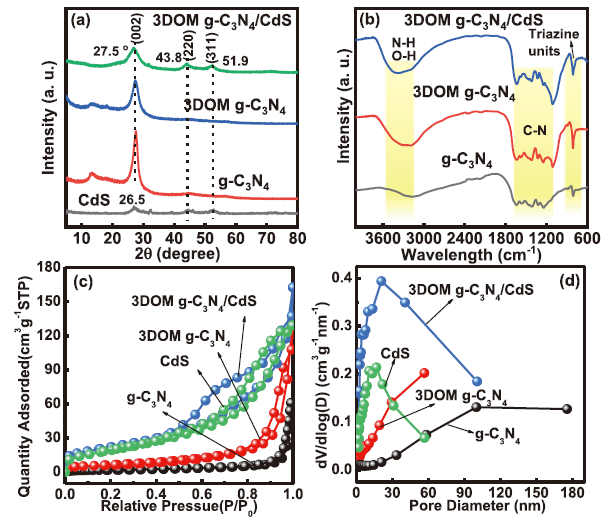
Fig. 2. (a) XRD patterns, (b) FT-IR spectra, (c) N2 adsorption-desorption isotherms and (d) pore diameter distribution of samples.

Fig. 3. (a) XPS spectra of C 1 s and (b) N 1 s in the samples; (c) XPS spectra of Cd 3d and (d) S 2p in the 3DOM g-C3N4/CdS.

Fig. 4. (a) UV-vis DRS of samples; (b) estimated bandgaps of g-C3N4 and 3DOM g-C3N4; (c) Mott-Schottky plots of 3DOM g-C3N4, g-C3N4 and CdS.

Fig. 5. (a) H2 production rates and (b) time courses of H2 yields for 3DOM g-C3N4/CdS with different contents of CdS nanoparticles; (c) the comparison of H2 evolution rates for samples; (d) cycles of H2 evolution for the 3DOM g-C3N4/CdS.
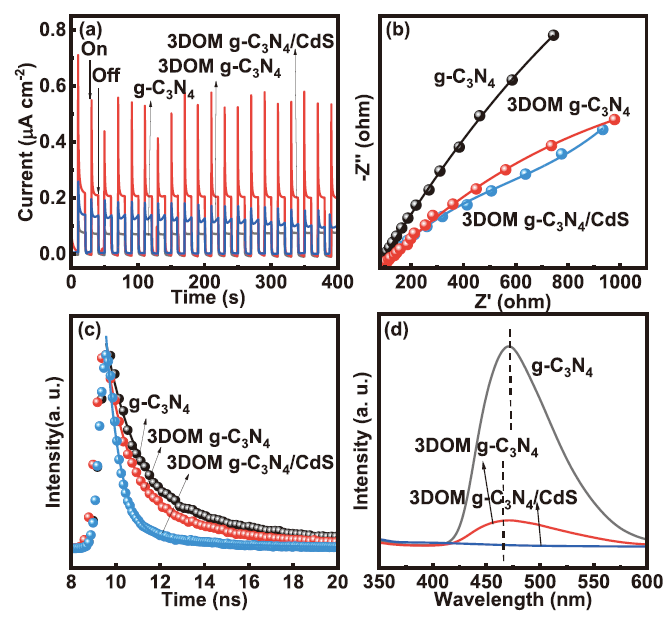
Fig. 6. (a) Photocurrent curves of samples with time at applied potential 0.3 V. (b) EIS curves, (c) decay time spectra and (d) PL spectra of samples.

Fig. 7. Sketch of photocatalytic H2 production over the 3DOM g-C3N4/CdS heterostructure.
| [1] |
W.J. Ong, L.L. Tan, Y.H. Ng, Chem. Rev. 116 (2016) 7159-7329.
DOI URL |
| [2] |
J. Liu, Y. Liu, N.Y. Liu, Y.Z. Han, X. Zhang, H. Huang, Y. Lifshitz, Science 347 (2017) 970-974.
DOI URL |
| [3] |
Z. Zhou, Y. Zhang, Y. Shen, Chem. Soc. Rev. 47 (2018) 2298-2321.
DOI URL |
| [4] |
S. Nardecchia, D. Carriazo, M.L. Ferrer, Chem. Soc. Rev. 42 (2013) 794-830.
DOI PMID |
| [5] |
K. Yu, C. Zhang, Y. Chang, Appl. Catal. B Environ. 200 (2017) 514-520.
DOI URL |
| [6] |
H. Hong, J. Liu, H. Huang, J. Am. Chem. Soc. 141 (2019) 14764-14771.
DOI PMID |
| [7] | Y. Chang, K. Yu, C. Zhang, Appl. Catal. B Environ. 176 (2015) 363-373. |
| [8] |
B. Liu, Y. Liu, C. Li, Appl. Catal. B Environ. 127 (2012) 47-58.
DOI URL |
| [9] |
X. Zhang, H. Liang, H. Li, Angew. Chem. Int. Ed. 59 (2020) 3287-3293.
DOI URL |
| [10] |
C. Zhang, B. Liu, X. Cheng, Chem. Eng. J. 393 (2020) 124774-124784.
DOI URL |
| [11] |
S. Wang, B.C. Zhu, M.J. Liu, Appl. Catal. B Environ. 243 (2019) 19-26.
DOI URL |
| [12] |
R.B. Wei, Z.L. Huang, G.H. Gua, Z. Wang, L.X. Zeng, Y.B. Chen, Z.Q. Liu, Appl. Catal. B Environ. 231 (2018) 101-107.
DOI URL |
| [13] | C. Feng, Z. Chen, J. Hou, Chem. Eng. J. 345 (2018) 404-413. |
| [14] |
Y. Li, R. Jin, Y. Xing, Adv. Energy Mater. 6 (2016) 1601273-1601278.
DOI URL |
| [15] |
S. You, M. Ma, W. Wang, Adv. Energy Mater. 7 (2017) 1601364-1601374.
DOI URL |
| [16] |
Y. Wang, Y. Zhang, J. Yan, Chem. Commun. 56 (2020) 14087-14090.
DOI URL |
| [17] |
H. Zhao, Z. Hu, J. Liu, Nano Energy 47 (2018) 266-274.
DOI URL |
| [18] |
K. Shen, L. Zhang, X.C. Chen, L.M. Liu, D.L. Zhang, Y. Han, J.Y. Chen, Science 359 (2018) 206-210.
DOI PMID |
| [19] |
B. Lin, G. Yang, B. Yang, Appl. Catal. B Environ. 198 (2016) 276-285.
DOI URL |
| [20] |
J. Liang, Y. Zheng, J. Chen, Angew. Chem. Int. Ed. 51 (2012) 3892-3896.
DOI PMID |
| [21] |
G.P. Mane, S.N. Talapaneni, K.S. Lakhi, Angew. Chem. Int. Ed. 56 (2017) 8481-8485.
DOI URL |
| [22] |
W. Ma, N. Wang, Y. Guo, Chem. Eng. J. 388 (2020) 124288-124296.
DOI URL |
| [23] |
G. Dong, D.L. Jacobs, L. Zang, Appl. Catal. B Environ. 218 (2017) 515-524.
DOI URL |
| [24] |
Q. Liang, Z. Li, Z.H. Huang, Adv. Funct. Mater. 25 (2015) 6885-6892.
DOI URL |
| [25] |
L. Zhang, Z. Jin, S. Huang, Appl. Catal. B Environ. 246 (2019) 61-71.
DOI URL |
| [26] |
J. Huang, D. Li, R. Li, Chem. Eng. J. 374 (2019) 242-253.
DOI URL |
| [27] |
T. Song, G. Zeng, P. Zhang, J. Mater. Chem. A 7 (2019) 503-512.
DOI URL |
| [28] |
D. Zheng, G. Zhang, X. Wang, Appl. Catal. B Environ. 179 (2015) 479-488.
DOI URL |
| [29] |
W. Yu, D. Xu, T. Peng, J. Mater. Chem. A 3 (2015) 19936-19947.
DOI URL |
| [30] | H. Yu, R. Shi, Y. Zhao, Adv.Mater. 29 (2017) 1605148-1605155. |
| [31] |
J. Pan, Z. Dong, B. Wang, Appl. Catal. B Environ. 242 (2019) 92-99.
DOI URL |
| [32] |
D.N. Liu, D.Y. Chen, N.J. Li, Q.F. Xu, H. Li, J.H. He, J.M. Lu, Angew. Chem. Int. Ed. 59 (2019) 4519-4524.
DOI URL |
| [33] |
B. Shao, X. Liu, Z. Liu, Chem. Eng. J. 374 (2019) 479-493.
DOI URL |
| [34] |
S. Zhang, S. Song, P. Gu, J. Mater. Chem. A 7 (2019) 5552-5560.
DOI |
| [35] |
X.J. She, J.J. Wu, H. Xu, J. Zhong, Y. Wang, Adv. Energy Mater. 7 (2017) 1700025-1700032.
DOI URL |
| [36] |
Z. Xu, H. Li, Z. Wu, J. Mater. Chem. C 4 (2016) 7501-7507.
DOI URL |
| [37] |
N. Tian, Y. Zhang, X. Li, Nano Energy 38 (2017) 72-81.
DOI URL |
| [38] |
Y. Song, N. Li, D. Chen, ACS Sustain, Chem. Eng. 6 (2018) 4000-4007.
DOI URL |
| [39] |
C. Zhou, C. Lai, D. Huang, Appl. Catal. B Environ. 220 (2018) 202-210.
DOI URL |
| [40] |
J. Jiao, Y. Wei, Y. Zhao, Appl. Catal. B Environ. 209 (2017) 228-239.
DOI URL |
| [41] |
C. Dong, Z. Ma, R. Qie, Appl. Catal. B Environ. 217 (2017) 629-636.
DOI URL |
| [42] |
Y. Wang, P. Du, H. Pan, Adv. Mater. 31 (2019) 1807540-1807548.
DOI URL |
| [43] | S. Wu, X. Xing, D. Wang, A.C.S. Sustain, Chem. Eng. 8 (2020) 148-153. |
| [44] |
Y. Chang, Y. Xuan, H. Quan, Chem. Eng. J. 382 (2020) 122869-122878.
DOI URL |
| [45] |
Q.Z. Zhang, S.Y. Huang, J.J. Deng, Adv. Funct. Mater. 29 (2019) 1902486-1902496.
DOI URL |
| [46] |
S.K. Le, T.S. Jiang, Y.W. Li, Appl. Catal. B Environ. 200 (2017) 601-610.
DOI URL |
| Viewed | ||||||
|
Full text |
|
|||||
|
Abstract |
|
|||||
 WeChat
