
J. Mater. Sci. Technol. ›› 2021, Vol. 90: 225-235.DOI: 10.1016/j.jmst.2021.02.035
• Research Article • Previous Articles Next Articles
Jinseo Kima, Le Thai Duyb, Hyunwoo Kanga, Byungmin Ahna,b,*( ), Hyungtak Seoa,b,*()
Received:2020-12-11
Revised:2021-02-21
Accepted:2021-02-28
Published:2021-11-05
Online:2021-11-05
Contact:
Byungmin Ahn,Hyungtak Seo
About author:hseo@ajou.ac.kr (H. Seo).1 These authors contribute equally to this work.
Jinseo Kim, Le Thai Duy, Hyunwoo Kang, Byungmin Ahn, Hyungtak Seo. Fluorine doping for improved thermoelectric properties of spark plasma sintered bismuth telluride[J]. J. Mater. Sci. Technol., 2021, 90: 225-235.
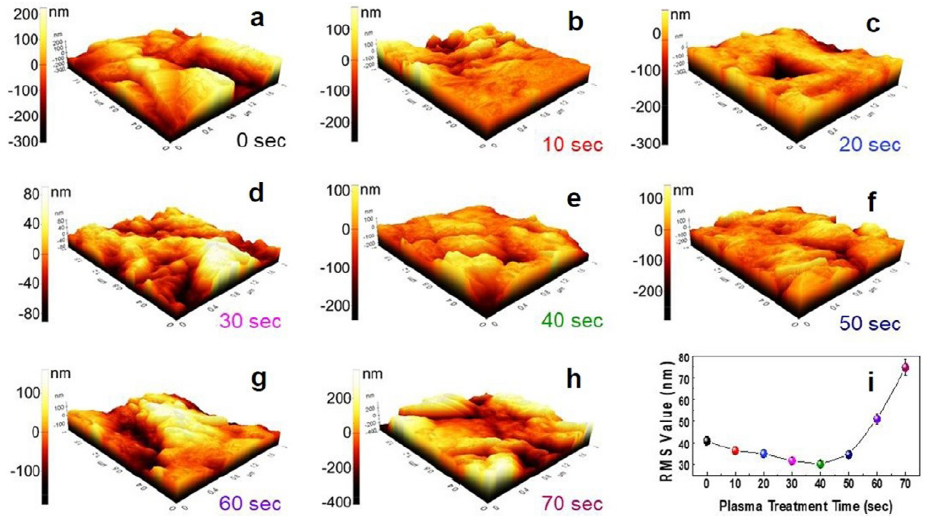
Fig. 1. (a-h) AFM images showing the surface morphology of pristine and F-doped Bi2Te3 samples with different plasma treatment time (tP = 0-70 s), respectively. Here, the analyzed sample area is 2 μm × 2 μm. (i) RMS roughness of those samples as a function of tP.
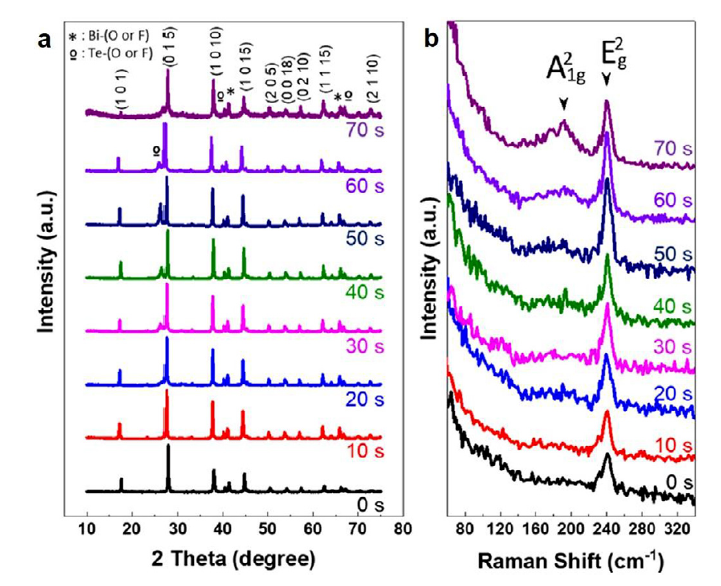
Fig. 2. (a) XRD patterns and (b) Raman spectra of pristine and F-doped Bi2Te3 samples (tP = 0-70 s).
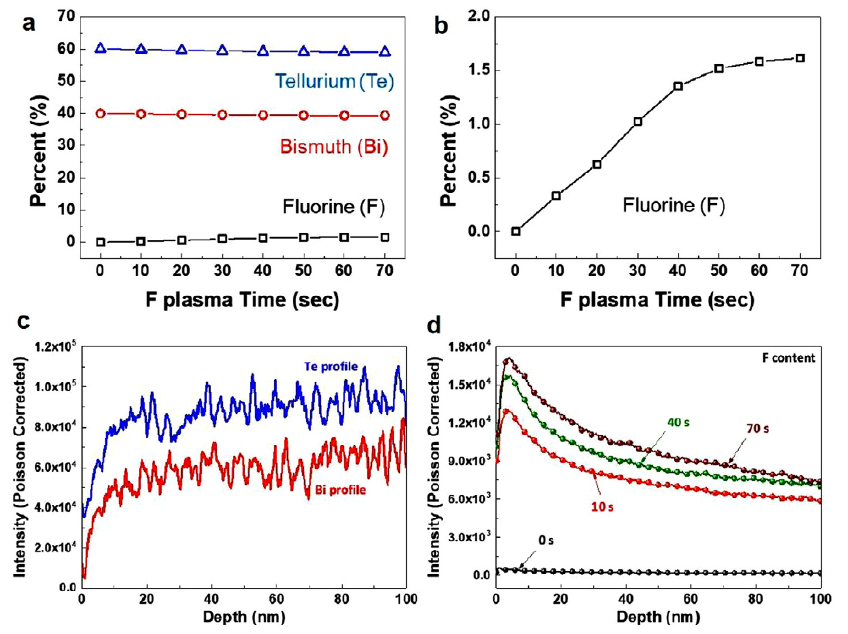
Fig. 3. (a) XRF results showing the content of Bi, Te, and F elements in pristine and F-doped Bi2Te3 samples. (b) Magnified XRF profile of F dopants as a function of tP. (c) TOF-SIMS depth profiles of Bi and Te in a pristine sample. (d) TOF-SIMS depth profiles of F in pristine and F-doped samples.
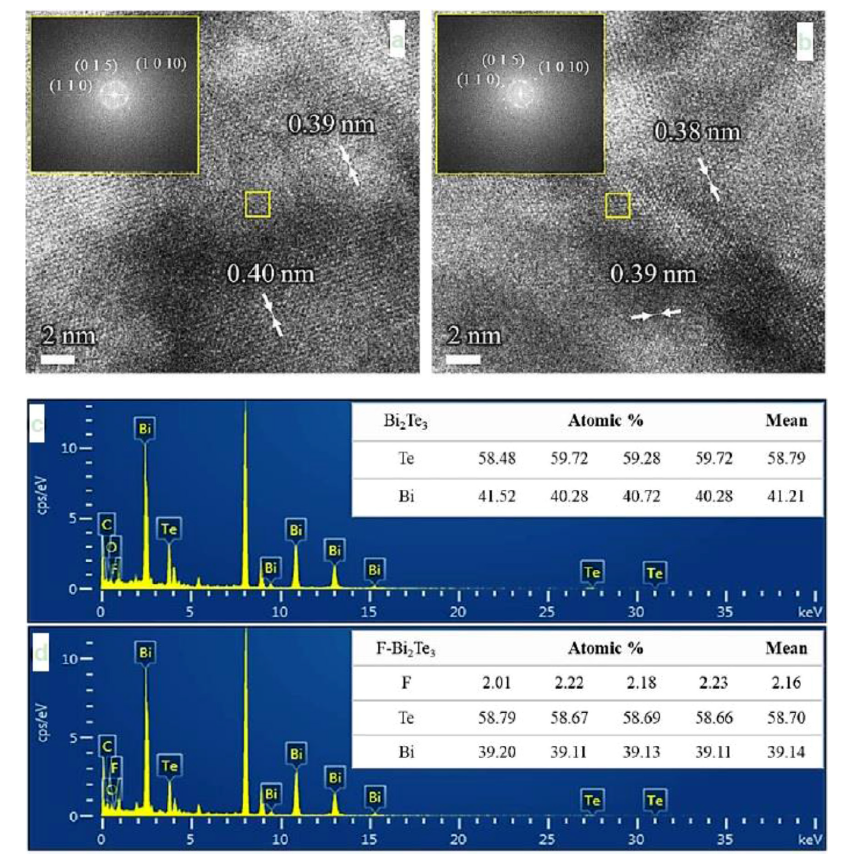
Fig. 4. (a, b) High-resolution TEM images of Bi2Te3 samples compacted at 533 K, respectively. The inset images show FFT results recorded from the focused area (1 nm × 1 nm). (c, d) EDS data of pristine and F-doped samples (tP = 0 and 40 s), respectively.
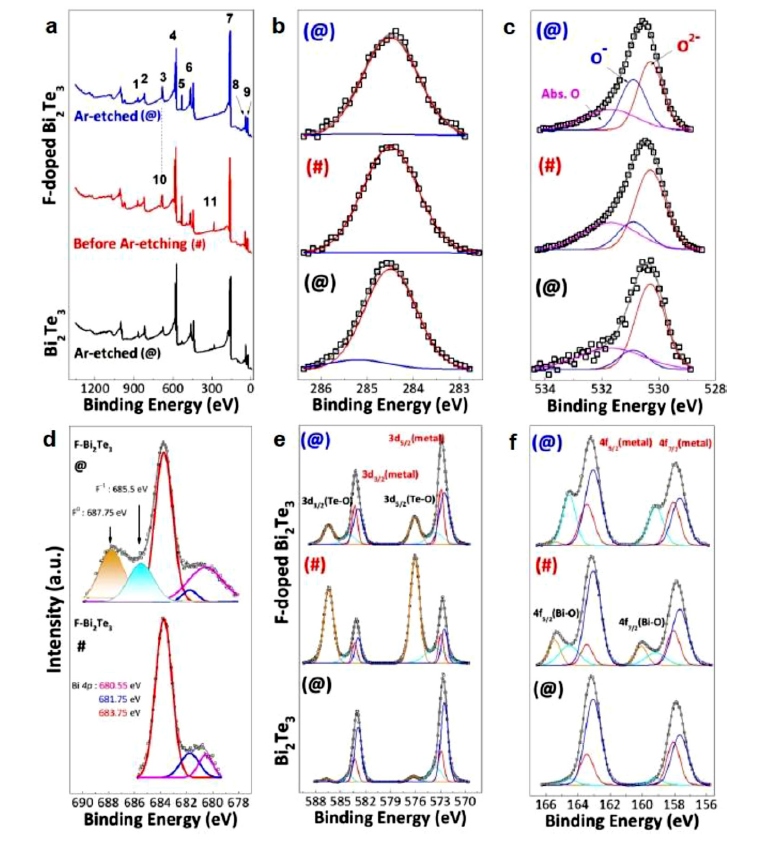
Fig. 5. (a) Wide-scan XPS survey of compacted samples at 533 K with the use of Ar etching. Here, XPS peaks noted with numbers from 1 to 11 correspond to Te 3p, Te (MNN), Bi 4p, Te 3d, O 1 s, Bi 4d, Bi 4f, Te 4d, Bi 5d, F 1 s, and C 1 s, respectively. Gaussian-fitted components in XPS peaks: (b) C 1 s, (c) O 1 s, (d) F 1 s (Bi 4p), (e) Te 3d, and (f) Bi 4f of Bi2Te3 sample after Ar etching and F-doped-Bi2Te3 sample before and after Ar etching.
| Chemical components (Binding energy (eV)) | Areal percentage (%) | ||
|---|---|---|---|
| Bi2Te3 after etching | F-doped Bi2Te3 before etching | F-doped Bi2Te3 after etching | |
| Carbon (C 1 s) | |||
| C-C (284.5)/ C—O (285.2) | 90.3/ 9.7 | 99.5/ 0.5 | 93.1/ 6.9 |
| Oxygen (O 1 s) | |||
| Metal-oxide O2- (530.3)Dangling O- (530.9)Absorbed O (531.7) | 56.812.430.8 | 50.918.031.1 | 42.032.026.0 |
| Fluorine (F 1 s) | |||
| Substitutional F - 1 (685.50) Interstitial F0 (687.75) | - - | 15.520.6 | |
| Tellurium (Te 3d) | |||
| Te+2 in Bi2Te3 (572.5, 582.9)Te+3 in Bi2Te3 (572.9, 583.3)Te+4 in Bi2Te3 (573.6, 584.0)Te+2 in TeO2 (576.15, 586.45) | 62.519.713.24.6 | 13.19.214.363.4 | 39.425.113.621.9 |
| Bismuth (Bi 4f) | |||
| Bi+3 in Bi2Te3 (156.8, 162.2)Bi+4 in Bi2Te3 (157.7, 163.1)Bi+5 in Bi2Te3 (158.8, 164.2)Bi+3 in Bi2O3 (159.2, 164.6) | 64.530.05.20.3 | 55.817.214.812.2 | 44.126.128.21.6 |
Table 1 Binding energy and areal percentage of components of C 1 s, O 1 s, F 1 s, Te 3d, and Bi 4f extracted from the high-resolution XPS spectra of pristine and F-doped samples.
| Chemical components (Binding energy (eV)) | Areal percentage (%) | ||
|---|---|---|---|
| Bi2Te3 after etching | F-doped Bi2Te3 before etching | F-doped Bi2Te3 after etching | |
| Carbon (C 1 s) | |||
| C-C (284.5)/ C—O (285.2) | 90.3/ 9.7 | 99.5/ 0.5 | 93.1/ 6.9 |
| Oxygen (O 1 s) | |||
| Metal-oxide O2- (530.3)Dangling O- (530.9)Absorbed O (531.7) | 56.812.430.8 | 50.918.031.1 | 42.032.026.0 |
| Fluorine (F 1 s) | |||
| Substitutional F - 1 (685.50) Interstitial F0 (687.75) | - - | 15.520.6 | |
| Tellurium (Te 3d) | |||
| Te+2 in Bi2Te3 (572.5, 582.9)Te+3 in Bi2Te3 (572.9, 583.3)Te+4 in Bi2Te3 (573.6, 584.0)Te+2 in TeO2 (576.15, 586.45) | 62.519.713.24.6 | 13.19.214.363.4 | 39.425.113.621.9 |
| Bismuth (Bi 4f) | |||
| Bi+3 in Bi2Te3 (156.8, 162.2)Bi+4 in Bi2Te3 (157.7, 163.1)Bi+5 in Bi2Te3 (158.8, 164.2)Bi+3 in Bi2O3 (159.2, 164.6) | 64.530.05.20.3 | 55.817.214.812.2 | 44.126.128.21.6 |
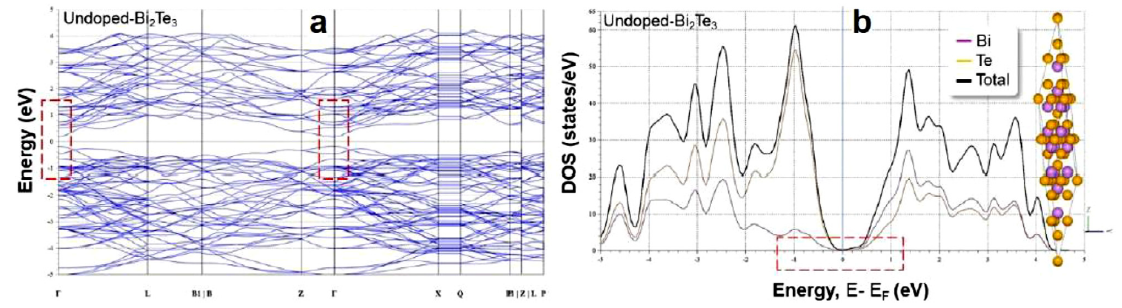
Fig. 6. DFT calculation results of undoped Bi2Te3 supercell. (a, b) Band structure and density of states (DOS) of undoped Bi2Te3 supercell, respectively, plotted using BURAI. The results show that the Fermi level (normalized to 0 eV) of the undoped Bi2Te3 is almost in the middle of the bandgap (~0.368 eV). Here, 13 k-points (Γ, L, B1, B, Z, Γ, X, Q, F, P1, Z, L, and P) were used for obtaining the band structures.
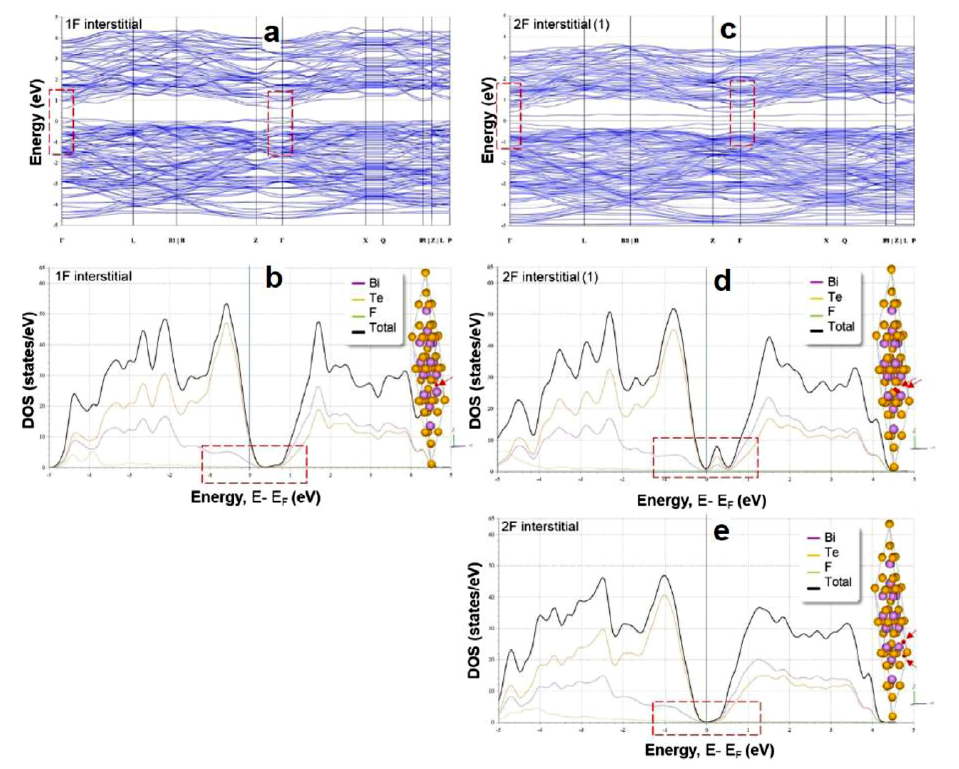
Fig. 7. DFT calculation results of F-doped Bi2Te3 supercell. (a, b) Band structure and DOS of F-doped Bi2Te3 supercell having one interstitial F dopant, respectively. (c, d) Band structure and DOS of F-doped supercell in which two interstitial F dopants bind to one Te atom, respectively. (e) DOS of F-doped supercell where two interstitial F dopants bind to one Te atom and one Bi atom (in a Bi-Te pair). Here, red arrows indicate the positions of F dopants.
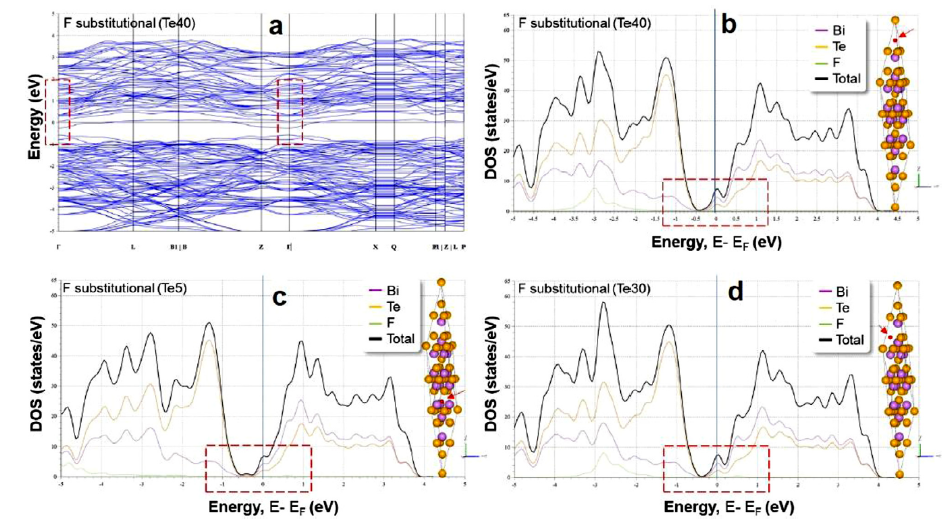
Fig. 8. DFT calculation results of F-doped Bi2Te3 supercell. (a, b) Band structure and density of states (DOS), respectively, of F-doped Bi2Te3 supercell where F dopant substituted the 40th Te atom. (c, d) DOS of F-doped Bi2Te3 supercells where F dopant substituted the 5th and 30th Te atoms, respectively. Here, red arrows indicate the positions of F dopants in the supercell models. Here, red arrows indicate the positions of F dopants.
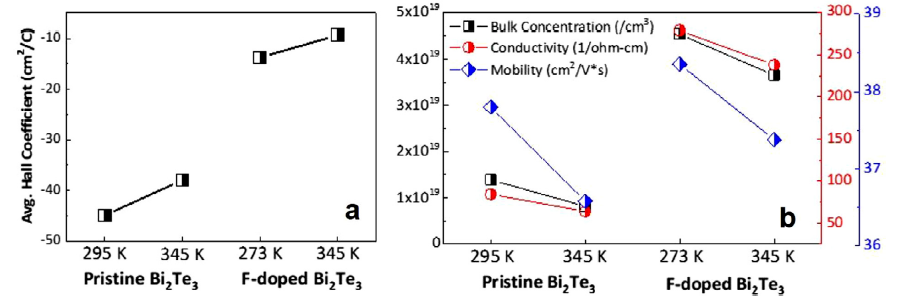
Fig. 9. (a) Hall coefficients of pristine and F-doped samples (tP = 0 and 40 s) showing that electron is their main charge carrier. (b) Bulk concentration, conductivity, and Hall carrier mobility of the pristine and F-doped samples measured at 273 and 345 K.
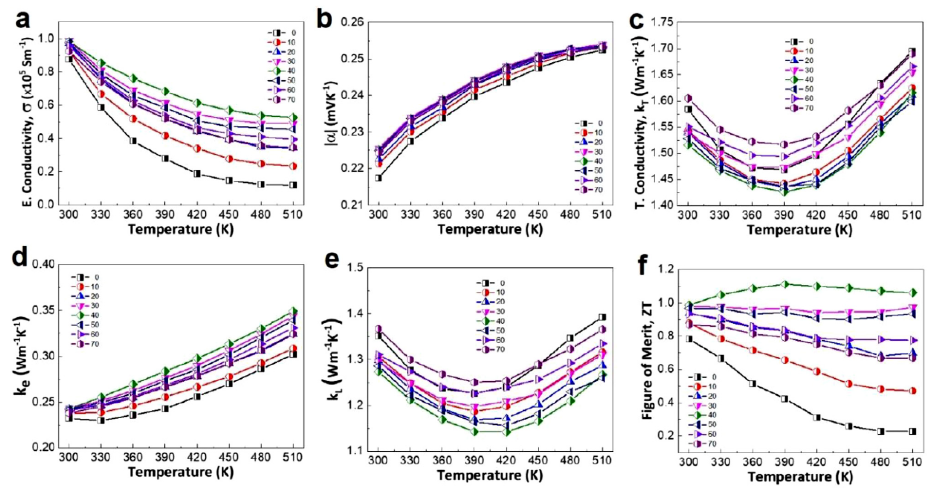
Fig. 10. Thermoelectric properties of Bi2Te3 samples with tP = 0-70 s. Their temperature-dependent changes in (a) electrical conductivity (σ), (b) Seebeck coefficient (α), (c) total thermal conductivity (kT), (d) electronic thermal conductivity (ke), (e) lattice thermal conductivity (kL), and (f) figures of merit (ZT).
| Refs. | Materials | Sample fabrication method | ZT and temperature |
|---|---|---|---|
| [ | I-doped Bi2Te2.9I0.1 | hydrothermal + hot pressing. | 1.1 at 448 K |
| [ | I-doped Bi2Te2.4Se0.6 | mechanical alloying + hot pressing. | 0.84 at 473 K |
| [ | I-doped Bi2Te2.4Se0.6Te-excessive Bi2Te2.41Se0.6 | SPS + annealing. | 1.0 at 400 K0.8 at 300-600 K |
| [ | I-doped Bi1.9Sb0.1Te2.85Se0.15 | melting + hot pressing | 0.84 at 473 K |
| [ | Cl-doped Bi2O2Se0.985Cl0.015 | ball-milling + SPS | 0.23 at 823 K |
| [ | Cl-doped Bi1.2Sb0.8Se3 | melting + SPS | 0.68 at 700 K |
| [ | Br-doped Bi2Te2.7Se0.3 | solid solution | ~ 0.75 at 300 K |
| [ | Br‐doped SnSe0.88Br0.12 | melting + hot pressing | ~ 1.3 at 773 K |
| [ | CuI/Sn-co-doped Bi2Te3 (2 phases) | melting + SPS | ~1.02 at 300-525 K |
| [ | Cu-doped Cu0.06Bi2Te3.17 | melting + SPS | 0.85 at ~ 423K |
| [ | K-doped K0.06Bi2Te3.18 | nano-synthesis + SPS | ~1.1 at 323 K |
| [ | Cr-doped Bi1.99Cr0.01Te3 | melting + SPS | ~0.4 at 375-400 K |
| Here | F-doped Bi2Te3 (2 at%) | SPS + RIE (SF6) | 1.1 at 390 K |
Table 2 Comparison of ZT performance of some n-type thermoelectric composites doped with halide and other elements.
| Refs. | Materials | Sample fabrication method | ZT and temperature |
|---|---|---|---|
| [ | I-doped Bi2Te2.9I0.1 | hydrothermal + hot pressing. | 1.1 at 448 K |
| [ | I-doped Bi2Te2.4Se0.6 | mechanical alloying + hot pressing. | 0.84 at 473 K |
| [ | I-doped Bi2Te2.4Se0.6Te-excessive Bi2Te2.41Se0.6 | SPS + annealing. | 1.0 at 400 K0.8 at 300-600 K |
| [ | I-doped Bi1.9Sb0.1Te2.85Se0.15 | melting + hot pressing | 0.84 at 473 K |
| [ | Cl-doped Bi2O2Se0.985Cl0.015 | ball-milling + SPS | 0.23 at 823 K |
| [ | Cl-doped Bi1.2Sb0.8Se3 | melting + SPS | 0.68 at 700 K |
| [ | Br-doped Bi2Te2.7Se0.3 | solid solution | ~ 0.75 at 300 K |
| [ | Br‐doped SnSe0.88Br0.12 | melting + hot pressing | ~ 1.3 at 773 K |
| [ | CuI/Sn-co-doped Bi2Te3 (2 phases) | melting + SPS | ~1.02 at 300-525 K |
| [ | Cu-doped Cu0.06Bi2Te3.17 | melting + SPS | 0.85 at ~ 423K |
| [ | K-doped K0.06Bi2Te3.18 | nano-synthesis + SPS | ~1.1 at 323 K |
| [ | Cr-doped Bi1.99Cr0.01Te3 | melting + SPS | ~0.4 at 375-400 K |
| Here | F-doped Bi2Te3 (2 at%) | SPS + RIE (SF6) | 1.1 at 390 K |
| [1] |
C.B. Vining, Nat. Mater. 8 (2009) 83-85.
DOI URL |
| [2] |
L.E. Bell, Science 321 (2008) 1457-1461.
DOI PMID |
| [3] | T. Mori, S. Priya, MRS Bull. 43 (2018) 176-180. |
| [4] | I. Petsagkourakis, K. Tybrandt, X. Crispin, I. Ohkubo, N. Satoh, T. Mori, Sci. Tech- nol. Adv. Mater. 19 (2018) 836-862. |
| [5] |
L. Hu, T. Zhu, X. Liu, X. Zhao, Adv. Funct. Mater. 24 (2014) 5211-5218.
DOI URL |
| [6] |
J. Na, Y. Kim, T. Park, C. Park, E. Kim, ACS Appl. Mater. Interfaces 8 (2016) 32392-32400.
DOI URL |
| [7] |
T. Mori, T. Hara, Scr. Mater. 111 (2016) 44-48.
DOI URL |
| [8] |
P. Roy, V. Pal, T. Maiti, Ceram. Int. 43 (2017) 12809-12813.
DOI URL |
| [9] |
H. Alam, S. Ramakrishna, Nano Energy 2 (2013) 190-212.
DOI URL |
| [10] |
M. Tan, W.D. Liu, X.L. Shi, H. Gao, H. Li, C. Li, X.B. Liu, Y. Deng, Z.G. Chen, Small Methods 3 (2019) 1900582.
DOI URL |
| [11] |
Y. Wang, W.D. Liu, H. Gao, L.J. Wang, M. Li, X.L. Shi, M. Hong, H. Wang, J. Zou, Z.G. Chen, ACS Appl. Mater. Interfaces 11 (2019) 31237-31244.
DOI URL |
| [12] |
Y. Wang, W.D. Liu, X.L. Shi, M. Hong, L.J. Wang, M. Li, H. Wang, J. Zou, Z.G. Chen, Chem. Eng. J. 391 (2020) 123513.
DOI URL |
| [13] |
H. Mun, S.M. Choi, K.H. Lee, S.W. Kim, ChemSusChem 8 (2015) 2312-2326.
DOI URL |
| [14] |
P. Puneet, R. Podila, M. Karakaya, S. Zhu, J. He, T.M. Tritt, M.S. Dresselhaus, A. M. Rao, Sci. Rep. 3 (2013) 3212.
DOI PMID |
| [15] |
M.M. Rojo, O.C. Calero, A.F. Lopeandia, J. Rodriguez-Viejo, M. Martín-Gonzalez, Nanoscale 5 (2013) 11526-11544.
DOI URL |
| [16] |
M. Kanagaraj, A. Pawbake, S.C. Sarma, V. Rajaji, C. Narayana, M.A. Measson, S. C. Peter, J. Alloys Compd. 794 (2019) 195-202.
DOI URL |
| [17] | C.L. Chien, C.R. Westgate ( US, 1980. |
| [18] |
O. Yamashita, S. Tomiyoshi, K. Makita, J. Appl. Phys. 93 (2003) 368-374.
DOI URL |
| [19] |
H. Yu, P.C. Gibbons, W.E. Buhro, J. Mater. Chem. 14 (2004) 595-602.
DOI URL |
| [20] |
X.L. Shi, J. Zou, Z.G. Chen, Chem. Rev. 120 (2020) 7399-7515.
DOI URL |
| [21] |
M. Hong, Z.G. Chen, J. Zou, Chin. Phys. B 27 (2018) 048403.
DOI URL |
| [22] | L.P. Hu, X.H. Liu, H.H. Xie, J.J. Shen, T.J. Zhu, X.B. Zhao, Acta Mater 60 (2012) 4 431-4 437. |
| [23] |
J. Yang, R. Chen, X. Fan, S. Bao, W. Zhu, J. Alloys Compd. 407 (2006) 330-333.
DOI URL |
| [24] |
Y. Pan, J.F. Li, NPG Asia Mater 8 (2016) e275-e275.
DOI URL |
| [25] |
O. Yamashita, S. Tomiyoshi, J. Appl. Phys. 95 (2004) 6277-6283.
DOI URL |
| [26] |
T. Tillocher, W. Kafrouni, J. Ladroue, P. Lefaucheux, M. Boufnichel, P. Ranson, R. Dussart, J. Micromech. Microeng. 21 (2011) 85005.
DOI URL |
| [27] |
C. Cardinaud, G. Turban, Appl. Surf. Sci. 45 (1990) 109-120.
DOI URL |
| [28] |
G.S. Kim, C. Steinbrüchel, J. Vac. Sci. Technol. A 24 (2006) 424-430.
DOI URL |
| [29] |
E. Kuantama, D.W. Han, Y.M. Sung, J.E. Song, C.H. Han, Thin Solid Films 517 (2009) 4211-4214.
DOI URL |
| [30] |
C.H. Kuo, C.S. Hwang, M.S. Jeng, W.S. Su, Y.W. Chou, J.R. Ku, J. Alloys Compd. 496 (2010) 687-690.
DOI URL |
| [31] |
Z. Zhang, P.A. Sharma, E.J. Lavernia, N. Yang, J. Mater. Res. 26 (2011) 475-484.
DOI URL |
| [32] |
E.S. Watson, M.J. O’Neill, J. Justin, N. Brenner, Anal. Chem. 36 (1964) 1233-1238.
DOI URL |
| [33] |
C.L. Hsin, M. Wingert, C.W. Huang, H. Guo, T.J. Shih, J. Suh, K. Wang, J. Wu, W.W. Wu, R. Chen, Nanoscale 5 (2013) 4669-4672.
DOI URL |
| [34] |
G.K. Pradhan, A. Bera, P. Kumar, D.V.S. Muthu, A.K. Sood, Solid State Commun 152 (2012) 284-287.
DOI URL |
| [35] | N. Peranio, O. Eibl, Phys. Status Solidi Appl. Mater. Sci. 204 (2007) 3243-3255. |
| [36] |
S.M. Patil, S.R. Mane, R.M. Mane, S.S. Mali, P.S. Patil, P.N. Bhosale, Can. J. Chem. 89 (2011) 1375-1381.
DOI URL |
| [37] |
H. Bando, K. Koizumi, Y. Oikawa, K. Daikohara, V.A. Kulbachinskii, H. Ozaki, J. Phys. Condens. Matter 12 (2000) 5607-5616.
DOI URL |
| [38] |
J. Cha, J. Seo, S. Kim, J. Therm. Anal. Calorim. 109 (2012) 295-300.
DOI URL |
| [39] |
V. Russo, A. Bailini, M. Zamboni, M. Passoni, C. Conti, C.S. Casari, A.L. Bassi, C. E. Bottani, J. Raman Spectrosc. 39 (2008) 205-210.
DOI URL |
| [40] |
J. Kim, L.T. Duy, B. Ahn, H. Seo, J. Asian Ceram. Soc. 8 (2020) 211-221.
DOI URL |
| [41] | Y.H. Lin, S.F. Lin, Y.C. Chi, C.L. Wu, C.H. Cheng, W.H. Tseng, J.H. He, C.I. Wu, C. K. Lee, G.R. Lin, ACS Photonics 2 (2015) 4 81-4 90. |
| [42] |
M. Loor, G. Bendt, U. Hagemann, C. Wölper, W. Assenmacher, S. Schulz, Dalt. Trans. 45 (2016) 15326-15335.
DOI URL |
| [43] |
A. Purkayastha, Q. Yan, M.S. Raghuveer, D.D. Gandhi, H. Li, Z.W. Liu, R.V. Ra- manujan, T. Borca-Tasciuc, G. Ramanath, Adv. Mater. 20 (2008) 2679-2683.
DOI PMID |
| [44] |
D.Y. Kuo, J.K. Kawasaki, J.N. Nelson, J. Kloppenburg, G. Hautier, K.M. Shen, D. G. Schlom, J. Suntivich, J. Am. Chem. Soc. 139 (2017) 3473-3479.
DOI URL |
| [45] |
K. Momma, F. Izumi, J. Appl. Crystallogr. 44 (2011) 1272-1276.
DOI URL |
| [46] | S. Nishihara, BURAI 1.3 - A GUI of Quantum ESPRESSO, 2020 available at . |
| [47] |
P. Giannozzi, S. Baroni, N. Bonini, M. Calandra, R. Car, C. Cavazzoni, D. Ceresoli, G. L. Chiarotti, M. Cococcioni, I. Dabo, A. Dal Corso, S. De Gironcoli, S. Fab- ris, G. Fratesi, R. Gebauer, U. Gerstmann, C. Gougoussis, A. Kokalj, M. Lazzeri, L. Martin-Samos, N. Marzari, F. Mauri, R. Mazzarello, S. Paolini, A. Pasquarello, L. Paulatto, C. Sbraccia, S. Scandolo, G. Sclauzero, A.P. Seitsonen, A. Smogunov, P. Umari, R.M. Wentzcovitch, J. Phys. Condens. Matter 21 (2009) 395502.
DOI URL |
| [48] | Topological Materials Database, Compound: Bi2 Te3, 2020 available at . |
| [49] |
A. Kokalj, J. Mol. Graph. Model. 17 (1999) 176-179.
PMID |
| [50] | Materials Project, Materials Data On Bi2 Te3 By Materials Project; Available At, 2020 . |
| [51] | K. Persson, M. Project, Materials Data on Bi2Te3 By Materials Project, 2020. |
| [52] |
A. Pakdel, Q. Guo, V. Nicolosi, T. Mori, J. Mater. Chem. A 6 (2018) 21341-21349.
DOI URL |
| [53] |
Y.S. Hor, J.G. Checkelsky, D. Qu, N.P. Ong, R.J. Cava, J. Phys. Chem. Solids 72 (2011) 572-576.
DOI URL |
| [54] |
N. Kamaraju, K. Sunil, A.K. Sood, Europhys. Lett. 92 (2010) 47007.
DOI URL |
| [55] |
A.Y. Eum, S.M. Choi, S. Lee, W.S. Seo, J.S. Park, S.H. Yang, I.H. Kim, J. Electron. Mater. 46 (2017) 2623-2628.
DOI URL |
| [56] |
F. Hao, T. Xing, P. Qiu, P. Hu, T. Wei, D. Ren, X. Shi, L. Chen, ACS Appl. Mater. Interfaces 10 (2018) 21372-21380.
DOI URL |
| [57] | W.J. Jung, H.J. Kim, I.H. Kim, J. Korean Inst. Met. Mater. 56 (2018) 544-550. |
| [58] |
X. Tan, J.Le Lan, G. Ren, Y. Liu, Y.H. Lin, C.W. Nan, J. Am. Ceram. Soc. 100 (2017) 1494-1501.
DOI URL |
| [59] |
N. Nasir, K.H. Lee, S. Il Kim, H.S. Kim, J.H. Lim, L. Fu, S.W. Kim, RSC Adv. 10 (2020) 24663-24668.
DOI URL |
| [60] |
D. Perrin, M. Chitroub, S. Scherrer, H. Scherrer, J. Phys. Chem. Solids 61 (2000) 1687-1691.
DOI URL |
| [61] |
S. Li, Y. Wang, C. Chen, X. Li, W. Xue, X. Wang, Z. Zhang, F. Cao, J. Sui, X. Liu, Q. Zhang, Adv. Sci. 5 (2018) 1800598.
DOI URL |
| [62] |
M.K. Han, J. Hwang, S.J. Kim, J. Mater. Sci. Mater. Electron. 30 (2019) 1282-1291.
DOI URL |
| [63] |
J. Cha, C. Zhou, S.P. Cho, S.H. Park, I. Chung, ACS Appl. Mater. Interfaces 11 (2019) 30999-31008.
DOI URL |
| [64] |
K. Park, K. Ahn, J. Cha, S. Lee, S.I. Chae, S.P. Cho, S. Ryee, J. Im, J. Lee, S.D. Park, M. J. Han, I. Chung, T. Hyeon, J. Am. Chem. Soc. 138 (2016) 14458-14468.
DOI URL |
| [65] | J.B. Vaney, S. Aminorroaya Yamini, H. Takaki, K. Kobayashi, N. Kobayashi, T. Mori, Mater. Today Phys 9 (2019) 100090. |
| [1] | Huiping Hu, Kaiyang Xia, Yuechu Wang, Chenguang Fu, Tiejun Zhu, Xinbing Zhao. Fast synthesis and improved electrical stability in n-type Ag2Te thermoelectric materials [J]. J. Mater. Sci. Technol., 2021, 91(0): 241-250. |
| [2] | Chunhai Jiang, Wenyang Zhou, Zhimin Zou. Nitrogen and oxygen co-doped mesoporous carbon spheres as capacitive anode for high performance sodium-ion capacitors [J]. J. Mater. Sci. Technol., 2021, 83(0): 188-195. |
| [3] | Yao Chen, Jie Chen, Bin Zhang, Meiling Yang, Xiaofang Liu, Hengyang Wang, Lei Yang, Guoyu Wang, Guang Han, Xiaoyuan Zhou. Realizing enhanced thermoelectric properties in Cu2S-alloyed SnSe based composites produced via solution synthesis and sintering [J]. J. Mater. Sci. Technol., 2021, 78(0): 121-130. |
| [4] | Shao-Fang Li, Zhen-Yi Gu, Jin-Zhi Guo, Xian-Kun Hou, Xu Yang, Bo Zhao, Xing-Long Wu. Enhanced electrode kinetics and electrochemical properties of low-cost NaFe2PO4(SO4)2 via Ca2+ doping as cathode material for sodium-ion batteries [J]. J. Mater. Sci. Technol., 2021, 78(0): 176-182. |
| [5] | Lin Zhao, Zhao Wang, Yan Li, Sen Wang, Lifeng Wang, Zhaojun Qi, Qiang Ge, Xiaoguang Liu, JinZhong Zhang. Designed synthesis of chlorine and nitrogen co-doped Ti3C2 MXene quantum dots and their outstanding hydroxyl radical scavenging properties [J]. J. Mater. Sci. Technol., 2021, 78(0): 30-37. |
| [6] | Jingyu Pang, Hongwei Zhang, Long Zhang, Zhengwang Zhu, Huameng Fu, Hong Li, Aimin Wang, Zhengkun Li, Haifeng Zhang. Simultaneous enhancement of strength and ductility of body-centered cubic TiZrNb multi-principal element alloys via boron-doping [J]. J. Mater. Sci. Technol., 2021, 78(0): 74-80. |
| [7] | Tao Xiang, Zeyun Cai, Peng Du, Kun Li, Zongwei Zhang, Guoqiang Xie. Dual phase equal-atomic NbTaTiZr high-entropy alloy with ultra-fine grain and excellent mechanical properties fabricated by spark plasma sintering [J]. J. Mater. Sci. Technol., 2021, 90(0): 150-158. |
| [8] | Zhufeng He, Nan Jia, Hongwei Wang, Haile Yan, Yongfeng Shen. Synergy effect of multi-strengthening mechanisms in FeMnCoCrN HEA at cryogenic temperature [J]. J. Mater. Sci. Technol., 2021, 86(0): 158-170. |
| [9] | Ximeng Dong, Wenlin Cui, Wei-Di Liu, Shuqi Zheng, Lei Gao, Luo Yue, Yue Wu, Boyi Wang, Zipei Zhang, Liqiang Chen, Zhi-Gang Chen. Synergistic band convergence and defect engineering boost thermoelectric performance of SnTe [J]. J. Mater. Sci. Technol., 2021, 86(0): 204-209. |
| [10] | Jing Bai, Die Liu, Jianglong Gu, Xinjun Jiang, Xinzeng Liang, Ziqi Guan, Yudong Zhang, Claude Esling, Xiang Zhao, Liang Zuo. Excellent mechanical properties and large magnetocaloric effect of spark plasma sintered Ni-Mn-In-Co alloy [J]. J. Mater. Sci. Technol., 2021, 74(0): 46-51. |
| [11] | Sining Wang, Lizhong Su, Yuting Qiu, Yu Xiao, Li-Dong Zhao. Enhanced thermoelectric performance in Cl-doped BiSbSe3 with optimal carrier concentration and effective mass [J]. J. Mater. Sci. Technol., 2021, 70(0): 67-72. |
| [12] | Thanh-Tung Le, Xiao Liu, Peijun Xin, Qing Wang, Chunyan Gao, Ye Wu, Yong Jiang, Zhangjun Hu, Shoushuang Huang, Zhiwen Chen. Phosphorus-doped Fe7S8@C nanowires for efficient electrochemical hydrogen and oxygen evolutions: Controlled synthesis and electronic modulation on active sites [J]. J. Mater. Sci. Technol., 2021, 74(0): 168-175. |
| [13] | Shi Tao, Wei Zhou, Dajun Wu, Zhicheng Wang, Bin Qian, Wangsheng Chu, Augusto Marcelli, Li Song. Insights into the Ti4+ doping in P2-type Na0.67Ni0.33Mn0.52Ti0.15O2 for enhanced performance of sodium-ion batteries [J]. J. Mater. Sci. Technol., 2021, 74(0): 230-236. |
| [14] | Mi Yan, Shengbo Yi, Xiuyuan Fan, Zhenghua Zhang, Jiaying Jin, Guohua Bai. High-frequency MnZn soft magnetic ferrite by engineering grain boundaries with multiple-ion doping [J]. J. Mater. Sci. Technol., 2021, 79(0): 165-170. |
| [15] | Yuyu Wei, Ping Lu, Chenxi Zhu, Kunpeng Zhao, Xun Shi, Lidong Chen, Fangfang Xu. Nano-scale compositional oscillation and phase intergrowth in Cu2S0.5Se0.5 and their role in thermal transport [J]. J. Mater. Sci. Technol., 2021, 79(0): 222-229. |
| Viewed | ||||||
|
Full text |
|
|||||
|
Abstract |
|
|||||
 WeChat
