
J. Mater. Sci. Technol. ›› 2021, Vol. 69: 239-272.DOI: 10.1016/j.jmst.2020.06.049
• Invited Review • Previous Articles
Mattia Biesuza,b,c,*( ), Theo Saundersb, Daoyao Kea, Michael J. Reeceb, Chungfeng Hua, Salvatore Grassoa,*()
Received:2020-04-28
Revised:2020-06-18
Accepted:2020-06-27
Published:2021-04-10
Online:2021-05-15
Contact:
Mattia Biesuz,Salvatore Grasso
About author:s.grasso@swjtu.edu.cn (S. Grasso).Mattia Biesuz, Theo Saunders, Daoyao Ke, Michael J. Reece, Chungfeng Hu, Salvatore Grasso. A review of electromagnetic processing of materials (EPM): Heating, sintering, joining and forming[J]. J. Mater. Sci. Technol., 2021, 69: 239-272.
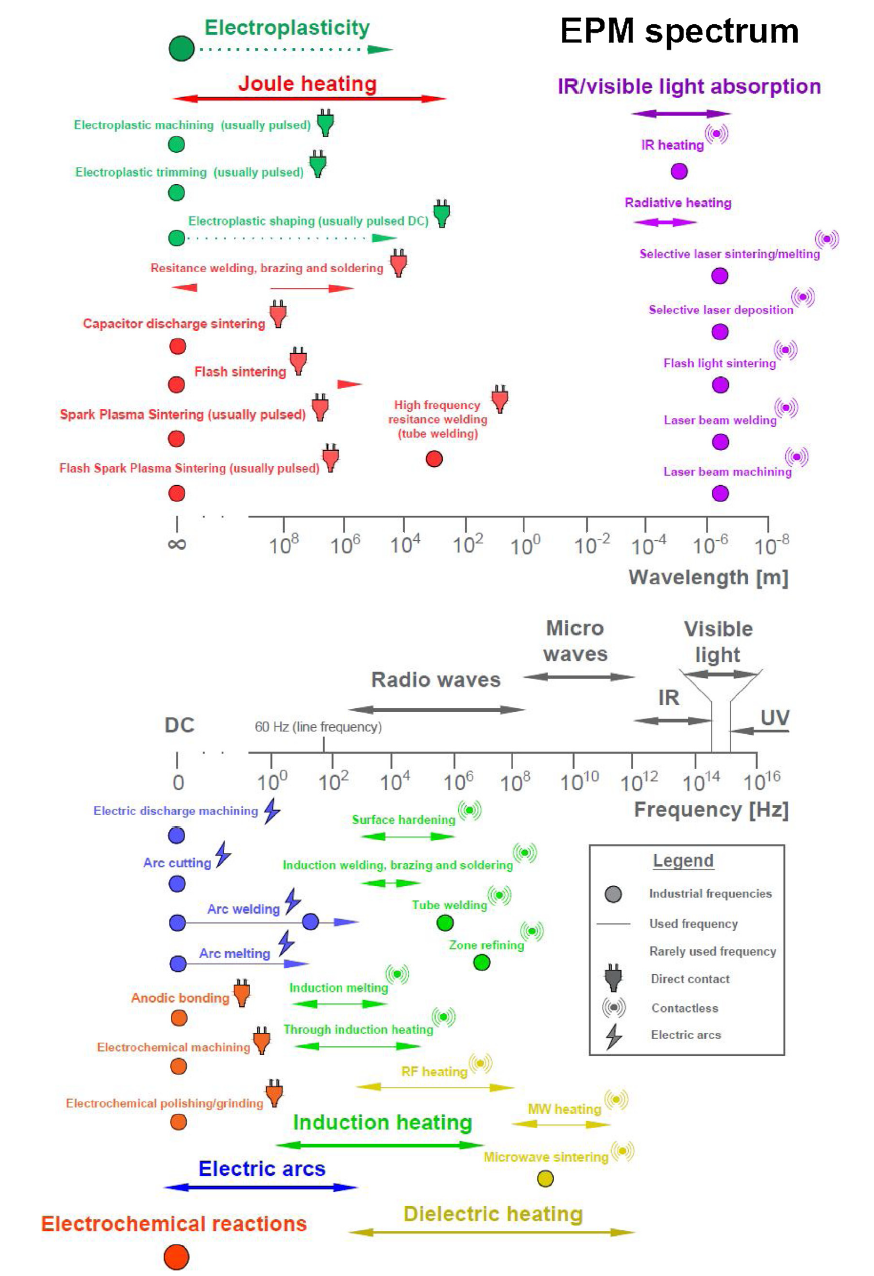
Fig. 1. EPM processing spectrum rationalized with respect to physical effects and working frequencies. The colours refers to distinctive effects: Joule heating (red); induction heating (bright green); dielectric heating (yellow); electrochemical reaction (orange); electroplasticity (dark green); and electric arcs (blue). Some EPM techniques might involve overlapping physical effects.
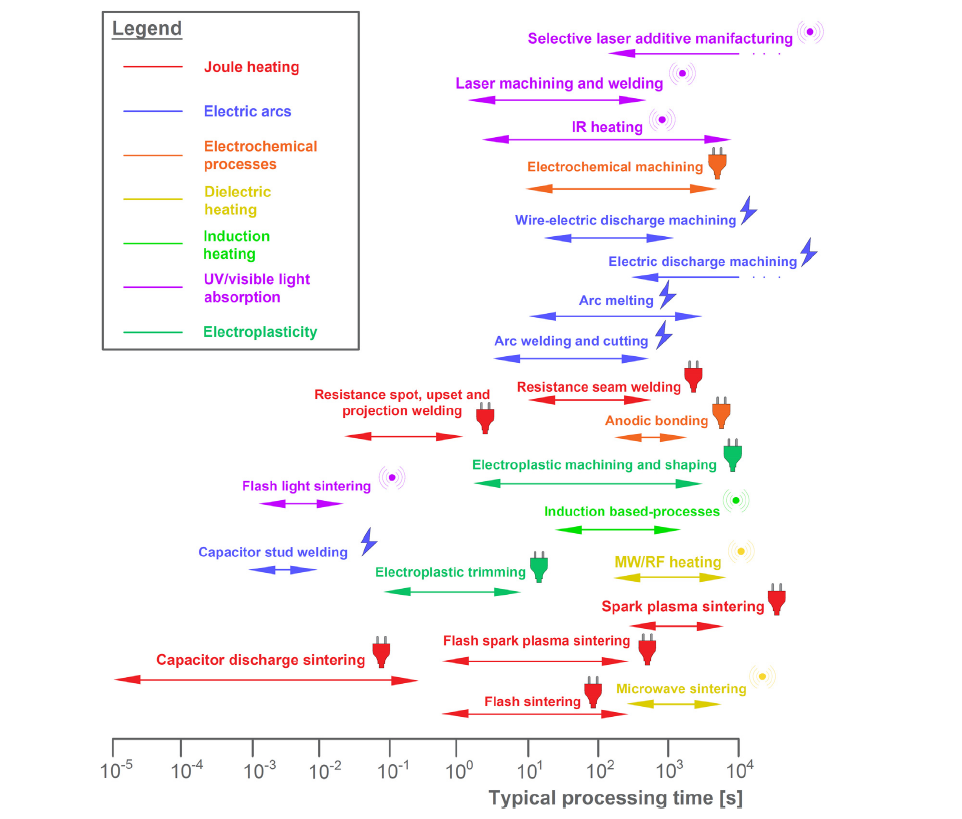
Fig. 2. Typical processing time (electromagnetic discharge) map for bulk electricity-assisted manufacturing processes. Legend maintained as in Fig. 1.
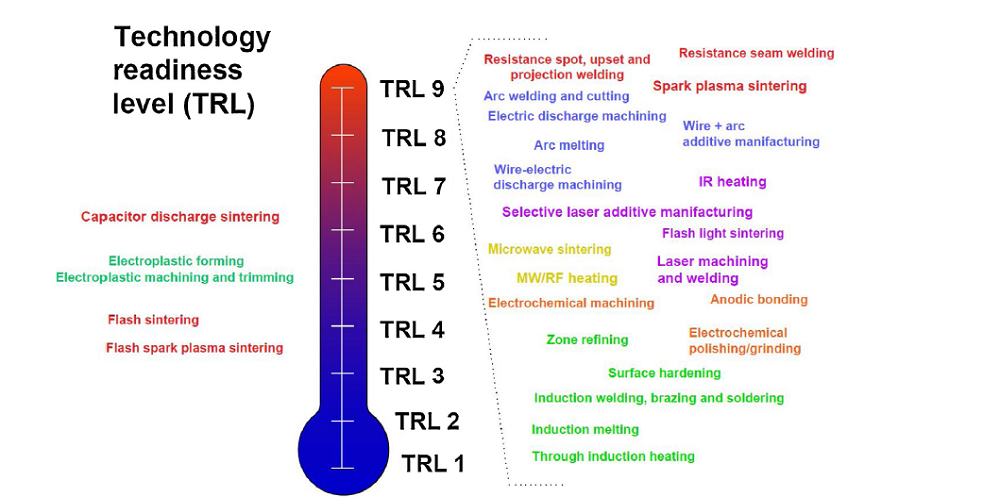
Fig. 3. Technology readiness level (TRL) for different electric current-assisted technologies. TRL 9 refer to technologies with industrial applications and they are on the right side of the figure. Low TRL techniques between 4 and 8 have not found large scale industrial applications.
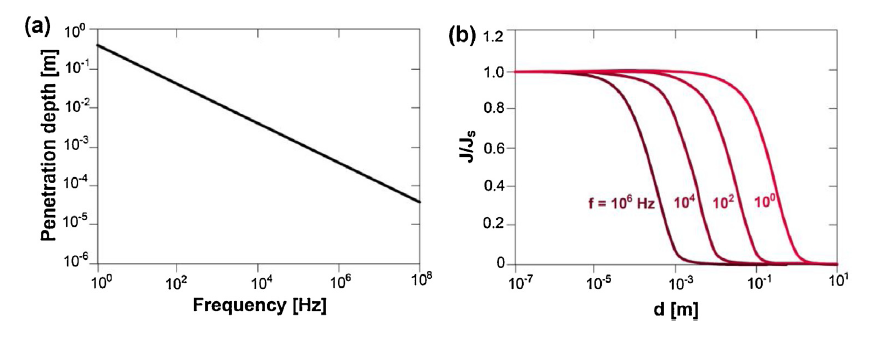
Fig. 4. (a) Penetration depth and (b) surface to bulk current ratio as a function of the distance, d, from the surface in Cu at room temperature subjected to induction heating. The plots are based on Eqs. (4) and (6); reference electric and magnetic data from Ref. [40].
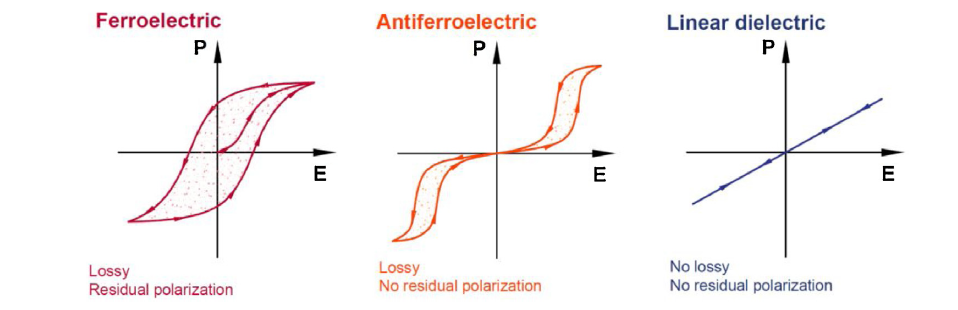
Fig. 5. Polarization in ferroelectrics, antiferroelectrics and linear dielectrics. The absorbed energy is represented by the area inside the hysteresis loop.
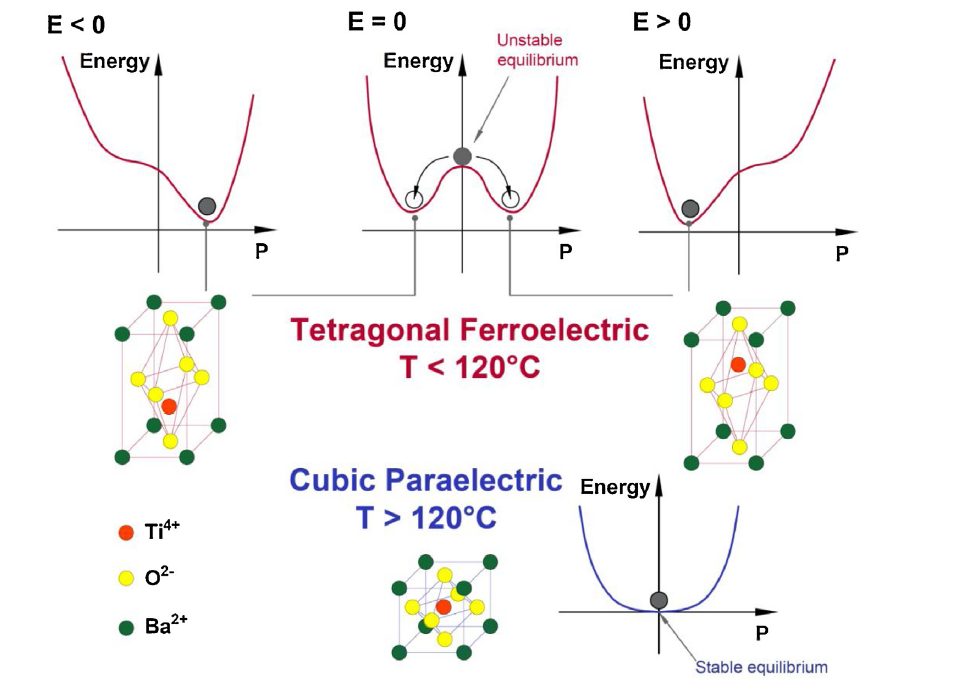
Fig. 6. Ferroelectric and paraelectric behaviour in BaTiO3. Ferroelectric domains switching due to dipole orientations by domain wall movement is responsible for the energy absorption and heat generation.
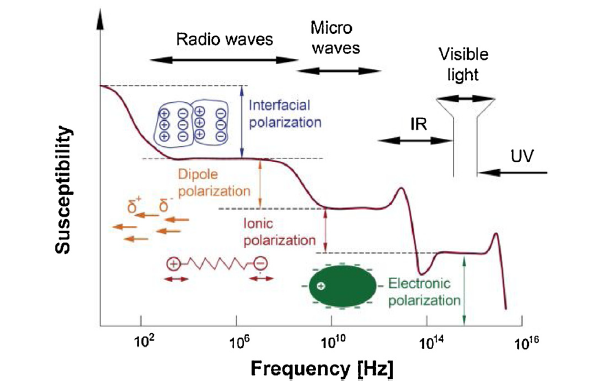
Fig. 7. Qualitative representation of a dielectric susceptibility variation with field frequency [40,45]. The different polarization mechanisms can be used for producing heating in dielectric materials.
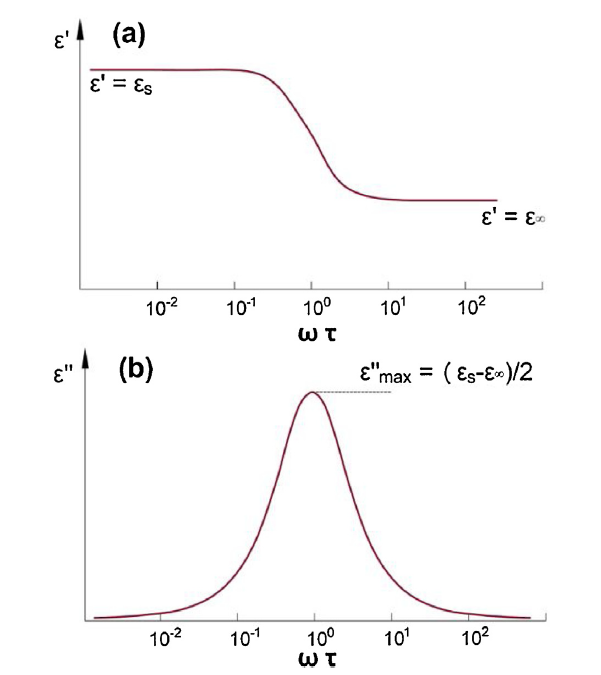
Fig. 8. Real (ε') and imaginary (ε'') part of the dielectric constant as predicted from the Debye equations.
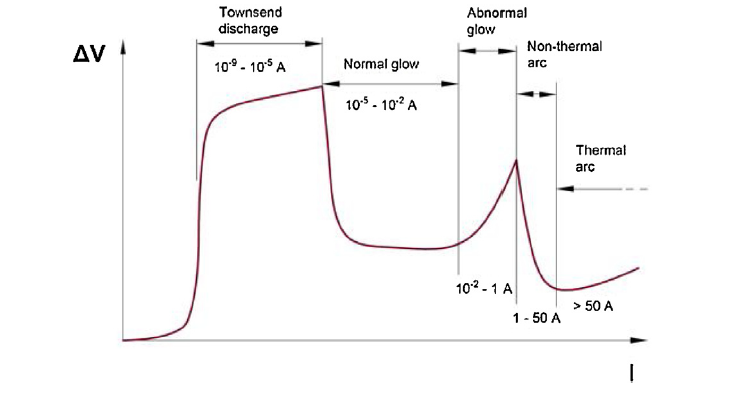
Fig. 9. Qualitative representation of the voltage/current relation in different plasmas [55].
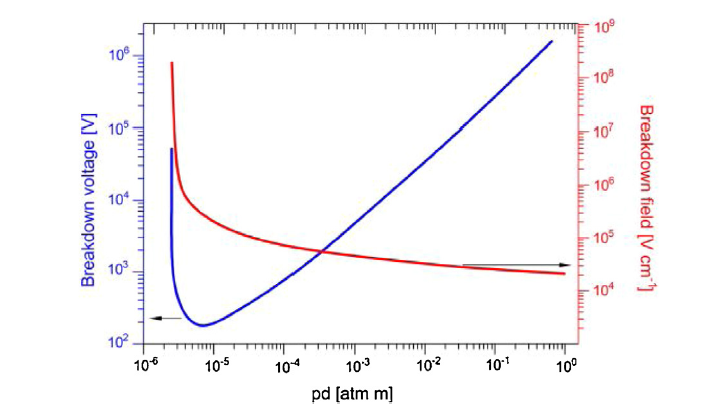
Fig. 10. Paschen's curves for air, drawn using references data from [55]. The curve lose accuracy when the gap is below 10 μm (p = 1 atm) [34].
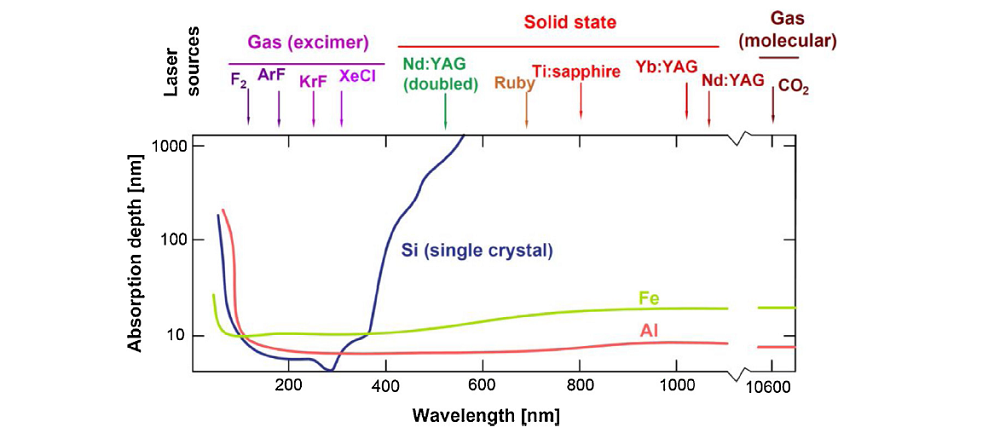
Fig. 11. Absorption depth as a function of the incident radiation wavelength for some metals and semiconductors. Emission wavelength of some common lasers is reported as well. Adapted from [58].
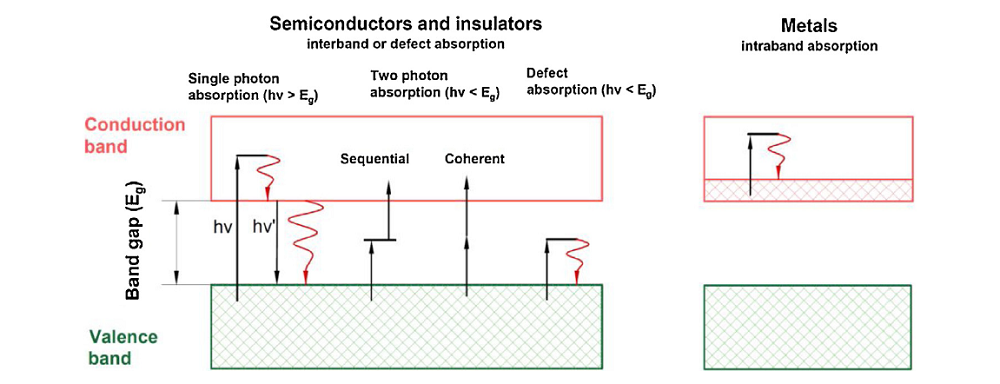
Fig. 12. Photon absorption in insulators, metals and semiconductors. Non-radiative decays, causing heating, are highlighted by the red oscillating lines. Adapted from Ref. [57].
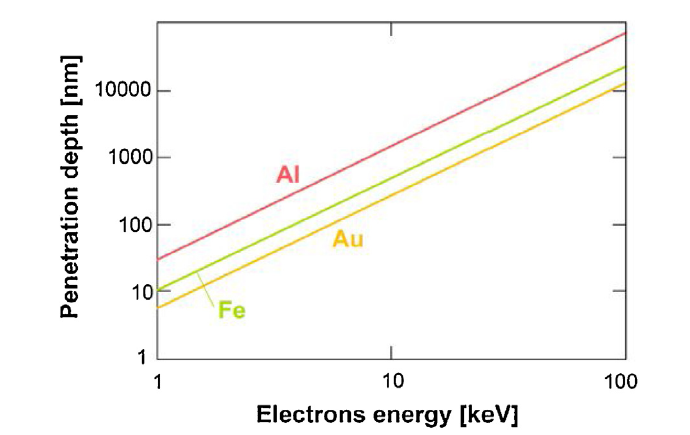
Fig. 13. Electron beam penetration depth in different metals as a function of the beam energy.
| Heating effect | Frequencies/Bands | Materials | Mechanism |
|---|---|---|---|
| Resistive Joule heating | DC and AC | Conductors | Electronic scattering |
| Induction heating | 50 - 500 kHz | Conductors | Electronic scattering (analogous to Joule heating, but induced by an alternating magnetic field) |
| Dielectric heating | Microwave / Radio frequencies | Lossy dielectric materials | Electronic cloud centre displacement with respect to nuclei (sole mechanism operative in covalent solids) Ionic bonding polarization (ionic, partially ionic materials) Dipole switching (ferroelectrics, dipolar liquids) Interfacial polarization (important in electronic conductors, analogous to Joule heating) |
| Arc heating | DC or AC | Metals and ceramics | Electron plasma transfer momentum to the work piece Additional Joule heating can take place due to the current in the work piece |
| Visible/IR light heating | Visible / IR | Metals and ceramics | Interband electronic transition in semiconductors and insulators Intraband transitions in metallic conductors Vibrational states transitions |
| Electron beam heating/melting | High energy electrons in a DC field | Conductors | High energy electrons are accelerated onto the work piece and transfer momentum to the lattice |
Table 1 Electric heating effects and connected mechanisms. Operating frequency ranges are in Fig. 1.
| Heating effect | Frequencies/Bands | Materials | Mechanism |
|---|---|---|---|
| Resistive Joule heating | DC and AC | Conductors | Electronic scattering |
| Induction heating | 50 - 500 kHz | Conductors | Electronic scattering (analogous to Joule heating, but induced by an alternating magnetic field) |
| Dielectric heating | Microwave / Radio frequencies | Lossy dielectric materials | Electronic cloud centre displacement with respect to nuclei (sole mechanism operative in covalent solids) Ionic bonding polarization (ionic, partially ionic materials) Dipole switching (ferroelectrics, dipolar liquids) Interfacial polarization (important in electronic conductors, analogous to Joule heating) |
| Arc heating | DC or AC | Metals and ceramics | Electron plasma transfer momentum to the work piece Additional Joule heating can take place due to the current in the work piece |
| Visible/IR light heating | Visible / IR | Metals and ceramics | Interband electronic transition in semiconductors and insulators Intraband transitions in metallic conductors Vibrational states transitions |
| Electron beam heating/melting | High energy electrons in a DC field | Conductors | High energy electrons are accelerated onto the work piece and transfer momentum to the lattice |
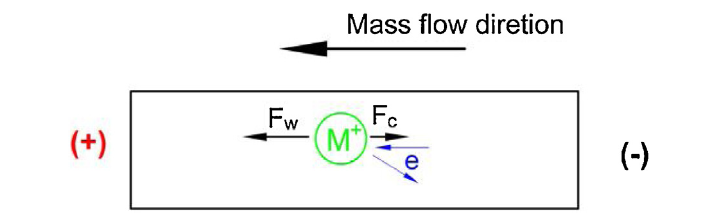
Fig. 14. Schematic representation of indirect electromigration in metals.
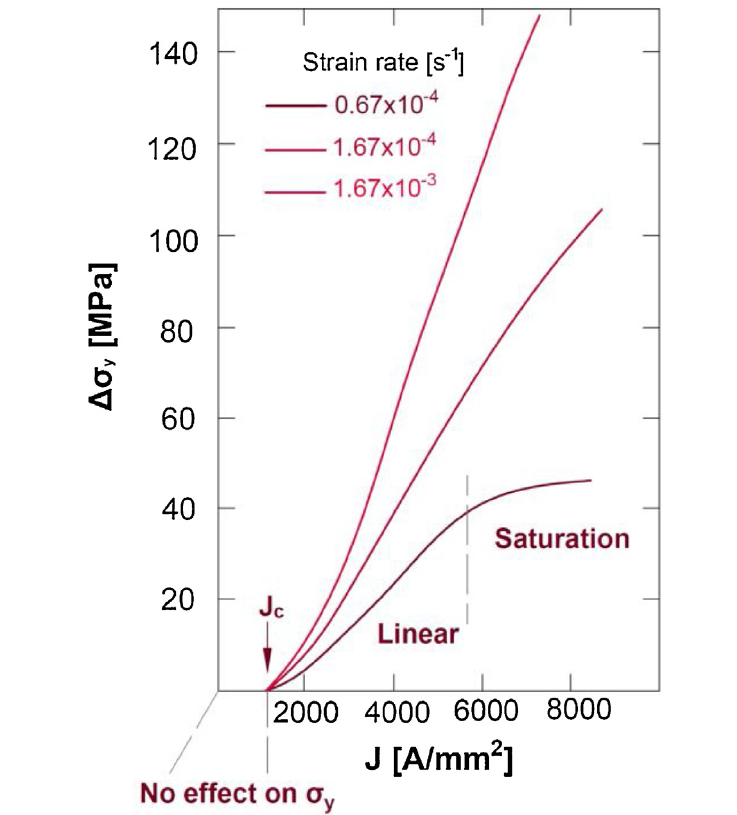
Fig. 15. Flow stress reduction (Δσy) as a function of the applied current density for Ti at 300 K at different strain rates; adapted from Okazaki et al. [96].
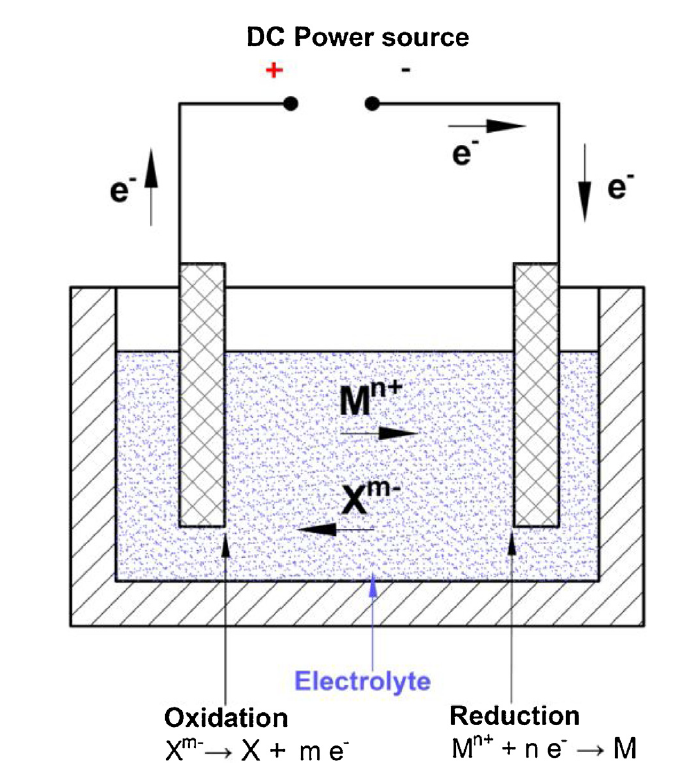
Fig. 16. Schematic representation of an electrochemical cell.
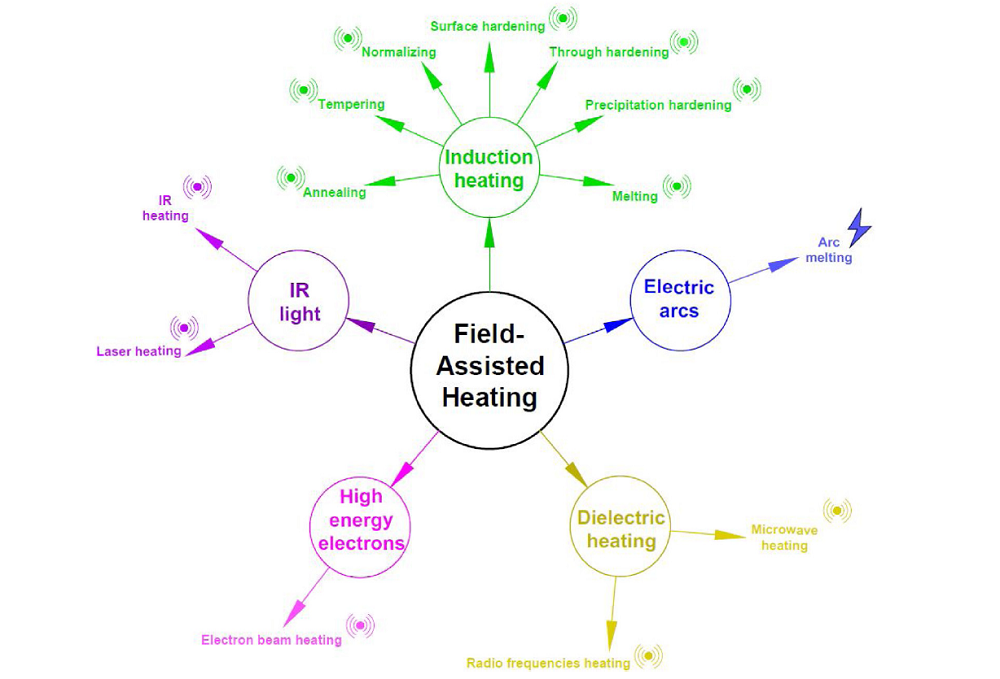
Fig. 17. Electric field-assisted heat treatments.
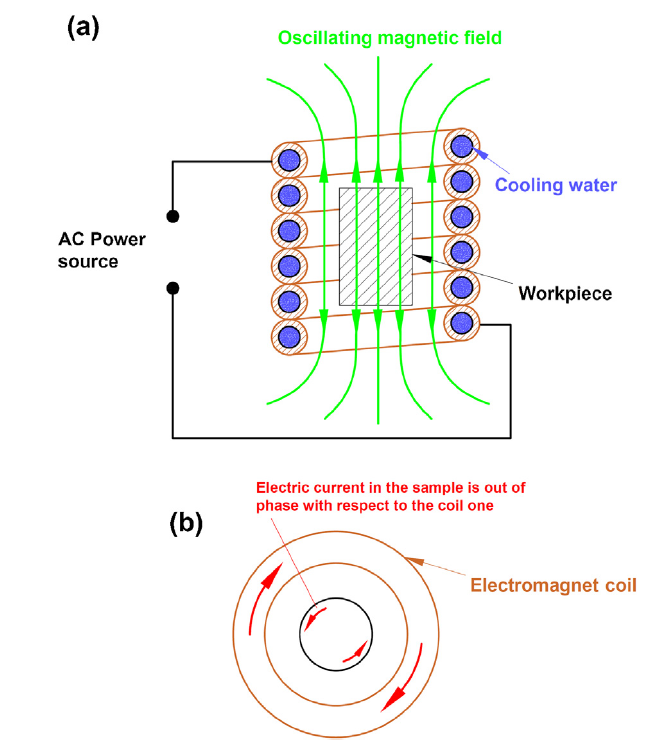
Fig. 18. Schematic representation of an induction heating set-up: (a) section and (b) top view.
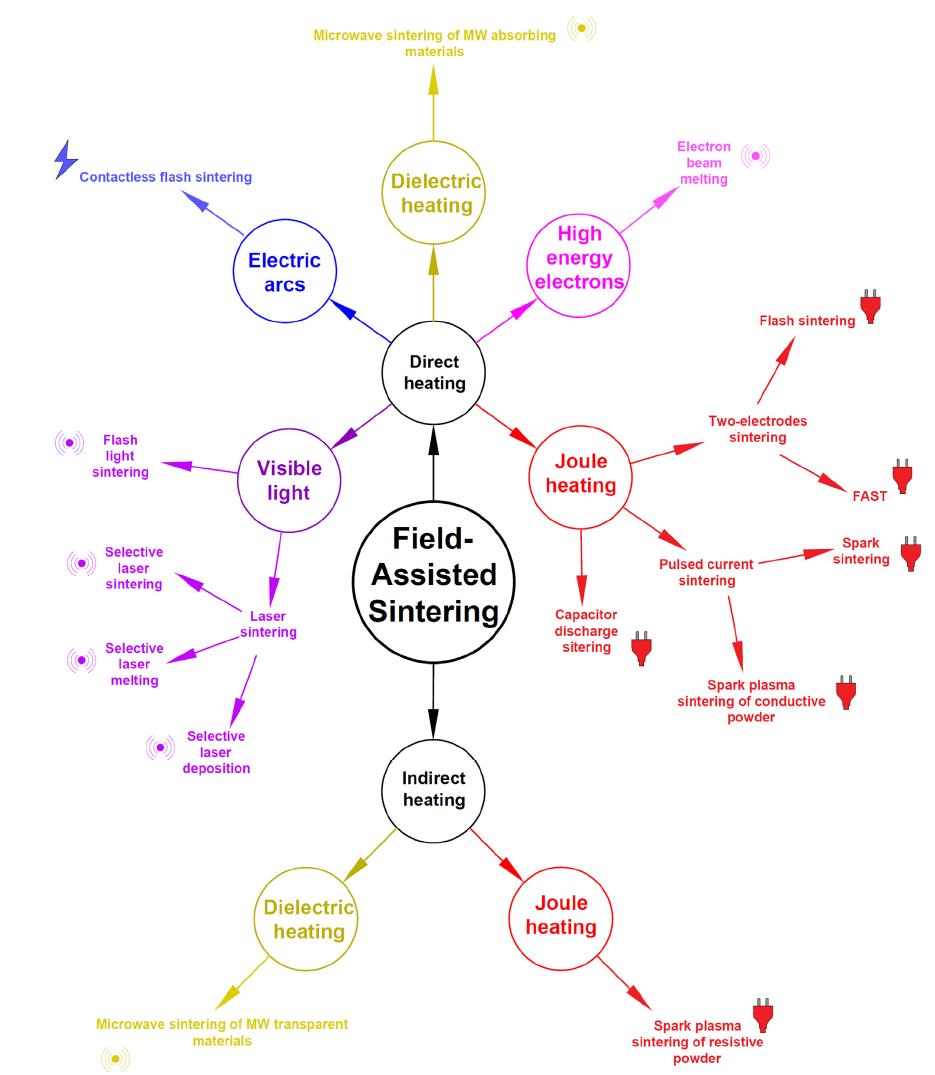
Fig. 19. Electric field-assisted sintering technologies. In indirect heating the electromagnetic radiation is not absorbed by the workpiece, heat is conducted from an auxiliary absorber.
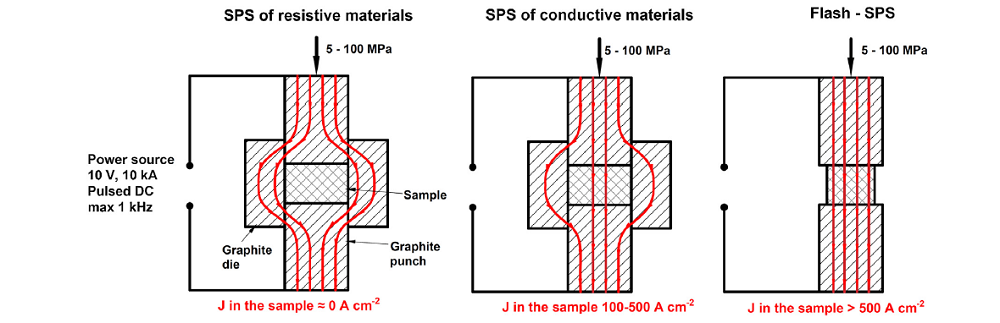
Fig. 20. Current distribution in various SPS configurations: insulating powder, conductive powder and conductive powder in FSPS. The pressure and current ranges are indicative and may vary depending on the sample geometry and materials properties.
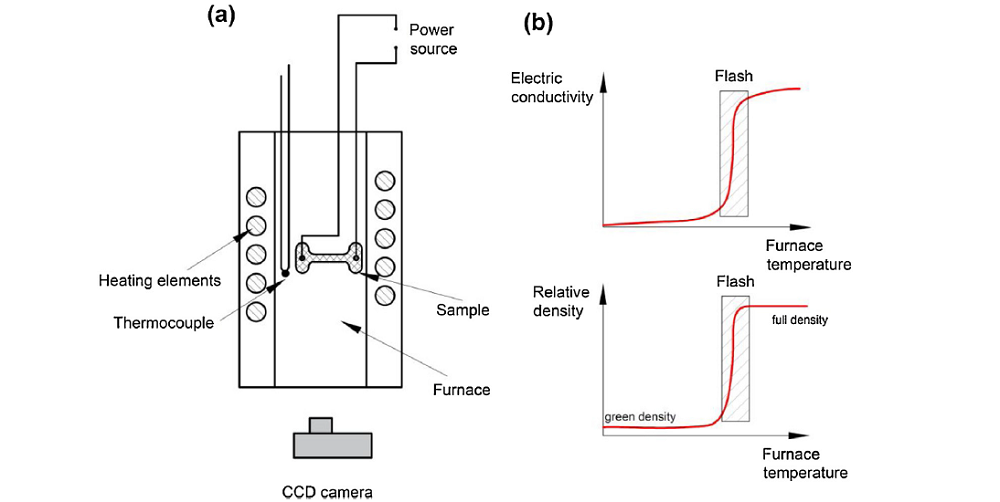
Fig. 21. (a) Schematic of Traditional Flash Sintering setup, (b) qualitative conductivity and densification evolution during flash sintering.
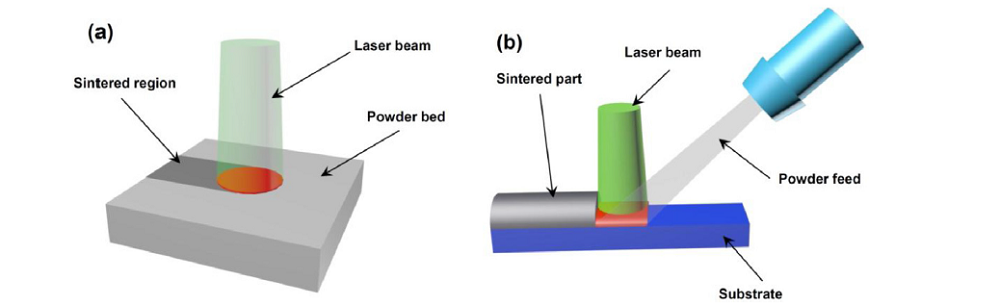
Fig. 22. Schematic representation of (a) selective laser sintering and (b) laser metal deposition.
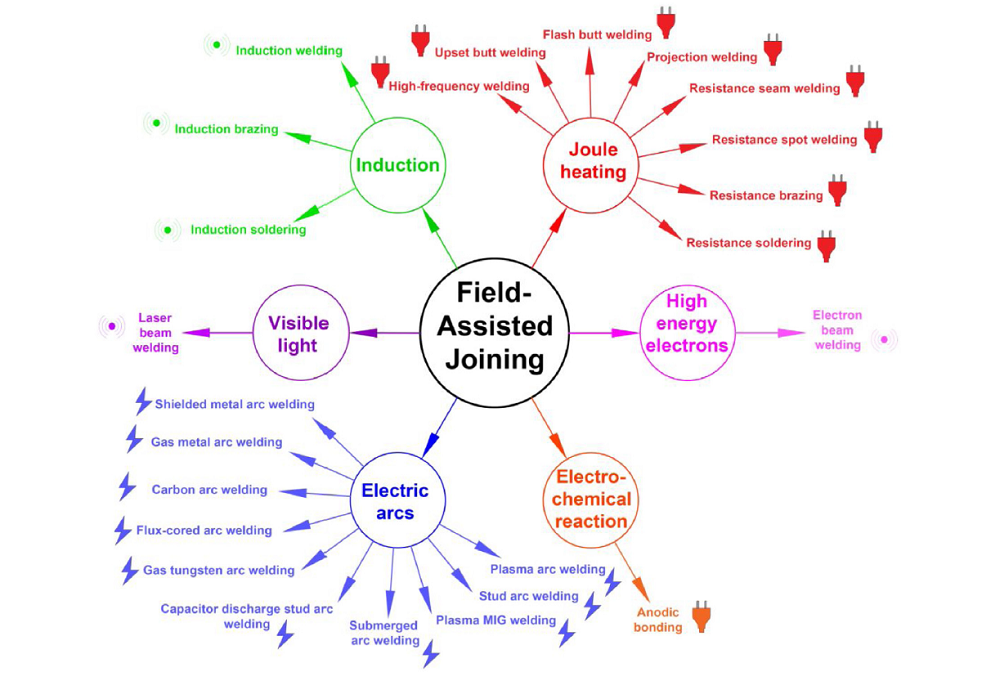
Fig. 23. Electric field-assisted joining technologies.
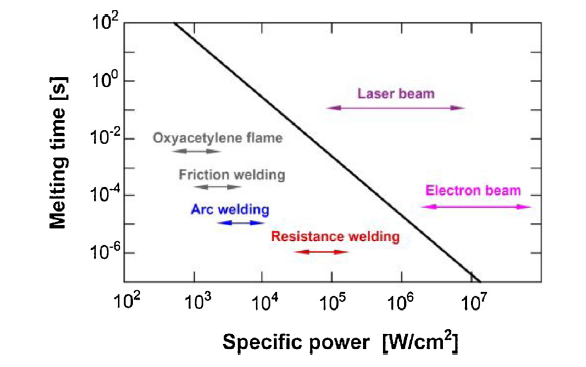
Fig. 24. Typical melting time for steel as a function of the specific welding power (melting time = (5000/Ws)2, where the melting time is expressed in [s], Ws is the specific power in [W/cm2]). The power ranges for different welding technologies are reported, as well. Data taken from Ref. [303].
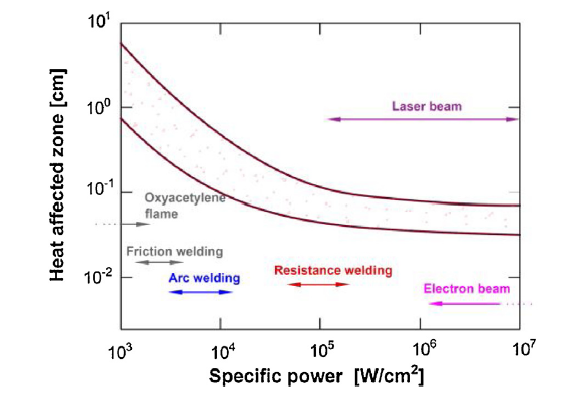
Fig. 25. Heat affected zone size as a function of the input specific power for different welding technologies. Data taken from Ref. [303].
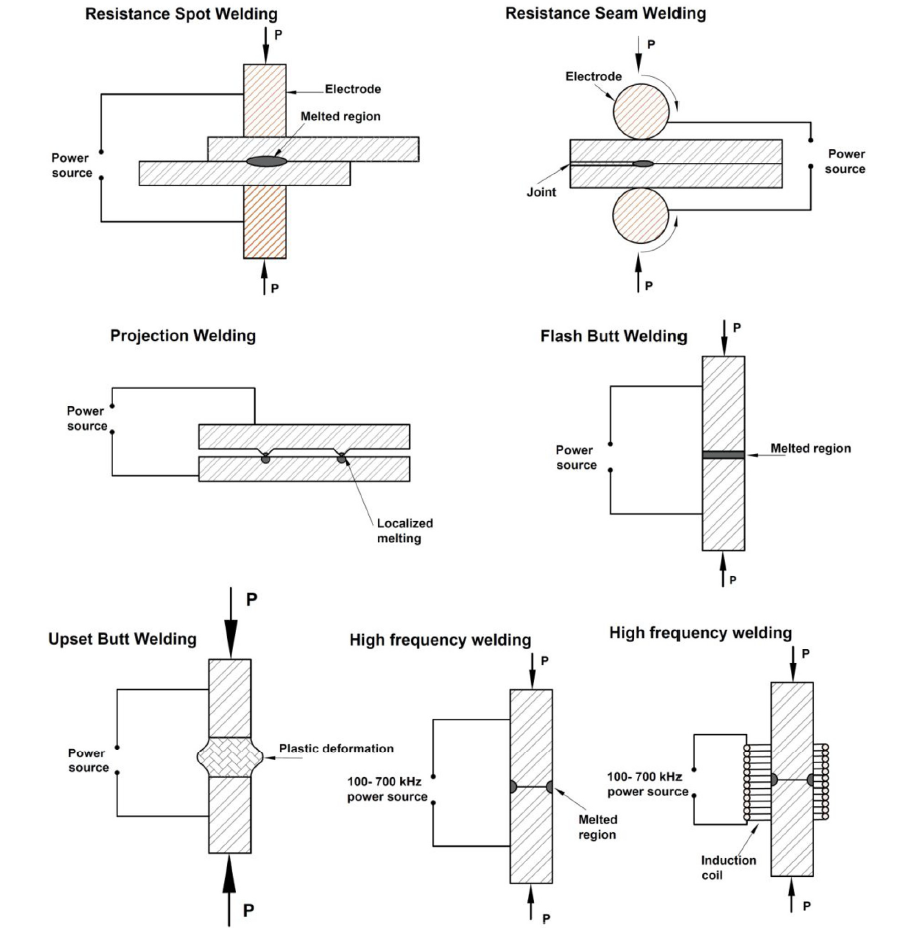
Fig. 26. Schematic representation of the most important resistive welding technologies.
| Technique | Electrode | Filler metal | Shielding | Plasma gas | Indicative Electric arc data | Polarization |
|---|---|---|---|---|---|---|
| Shielded Metal Arc Welding | Consumable: metal core with flux coating | From the consumable electrode | Molten flux, gasses developed from the flux decomposition | Air + gasses developed from flus decomposition | 25 - 500 A | DCEP, DCEN, AC |
| 15 - 35 V | ||||||
| Flux-Cored Arc Welding | Consumable: tubular electrode containing powder of metal, flux, slag forming and deoxidizing agents | From the consumable electrode | Molten flux, gasses developed from the flux decomposition or inert shielding gas (Ar or CO2) | Air + gasses developed from flus decomposition or inert shielding gas (Ar or CO2) | 100 - 600 A | DCEP, DCEN |
| 20 - 30 V | ||||||
| Carbon Arc Welding | Carbon or graphite “partially” consumable | With (filler road place close to the melted pool) or without | CO developed from the electrode oxidation | CO + atmospheric air | 15 - 700 A | DCEN or AC |
| Gas Metal Arc Welding (also known as MIG) | Consumable | From the consumable electrode | Inert gas (usually Ar or mixtures with He, CO2, H2 or small quantities of O2) | Same of the shielding gas | 100 - 400 A | Usually DCEP |
| 20 - 70 V | ||||||
| Gas Tungsten Arc Welding (also known as TIG) | Non consumable (Tungsten) | With (filler road place close to the melted pool) or without | Inert gas (usually Ar, also He or mixtures are used) | Same of the shielding gas | 300 - 500 A | Usually DCEN, less common AC and DCEP |
| 10 - 15 V | ||||||
| Plasma Arc Welding (PAW) | Non consumable (Tungsten) | With (filler road place close to the melted pool) or without | Inert gas (usually Ar, also Ar/He and Ar/H2 mixtures are used) | Ar (in this case two gasses are fluxed: one for shielding and one for sustaining the electric arc) | 15 - 500 A (micro-welding systems are also available using 0.5-10 A) | Usually DCEN, less common AC |
| 20 - 40 V | ||||||
| Plasma- MIG Welding | Consumable | With (filler road place close to the melted pool) or without | Inert gas (usually Ar, or mixtures) | Ar (in this case two gasses are fluxed: one for shielding and one for sustaining the electric arc) | 40 - 200 A | Almost always DCEP |
| 20 - 40 V | ||||||
| Submerged Arc Welding | Consumable | From the consumable electrode | Granular flux provided by and hopper moving close to the plasma torch | The discharge takes place within the molten fluxes | 150 - 1000 A | DCEP, DCEN, AC |
| 20 - 40 V | ||||||
| Stud Arc Welding | One electrode is a stud the other a metal component. When the arc creates a melt the stud is pushed on the component and welds | Without | Usually no shielding, for joining Al components an inert gas flow is used | Air | 150 - 200 A | DCEP, DCEN |
| Capacitor Discharge Stud Arc Welding | One electrode is a stud the other a metal component. When the arc creates a melt the stud is pushed on the component and welds | Without | Usually no shielding, for joining Al components an inert gas flow is used | Air | 2000 - 10,000 A | Capacitor discharge |
Table 2 Main characteristics of the different arc welding technologies. Data based on Refs. [[326], [327], [328], [329], [330], [331], [332], [333], [334], [335], [336]].
| Technique | Electrode | Filler metal | Shielding | Plasma gas | Indicative Electric arc data | Polarization |
|---|---|---|---|---|---|---|
| Shielded Metal Arc Welding | Consumable: metal core with flux coating | From the consumable electrode | Molten flux, gasses developed from the flux decomposition | Air + gasses developed from flus decomposition | 25 - 500 A | DCEP, DCEN, AC |
| 15 - 35 V | ||||||
| Flux-Cored Arc Welding | Consumable: tubular electrode containing powder of metal, flux, slag forming and deoxidizing agents | From the consumable electrode | Molten flux, gasses developed from the flux decomposition or inert shielding gas (Ar or CO2) | Air + gasses developed from flus decomposition or inert shielding gas (Ar or CO2) | 100 - 600 A | DCEP, DCEN |
| 20 - 30 V | ||||||
| Carbon Arc Welding | Carbon or graphite “partially” consumable | With (filler road place close to the melted pool) or without | CO developed from the electrode oxidation | CO + atmospheric air | 15 - 700 A | DCEN or AC |
| Gas Metal Arc Welding (also known as MIG) | Consumable | From the consumable electrode | Inert gas (usually Ar or mixtures with He, CO2, H2 or small quantities of O2) | Same of the shielding gas | 100 - 400 A | Usually DCEP |
| 20 - 70 V | ||||||
| Gas Tungsten Arc Welding (also known as TIG) | Non consumable (Tungsten) | With (filler road place close to the melted pool) or without | Inert gas (usually Ar, also He or mixtures are used) | Same of the shielding gas | 300 - 500 A | Usually DCEN, less common AC and DCEP |
| 10 - 15 V | ||||||
| Plasma Arc Welding (PAW) | Non consumable (Tungsten) | With (filler road place close to the melted pool) or without | Inert gas (usually Ar, also Ar/He and Ar/H2 mixtures are used) | Ar (in this case two gasses are fluxed: one for shielding and one for sustaining the electric arc) | 15 - 500 A (micro-welding systems are also available using 0.5-10 A) | Usually DCEN, less common AC |
| 20 - 40 V | ||||||
| Plasma- MIG Welding | Consumable | With (filler road place close to the melted pool) or without | Inert gas (usually Ar, or mixtures) | Ar (in this case two gasses are fluxed: one for shielding and one for sustaining the electric arc) | 40 - 200 A | Almost always DCEP |
| 20 - 40 V | ||||||
| Submerged Arc Welding | Consumable | From the consumable electrode | Granular flux provided by and hopper moving close to the plasma torch | The discharge takes place within the molten fluxes | 150 - 1000 A | DCEP, DCEN, AC |
| 20 - 40 V | ||||||
| Stud Arc Welding | One electrode is a stud the other a metal component. When the arc creates a melt the stud is pushed on the component and welds | Without | Usually no shielding, for joining Al components an inert gas flow is used | Air | 150 - 200 A | DCEP, DCEN |
| Capacitor Discharge Stud Arc Welding | One electrode is a stud the other a metal component. When the arc creates a melt the stud is pushed on the component and welds | Without | Usually no shielding, for joining Al components an inert gas flow is used | Air | 2000 - 10,000 A | Capacitor discharge |
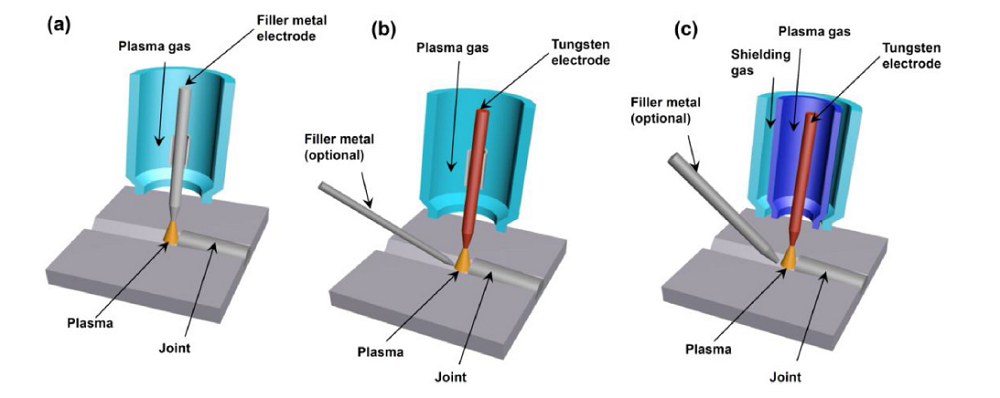
Fig. 27. Schematic representation of (a) gas metal arc welding, MIG, (b) gas tungsten arc welding, TIG and (c) plasma arc welding, PAW.
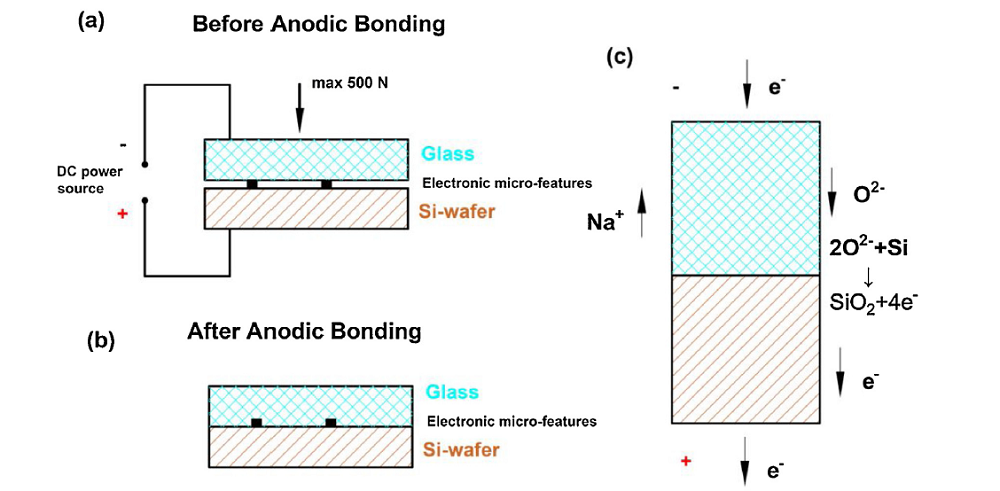
Fig. 28. Schematic of the anodic bonding procedure showing (a) before and (b) after the bonding, (c) the electrochemical reactions occurring during the process are also reported.
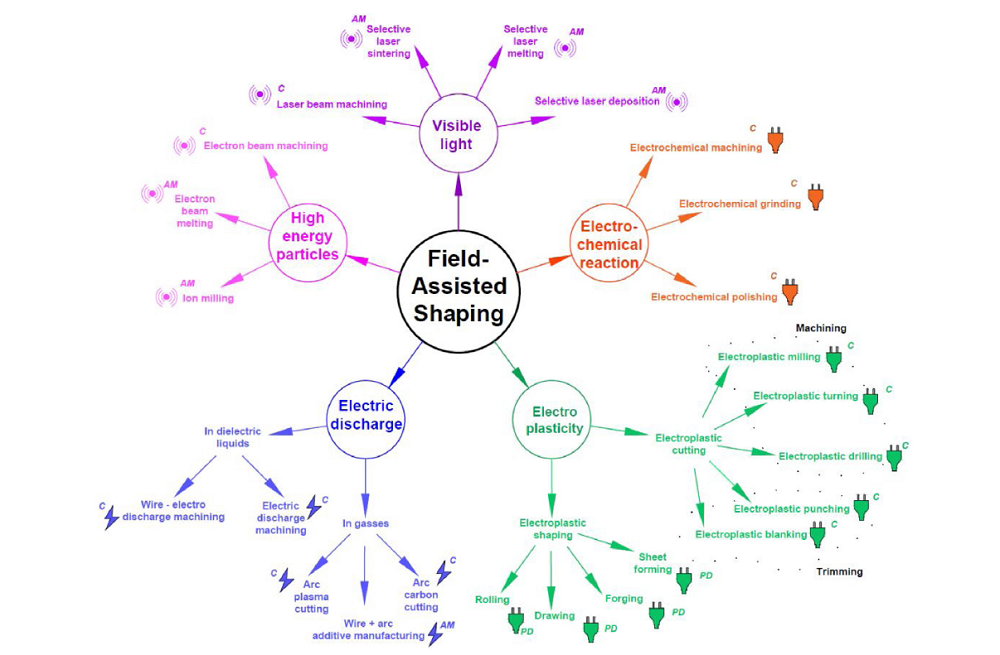
Fig. 29. Electric field-assisted shaping technologies. The italics letters identify the processing family: C = Cutting (removal of material), AM = Additive Manufacturing, PD = Plastic Deformation process.
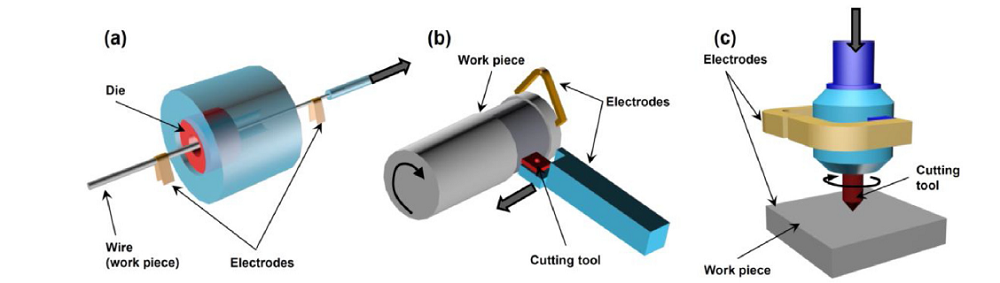
Fig. 30. Schematic representation for electroplastic (a) wire drawing, (b) tuning and (c) drilling.
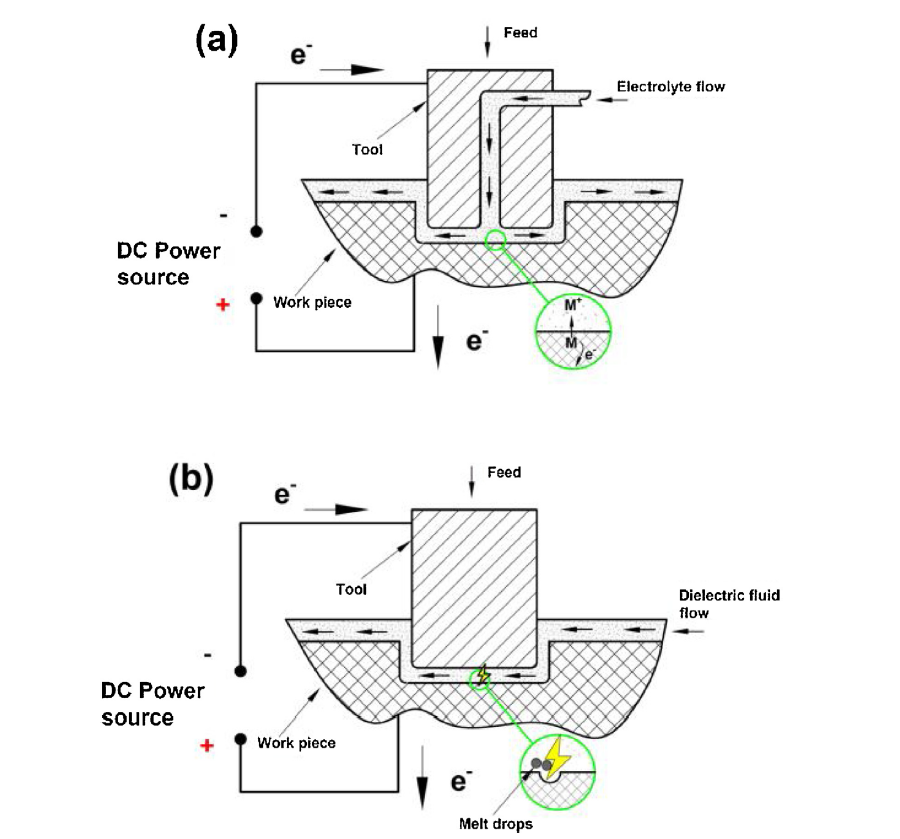
Fig. 31. Schematic representation of an (a) ECM and (b) EDM machines.
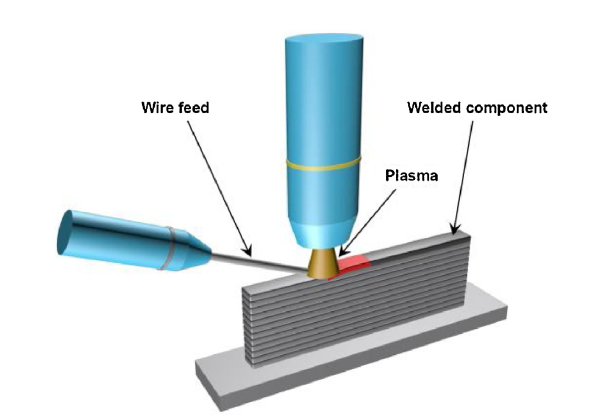
Fig. 32. Simplified sketch of wire + arc additive manufacturing system. The 3D component is formed layer-by-layer by melting a metal filament under an electric arc.
| Technique | Materials | Description | Effects | |
|---|---|---|---|---|
| Surface treatments | Galvanic deposition [ | Metals | A metal coating is deposited from a metal-ion containing solution through a reduction electrochemical reaction (substrate needs to be conductive). Galvanic coatings are used both in the field of mechanical engineering (i.e., surface modification for tribological purposes…) to aesthetic applications. | Electrochemical reactions |
| Anodization [ | Metals (mainly Al and its alloys) | The metal surface is oxidised in controlled conditions to attain an hard and protective coating. | Electrochemical reactions | |
| Cathodic protection [ | Metals | A DC potential (+) prevent the oxidation of a metal component (i.e., pipeline, buildings, off-shore implants…). | Electrochemical reactions | |
| Field-assisted ion exchange [ | Glasses | Ions from a molten salt bath are forced to enter onto the surface of a glass work piece and substitute the formerly present ions with analogous valence. This can be used to produce surface-compressive stresses (chemical tempering) or to modify the surface optical properties. | Electromigration | |
| Sputtering [ | Any substrate, coating is usually a metal or alloys | A thin film is produced by a ionic bombardment of a metal or metal-alloy target, the material removed from the target is deposited on a substrate. RF-magnetron sputtering or pulsed-DC sputtering allows the deposition of non-conductive coatings. | Plasma | |
| Plasma-enhanced chemical vapour deposition [ | Metals, ceramics, carnon-based nanomaterials | A coating is produced from the deposition of a vapour phase. The chemical reactions required for the deposition are facilitated by the presence of a glow containing hot electrons. | Plasma | |
| Pulsed-laser deposition [ | Metals and ceramics | A coating is produced by ablating a target material in a vacuum chamber with an high-energy pulsed laser. The target material evaporates and condense on the substrate surface. | IR/visible light absorption | |
| Plasma spraying [ | Metals and ceramics | Powder is used as feedstock. It is heated by mean of a plasma torch and accelerated on a substrate. | Plasma | |
| Electrophoretic deposition [ | Colloidal particles | Colloidal particles dispersed in a liquid are moved under the effect of an electric field on a conductive substrate. | Coulomb force | |
| Plasma-assisted etching [ | Usually metals | Active ions in a plasma (i.e., fluorine…) reacts with a substrate to produce volatile species which are removed from the substrate. | Plasma | |
| Corona treatment [ | Polymers | Used to modify the surface energy, surface activation of polymers. | Plasma | |
| Synthesis | Electrowinning [ | Metals | Metal ores are reduced to extract the corresponding metal. | Electrochemical reactions |
| Wire explosion [ | Metals | An electric current passes through a thin metal wire. The high power density causes metal sublimation and the formation of electric arcs in the metal vapours. Metal nanoparticles are obtained. | Joule heating Plasma | |
| Microwave-assisted organic synthesis [ | Organic molecules | Organic compounds are prepared under microwave radiation | Dielectric heating | |
| Mixing | Electromagnetic stirring [ | Magnetic melts (usually steel) | A metal melt is mixed using a magnetic field. Typical applications are in the field of continuous casting of steel components | Magnetic forces |
| Fiber production | Electrospinning [ | Polymers | Fiber are produced by drawing a melted polymer or a polymer solution through a strong electric field. High voltages are generally used (several kV). | Coulomb force |
| Rocks drilling | Plasma deep drilling [ | Rocks | Production of holes using electric arcs. | Plasma |
| Separation | Electrostatic precipitators [ | Fumes | Charged dust particles are removed from the fumes using electric fields. | Coulomb force |
| Electro-osmosis [ | Liquids | A liquid moves under the effect of an electric field in micro-tubes, capillarity tubes, porous structures or membranes. | Coulomb force | |
| Electrodialysis [ | Ionic solutions | Ions moves under the effect of an electric field from one solution to another. The solutions are separated by an ion-exchange membrane. At the electrodes electrochemical reaction occur to balance the charge. | Electrochemical reactions, Coulomb force | |
| Electron beam cross-linking [ | Polymers | Thermoset materials can be produced by electron beam induced cross-linking. When the process is carried out on a thermoplastic polymer links between chains can be formed as in the case of ultra-high-density polyethylene. | Electron beam irradiation | |
| Cross-linking | UV crosslinking [ | Polymers | Polymers can be cross-linked by UV light irradiation. The process can make use of UV lamps and mask to produce a selective polymerization of the material (photolithography). An alternative is represented by the use of lasers. The process can be used to produce objects by additive manufacturing. | UV light absorption |
| Sterilization | Electron beam sterilization [ | Medical devices and packaging, biomaterials | High energy electrons are focused on the component to be sterilized. The electronic bombardment breaks the DNA of the bacteria and other living organisms. | Electron beam irradiation |
| Pulsed electric field sterilization [ | Foods and drinks | The cellular membrane of bacteria are irreversibly broken (irreversible electroporation) causing the death of micro-organisms. | Under debate Breakdown of the cell membrane | |
| Plasma sterilization [ | Medical devices | A plasma is used to remove micro-organisms through an oxidation process. | Plasma Electrochemical reactions |
Table 3 An overview of the EPMs used for surface treatments, synthesis, separation, rocks drilling, sterilization, mixing and for fibre production.
| Technique | Materials | Description | Effects | |
|---|---|---|---|---|
| Surface treatments | Galvanic deposition [ | Metals | A metal coating is deposited from a metal-ion containing solution through a reduction electrochemical reaction (substrate needs to be conductive). Galvanic coatings are used both in the field of mechanical engineering (i.e., surface modification for tribological purposes…) to aesthetic applications. | Electrochemical reactions |
| Anodization [ | Metals (mainly Al and its alloys) | The metal surface is oxidised in controlled conditions to attain an hard and protective coating. | Electrochemical reactions | |
| Cathodic protection [ | Metals | A DC potential (+) prevent the oxidation of a metal component (i.e., pipeline, buildings, off-shore implants…). | Electrochemical reactions | |
| Field-assisted ion exchange [ | Glasses | Ions from a molten salt bath are forced to enter onto the surface of a glass work piece and substitute the formerly present ions with analogous valence. This can be used to produce surface-compressive stresses (chemical tempering) or to modify the surface optical properties. | Electromigration | |
| Sputtering [ | Any substrate, coating is usually a metal or alloys | A thin film is produced by a ionic bombardment of a metal or metal-alloy target, the material removed from the target is deposited on a substrate. RF-magnetron sputtering or pulsed-DC sputtering allows the deposition of non-conductive coatings. | Plasma | |
| Plasma-enhanced chemical vapour deposition [ | Metals, ceramics, carnon-based nanomaterials | A coating is produced from the deposition of a vapour phase. The chemical reactions required for the deposition are facilitated by the presence of a glow containing hot electrons. | Plasma | |
| Pulsed-laser deposition [ | Metals and ceramics | A coating is produced by ablating a target material in a vacuum chamber with an high-energy pulsed laser. The target material evaporates and condense on the substrate surface. | IR/visible light absorption | |
| Plasma spraying [ | Metals and ceramics | Powder is used as feedstock. It is heated by mean of a plasma torch and accelerated on a substrate. | Plasma | |
| Electrophoretic deposition [ | Colloidal particles | Colloidal particles dispersed in a liquid are moved under the effect of an electric field on a conductive substrate. | Coulomb force | |
| Plasma-assisted etching [ | Usually metals | Active ions in a plasma (i.e., fluorine…) reacts with a substrate to produce volatile species which are removed from the substrate. | Plasma | |
| Corona treatment [ | Polymers | Used to modify the surface energy, surface activation of polymers. | Plasma | |
| Synthesis | Electrowinning [ | Metals | Metal ores are reduced to extract the corresponding metal. | Electrochemical reactions |
| Wire explosion [ | Metals | An electric current passes through a thin metal wire. The high power density causes metal sublimation and the formation of electric arcs in the metal vapours. Metal nanoparticles are obtained. | Joule heating Plasma | |
| Microwave-assisted organic synthesis [ | Organic molecules | Organic compounds are prepared under microwave radiation | Dielectric heating | |
| Mixing | Electromagnetic stirring [ | Magnetic melts (usually steel) | A metal melt is mixed using a magnetic field. Typical applications are in the field of continuous casting of steel components | Magnetic forces |
| Fiber production | Electrospinning [ | Polymers | Fiber are produced by drawing a melted polymer or a polymer solution through a strong electric field. High voltages are generally used (several kV). | Coulomb force |
| Rocks drilling | Plasma deep drilling [ | Rocks | Production of holes using electric arcs. | Plasma |
| Separation | Electrostatic precipitators [ | Fumes | Charged dust particles are removed from the fumes using electric fields. | Coulomb force |
| Electro-osmosis [ | Liquids | A liquid moves under the effect of an electric field in micro-tubes, capillarity tubes, porous structures or membranes. | Coulomb force | |
| Electrodialysis [ | Ionic solutions | Ions moves under the effect of an electric field from one solution to another. The solutions are separated by an ion-exchange membrane. At the electrodes electrochemical reaction occur to balance the charge. | Electrochemical reactions, Coulomb force | |
| Electron beam cross-linking [ | Polymers | Thermoset materials can be produced by electron beam induced cross-linking. When the process is carried out on a thermoplastic polymer links between chains can be formed as in the case of ultra-high-density polyethylene. | Electron beam irradiation | |
| Cross-linking | UV crosslinking [ | Polymers | Polymers can be cross-linked by UV light irradiation. The process can make use of UV lamps and mask to produce a selective polymerization of the material (photolithography). An alternative is represented by the use of lasers. The process can be used to produce objects by additive manufacturing. | UV light absorption |
| Sterilization | Electron beam sterilization [ | Medical devices and packaging, biomaterials | High energy electrons are focused on the component to be sterilized. The electronic bombardment breaks the DNA of the bacteria and other living organisms. | Electron beam irradiation |
| Pulsed electric field sterilization [ | Foods and drinks | The cellular membrane of bacteria are irreversibly broken (irreversible electroporation) causing the death of micro-organisms. | Under debate Breakdown of the cell membrane | |
| Plasma sterilization [ | Medical devices | A plasma is used to remove micro-organisms through an oxidation process. | Plasma Electrochemical reactions |
| Process | Compatible Materials | AC/ DC/ Pulse | Indicative Electric parameters (current density, voltage and power density) | Electric current effects |
|---|---|---|---|---|
| Induction-based processes | Metals, conductive ceramics | AC | Up to 3 kA cm-2 on the sample surface, few Volts, 101 - 102 W cm-2 | Induction heating; |
| Arc melting | Metals and ceramics | AC or DC | 10 - 105 A ≈ 102 V 103-108 W | Electric arcs, Joule heating is a secondary effect |
| Laser glazing | Metals | Visible/IR light | 105 - 107 W cm-2 | Visible/IR light absorption; |
| Laser hardening | Metals | Visible/IR light | 500 - 6000 W cm-2 | Visible/IR light absorption; |
| SPS | Metals and ceramics | DC pulsed | 0 to 500 A cm-2, 1-10 V | Joule heating, possible secondary effects: plasma formation, electromigration, thermodiffusion, electroplasticity, thermoelectric effect; |
| Microwave sintering/ heating | Metals and lossy dielectrics powder | AC | 10 - 102 mW mm-3 * | Dielectric heating, Ponderomotive force |
| Flash sintering | Ceramics | DC, AC, pulsed | 10° - 102 A cm-2 | Joule heating, possible secondary effects: localized melting at the particle contact points, electrochemical reaction, thermodiffusion, thermoelectric effect; |
| 10° - 103 V cm-1 | ||||
| 102 - 103 mW mm-3 | ||||
| Flash light sintering | Metals | Visible/IR light | 103 mW cm-2 | Visible/IR light absorption; |
| Selective laser sintering, | Metals and ceramics | Visible/IR light | 102 - 5 × 10⁴ W cm-2 | Visible/IR light absorption |
| Capacitor discharge sintering | Metals | Capacitor discharge | < 104 A cm-2 below 100 V | Joule heating, Electromigration can be a secondary effect |
| Resistance welding | Metals | AC or DC | 104 A cm-2, few volts, 5 × 10⁴ - 3 × 10⁵ W cm-2 | Joule heating, Elelctromigration is also present during nanowires welding |
| Arc welding | Metals | AC or DC | 10 - 103 A | Electric arcs, Joule heating is a secondary effect |
| 10 - 10 2 V | ||||
| 3 × 10³ -104 W cm-2 | ||||
| Capacitor discharge stud arc welding | Metals | Capacitor discharge | 103 - 104 A | Electric arcs, Joule heating is a secondary effect |
| Laser welding | Metals | Visible/IR light | 105 - 107 W cm-2 | Visible light/IR absorption, Thermodiffusion of impurities is a secondary effect |
| Electron beam welding | Metals | DC | 30-200 kV | High energy electrons collision; |
| 0.5-1500 mA | ||||
| Up to 108 W cm-2 | ||||
| Anodic bonding | Glasses/ semiconductor | DC | 10-3 -10-2 A | Electrochemical reactions and electromigration; |
| 102 - 103 V | ||||
| Pulsed current-assisted crack healing | Metals | Pulse DC | 0.5-10 kA | Joule heating with localized current/field concentration at the crack tip; |
| Few volts | ||||
| Microwave-assisted crack healing | Ceramics | AC | 2.45 GHz | Dielelctric heating with localized current/field concentration at the crack tip, Ponderomotive force |
| Electroplastic shaping | Metals | Pulse DC | 10 - 105 A cm-2 | Electroplasticity, Joule heating is a secondary effect; |
| Electroplastic trimming | Metals | Pulse DC | 103 - 104 A cm-2 | Electroplasticity, Joule heating is a secondary effect; |
| Electroplastic machining | Metals | Pulse DC | 104 - 105 A cm-2 | Electroplasticity, Joule heating is a secondary effect; |
| 102 - 103 A | ||||
| Electric discharge machining | Metals, conductive ceramics | DC | 1-60 A, few A cm-2 | Electric arcs (localized melting); |
| 50-250 V | ||||
| Electrochemical machining | Metals | DC | 20 - 200 A cm-2 | Electrochemical reactions; |
| 10-25 V | ||||
| Plasma arc cutting | Metals | DC | ≈ 5000 A cm-2, 100 A, | Electric arcs, Joule heating is a secondary effect; |
| 100 V | ||||
| Laser machining | Metals, ceramics polymers and composites | Visible/IRlight | 105 - 108 W cm-2 | Visible/IR light absorption; |
Table 4 Electric process parameters and electricity effect on matter used for different EPM.
| Process | Compatible Materials | AC/ DC/ Pulse | Indicative Electric parameters (current density, voltage and power density) | Electric current effects |
|---|---|---|---|---|
| Induction-based processes | Metals, conductive ceramics | AC | Up to 3 kA cm-2 on the sample surface, few Volts, 101 - 102 W cm-2 | Induction heating; |
| Arc melting | Metals and ceramics | AC or DC | 10 - 105 A ≈ 102 V 103-108 W | Electric arcs, Joule heating is a secondary effect |
| Laser glazing | Metals | Visible/IR light | 105 - 107 W cm-2 | Visible/IR light absorption; |
| Laser hardening | Metals | Visible/IR light | 500 - 6000 W cm-2 | Visible/IR light absorption; |
| SPS | Metals and ceramics | DC pulsed | 0 to 500 A cm-2, 1-10 V | Joule heating, possible secondary effects: plasma formation, electromigration, thermodiffusion, electroplasticity, thermoelectric effect; |
| Microwave sintering/ heating | Metals and lossy dielectrics powder | AC | 10 - 102 mW mm-3 * | Dielectric heating, Ponderomotive force |
| Flash sintering | Ceramics | DC, AC, pulsed | 10° - 102 A cm-2 | Joule heating, possible secondary effects: localized melting at the particle contact points, electrochemical reaction, thermodiffusion, thermoelectric effect; |
| 10° - 103 V cm-1 | ||||
| 102 - 103 mW mm-3 | ||||
| Flash light sintering | Metals | Visible/IR light | 103 mW cm-2 | Visible/IR light absorption; |
| Selective laser sintering, | Metals and ceramics | Visible/IR light | 102 - 5 × 10⁴ W cm-2 | Visible/IR light absorption |
| Capacitor discharge sintering | Metals | Capacitor discharge | < 104 A cm-2 below 100 V | Joule heating, Electromigration can be a secondary effect |
| Resistance welding | Metals | AC or DC | 104 A cm-2, few volts, 5 × 10⁴ - 3 × 10⁵ W cm-2 | Joule heating, Elelctromigration is also present during nanowires welding |
| Arc welding | Metals | AC or DC | 10 - 103 A | Electric arcs, Joule heating is a secondary effect |
| 10 - 10 2 V | ||||
| 3 × 10³ -104 W cm-2 | ||||
| Capacitor discharge stud arc welding | Metals | Capacitor discharge | 103 - 104 A | Electric arcs, Joule heating is a secondary effect |
| Laser welding | Metals | Visible/IR light | 105 - 107 W cm-2 | Visible light/IR absorption, Thermodiffusion of impurities is a secondary effect |
| Electron beam welding | Metals | DC | 30-200 kV | High energy electrons collision; |
| 0.5-1500 mA | ||||
| Up to 108 W cm-2 | ||||
| Anodic bonding | Glasses/ semiconductor | DC | 10-3 -10-2 A | Electrochemical reactions and electromigration; |
| 102 - 103 V | ||||
| Pulsed current-assisted crack healing | Metals | Pulse DC | 0.5-10 kA | Joule heating with localized current/field concentration at the crack tip; |
| Few volts | ||||
| Microwave-assisted crack healing | Ceramics | AC | 2.45 GHz | Dielelctric heating with localized current/field concentration at the crack tip, Ponderomotive force |
| Electroplastic shaping | Metals | Pulse DC | 10 - 105 A cm-2 | Electroplasticity, Joule heating is a secondary effect; |
| Electroplastic trimming | Metals | Pulse DC | 103 - 104 A cm-2 | Electroplasticity, Joule heating is a secondary effect; |
| Electroplastic machining | Metals | Pulse DC | 104 - 105 A cm-2 | Electroplasticity, Joule heating is a secondary effect; |
| 102 - 103 A | ||||
| Electric discharge machining | Metals, conductive ceramics | DC | 1-60 A, few A cm-2 | Electric arcs (localized melting); |
| 50-250 V | ||||
| Electrochemical machining | Metals | DC | 20 - 200 A cm-2 | Electrochemical reactions; |
| 10-25 V | ||||
| Plasma arc cutting | Metals | DC | ≈ 5000 A cm-2, 100 A, | Electric arcs, Joule heating is a secondary effect; |
| 100 V | ||||
| Laser machining | Metals, ceramics polymers and composites | Visible/IRlight | 105 - 108 W cm-2 | Visible/IR light absorption; |
| [1] |
J.P. Joule, Philos. Mag. J. Sci. 19 (1841) 260-277.
DOI URL |
| [2] |
B.J. Ruszkiewicz, T. Grimm, I. Ragai, L. Mears, J.T. Roth, J. Manuf. Sci. Eng. 139 (2017), 110801.
DOI URL |
| [3] |
N.M. Abbas, D.G. Solomon, M.F. Bahari, Int. J. Mach. Tools Manuf. 47 (2007) 1214-1228.
DOI URL |
| [4] |
E.A. Olevsky, E.V. Aleksandrova, A.M. Ilyina, D.V. Dudina, A.N. Novoselov, K.Y. Pelve, E.G. Grigoryev, Materials (Basel) 6 (2013) 4375-4440.
DOI URL |
| [5] |
R. Orrù, R. Licheri, A.M. Locci, A. Cincotti, G. Cao, Mater. Sci. Eng. R 63 (2009) 127-287.
DOI URL |
| [6] |
S. Grasso, Y. Sakka, G. Maizza, Sci. Technol. Adv. Mater. 10 (2009), 053001.
DOI URL |
| [7] | E.A. Olevsky, D.V. Dudina, Field-Assisted Sintering, Springer, 2018. |
| [8] | S.M. Manladan, F. Yusof, S. Ramesh, M. Fadzil, Z. Luo, S. Ao, Int. J. Manuf. Technol. Manag. 90 (2017) 605-634. |
| [9] |
S.M. Manladan, F. Yusof, S. Ramesh, M. Fadzil, Z. Luo, S. Ao, Int. J. Adv. Manuf. Technol. 90 (2016) 605-634.
DOI URL |
| [10] |
N.T. Williams, J.D. Parker, Int. Mater. Rev. 49 (2004) 45-75.
DOI URL |
| [11] |
N.T. Williams, J.D. Parker, N.T. Williams, J.D. Parker, Int. Mater. Rev. 49 (2004) 77-108.
DOI URL |
| [12] |
C. Bagger, F.O. Olsen, J. Laser Appl. 17 (2005) 2-14.
DOI URL |
| [13] | V. Rudnev, D. Loveless, R.L. Cook, Taylor & Francis, 2017. |
| [14] | S. Zinn, L. Semiatin, Element of Induction Heating, ASM International, 1988. |
| [15] | N. Perez, Electrochemistry and Corrosion Science, Springer, Switzerland, 2016. |
| [16] |
P.J. Kelly, R.D. Arnell, Vacuum 56 (2000) 159-172.
DOI URL |
| [17] |
K. Sarakinos, J. Alami, S. Konstantinidis, Surf. Coatings Technol. 204 (2010) 1661-1684.
DOI URL |
| [18] |
L. Sun, C.C. Berndt, K. Gross, A. Kucuk, J. Biomed. Mater. Res. 58 (2001) 570-592.
DOI URL |
| [19] |
A. Sharma, V. Yadava, Opt. Laser Technol. 98 (2018) 264-280.
DOI URL |
| [20] |
S.B. Pawar, V.M. Pratape, J. Food Process Eng. 40 (2017), e12308.
DOI URL |
| [21] |
S.L. Sing, W.Y. Yeong, F.E. Wiria, B.Y. Tay, Z. Zhao, L. Zhao, Z. Tian, S. Yang, Rapid Prototyp. J. 23 (2017) 611-623.
DOI URL |
| [22] |
Z.A. Munir, U. Anselmi-Tamburini, M. Ohyanagi, J. Mater. Sci. 41 (2006) 763-777.
DOI URL |
| [23] |
R.A. Surmenev, Surf. Coatings Technol. 206 (2012) 2035-2056.
DOI URL |
| [24] |
X. Cao, M. Jahazi, J.P. Immarigeon, W. Wallace, J. Mater. Process. Technol. 171 (2006) 188-204.
DOI URL |
| [25] |
D.G. Pierce, P.G. Brusius, Microelectron. Reliab. 37 (1997) 1053-1072.
DOI URL |
| [26] | R.I. Todd, Proc. IV Adv. Ceram. Appl. Conf. 116 (2017) 1-12. |
| [27] | M. Pouranvari, S.P.H. Marashi, Sci. Technol. Weld. Joints 18 (2013) 361-403. |
| [28] |
K.I. Rybakov, E.A. Olevsky, E.V. Krikun, J. Am. Ceram. Soc. 96 (2013) 1003-1020.
DOI URL |
| [29] |
H. Conrad, Mater. Sci. Eng. A 287 (2000) 276-287.
DOI URL |
| [30] |
M. Yu, S. Grasso, R. Mckinnon, T. Saunders, M.J. Reece, Adv. Appl. Ceram. 116 (2017) 24-60.
DOI URL |
| [31] |
C.E.J. Dancer, Mater. Res. Express 3 (2016), 102001.
DOI URL |
| [32] |
J.D. Katz, Annu. Rev. Mater. Sci. 22 (1992) 153-170.
DOI URL |
| [33] | W.A. Salandro, J.J. Jones, C. Bunget, M. Laine, J.T. Roth, Electrically Assisted Forming, Springer, 2015. |
| [34] | S. Asai, Electromagnetic Processing of Materials, Springer Netherlands, Dordrecht, 2012. |
| [35] | International Telecommunication Union (ITU), What Is Meant by ISM Applications and How Are the Related Frequencies Used, 2019 https://www.itu.int/net/ITU-R/terrestrial/faq/index.html#g013. |
| [36] | J.C. Mankins, Technology Readiness Level, https://aiaa.kavi.com/apps/group public/download.php/2212/TRLs MankinsPaper1995.pdf, November 2, 2018. |
| [37] | U.A. Bakshi, V.U. Bakshi, Basic Electrical Engineering, II, Technical Pubblication Pune, Pune (India), 2009. |
| [38] | J.P. Hartnett, Advances in Heat Transfer, Vol 37, Elsevier Ltd, UK, 2003. |
| [39] | J.R. Keough, J.W.J. Laird, A.D. Godding, ASM-Handb.-4, ASM International, 1991. |
| [40] | J.D.J. Callister, Fundamentals of Materials Science and Engineering, Wiley, USA, 2001. |
| [41] | J.G. Chaffee, Method and Apparatus for Heating Dielectric Materials, US2147689A, 1937. |
| [42] | T. Nishitani, Method for Sintering Refractories and an Apparatus Therefor, US4147911A, 1976. |
| [43] | D.J. Hoffman, H.D.J. Kimrey, Method and Apparatus for Radio Frequency Ceramic Sintering, US5266762A, 1992. |
| [44] |
M. Oghbaei, O. Mirzaee, J. Alloys. Compd. 494 (2010) 175-189.
DOI URL |
| [45] | C.B. Carter, M.G. Norton, eramic Materials Science and Engineering, Springer, 2007. |
| [46] | W.D. Kingery, H.K. Bowen, D.R. Uhlmann, Introduction to Ceramics, 2nd ed., Wiley, New York, 1976. |
| [47] | A.K. Bain, P. Chand, Ferroelectrics Principles and Applications, 2017. |
| [48] | Y.M. Chiang, D. Birnie, P.W.D. Kingery, Physical Ceramics: Principles for Ceramic Science and Engineering, Wiley, 1997. |
| [49] |
A. Chauhan, S. Patel, R. Vaish, C.R. Bowen, Materials (Basel) 8 (2015) 8009-8031.
DOI URL |
| [50] |
A.K. Jonscher, J. Phys. D 32 (1999) R57-R70.
DOI URL |
| [51] | R.J. Meredith, Engineers’ Handbook of Industrial Microwave Heating, The Institution of Elelctrical Engineers, London, 1998. |
| [52] |
Y.V. Bykov, S.V. Egorov, A.G. Eremeev, V.V. Kholoptsev, I.V. Plotnikov, K.I. Rybakov, A.A. Sorokin, Materials (Basel) 9 (2016) 1-18.
DOI URL |
| [53] |
P.D. Ramesh, D. Brandon, L. Schächter, Mater. Sci. Eng. A 266 (1999) 211-220.
DOI URL |
| [54] | A. Fridman, Plasma Cemistry, Cambridge University Press, New York, 2008. |
| [55] | J.R. Roth, Industrial Plasma Engineering Volume 1: Principles, Bookcraft, Midsomer Norton, 2000. |
| [56] | M.E. Van Valkenburg, W.M. Middleton, Reference Data for Engineers: Radio Electronics, Computer, and Communications, 9th ed., Newnes, USA, 2002. |
| [57] | D. Bauerle, Laser Processing and Chemistry, Springer, 2011. |
| [58] | M.S. Brown, C.B. Arnold, Laser Precise Microfabbrication, Springer, 2010, pp. 91-120. |
| [59] | D. Bergstrom, The Absorption of Laser Light by Rough Metal Surfaces, Luleå University of Technology, 2008. |
| [60] |
L.K. Ang, Y.Y. Lau, R.M. Gilgenbach, H.L. Spindler, Appl. Phys. Lett. 70 (1997) 696-698.
DOI URL |
| [61] | C.D. Boley, S.A. Khairallah, A.M. Rubenchik, Addit. Manuf. Handb. Prod. Dev. Def. Ind. (2017) 507-517. |
| [62] | H. Cao, Y.G. Zhao, S.T. Ho, E.W. Seelig, Q.H. Wang, R.P.H.Chang, Phys. Rev. Lett. 82 (1999) 2278-2281. |
| [63] | J.P. Kruth, X. Wang, T. Laoui, L. Froyen, Assem. Autom. 2315 (2003) 357-371. |
| [64] | X. Li, W. Tan, in: Proc. 27th Solid Free. Fabr. Symp., 2016, pp. 219-235. |
| [65] | M. von Allmen, Laser-Beam Interactions With Materials Physical Principles and Applications, Springer Verlag, 1987. |
| [66] |
M.G. Blaber, M.D. Arnold, M.J. Ford, J. Phys. Condens. Matter 22 (2010), 143201.
DOI PMID |
| [67] | W. Smith, J. Roberts, ASM Handbook, Vol. 6, ASM International, 1998. |
| [68] |
K. Kanaya, S. Okayama, J. Phys. D: Appl. Phys. 5 (1972) 43-58.
DOI URL |
| [69] |
F.A. Lukiyanov, E.I. Rau, R.A. Sennov, Bull. Russ. Acad. Sci. Phys. 73 (2009) 441-449.
DOI URL |
| [70] |
A. Talimian, G. Mariotto, V.M. Sglavo, Int. J. Appl. Glas. Sci. 8 (2017) 291-300.
DOI URL |
| [71] |
N.A. Sanford, K.J. Malone, D.R. Larson, Opt. Lett. 15 (1990) 366-368.
PMID |
| [72] |
P.C. Wang, R.G. Filippi, Appl. Phys. Lett. 78 (2001) 3598-3600.
DOI URL |
| [73] |
H.B. Huntington, A.R. Grone, J. Phys. Chem. Solids 20 (1961) 76-87.
DOI URL |
| [74] |
F.M. D’heurle, Proc. IEEE 59 (1971) 1409-1418.
DOI URL |
| [75] |
I.A. Blech, C. Herring, Appl. Phys. Lett. 29 (1976) 131-133.
DOI URL |
| [76] |
M. Scherge, C.L. Bauer, W.W. Mullins, Acta Metall. 43 (1995) 3525-3538.
DOI URL |
| [77] |
J.R. Black, IEEE Trans. Electron Dev. 16 (1969) 338-347.
DOI URL |
| [78] |
P.S. Ho, T. Kwok, Rep. Prog. Phys. 52 (1989) 301-348.
DOI URL |
| [79] |
E. Olevsky, L. Froyen, Scr. Mater. 55 (2006) 1175-1178.
DOI URL |
| [80] |
E. Arzt, W.D. Nix, J. Mater. Res. 6 (1991) 731-736.
DOI URL |
| [81] | F. Cacho, X. Federspiel, in: C.U. Kim (Ed.), Electromigration in Thin Films and Electronic Devices: Materials and Reliability, Woodhead Publishing, Cornwall, 2011. |
| [82] | J. Lienig, M. Thiele, Fundamentals of Electromigration- Aware Integrated Circuit Design, Springer, Cham (Switzerland), 2018. |
| [83] | D. Burgess, Electron. Dev. Fail. Anal. 3 (2014) 14-19. |
| [84] |
R.E. Hummel, R.M. Breitling, Appl. Phys. Lett. 18 (1971) 373-375.
DOI URL |
| [85] | H. Conrad, W.D. Cao, X.P. Lu, A.F. Sprecher, Scr. Metall. Mater. 23 (1989) 697-702. |
| [86] | K. Okazaki, M. Kagawa, H. Conrad, Scr. Metall. Mater. 13 (1979) 277-280. |
| [87] | K. Okazaki, M. Kagawa, H. Conrad, Mater. Sci. Eng. 45 (1980) 109-116. |
| [88] | H. Conrad, Mater. Sci. Eng. 6 (1970) 265-273. |
| [89] |
A.F. Sprecher, H. Conrad, Acta Metall. 34 (1986) 1145-1162.
DOI URL |
| [90] |
M. Molotskii, V. Fleurov, Phys. Rev. B 52 (1995) 829-834.
DOI URL |
| [91] | H. Conrad, A.F. Sprecher, W.O. Cao, X.P. Lu, JOM 42 (1990) 28-33. |
| [92] |
J. Mai, L. Peng, Z. Lin, X. Lai, Mater. Sci. Eng. A 528 (2011) 3539-3544.
DOI URL |
| [93] |
H. Conrad, Mater. Sci. Eng. A 322 (2002) 100-107.
DOI URL |
| [94] |
M.I. Molotskii, Mater. Sci. Eng. A 287 (2000) 248-258.
DOI URL |
| [95] | K. Okazaki, M. Kagawa, H. Conrad, Scr. Metall. Mater. 12 (1978) 1063-1068. |
| [96] | K. Okazaki, M. Kagawa, H. Conrad, Scr. Metall. Mater. 13 (1979) 473-477. |
| [97] | W. Kim, K. Yeom, N. Trung, S. Hong, B. Min, S. Ik, M. Kim, H. Nam, H. Lee, CIRP Ann.-Manuf.Technol. 63 (2014) 273-276. |
| [98] |
A.J. Sánchez, H.A. González, D.J. Celentano, J.A. Travieso-rodríguez, J. Llumà, J. Mater. Process. Technol. 214 (2014) 2261-2267.
DOI URL |
| [99] | N.G. Dariavach, J.A. Rice, JOM 52 (2000) 40-42. |
| [100] | O.A. Troitskiy, V.I. Stashenko, J. Mach, Manuf. Reliab. 44 (2015) 758-765. |
| [101] |
D. Yang, H. Conrad, J. Am. Ceram. Soc. 80 (1997) 1389-1396.
DOI URL |
| [102] |
D. Yang, H. Conrad, Scr. Mater. 37 (1997) 767-771.
DOI URL |
| [103] | D. Yang, H. Conrad, Acta Mater. 46 (1997) 173-183. |
| [104] |
D. Yang, H. Conrad, Scr. Mater. 41 (1999) 397-401.
DOI URL |
| [105] |
J. Janek, C. Korte, Solid State Ion. 116 (1999) 181-195.
DOI URL |
| [106] |
T.P. Mishra, R. R.I.Neto, G. Speranza, A. Quaranta, V.M. Sglavo, R. Raj, O. Guillon, M. Bram, M. Biesuz, Scr. Mater. 179 (2020) 55-60.
DOI URL |
| [107] | A.K. Varshneya, Fundamentals of Inorganic Glasses, Academic Press, Inc., 1994. |
| [108] |
R.M. Ormerod, Chem. Soc. Rev. 32 (2003) 17-28.
PMID |
| [109] |
E. Ivers-Tiffée, K.H. Härdtl, W. Menesklou, J. Riegel, Electrochim. Acta 47 (2001) 807-814.
DOI URL |
| [110] |
A. Kildal, Contrib. Plasma Phys. 39 (1999) 349-358.
DOI URL |
| [111] | G. Schmidt, Physics of High Temperature Plasmas, 2nd ed., Academic Press, Inc., London, 1979. |
| [112] | H. Schwoerer, Laser and Nuclei, Springer, Netherland, 2006. |
| [113] | R.N. Dwight, Introduction to Plasma Theory, Wiley, 1983. |
| [114] |
J. Chipman, J. Am. Chem. Soc. 48 (1926) 2577-2589.
DOI URL |
| [115] |
G. Schottky, Phys. Status Solidi 8 (1965) 357-368.
DOI URL |
| [116] |
R.M. Young, R. McPherson, J. Am. Ceram. Soc. 72 (1989) 1080-1081.
DOI URL |
| [117] | E.A. Olevsky, L. Froyen, J. Am. Ceram. Soc. 92 (2009) 122-132. |
| [118] |
O. Guillon, J. Gonzalez-Julian, B. Dargatz, T. Kessel, G. Schierning, J. Räthel, M. Herrmann, Adv. Eng. Mater. 16 (2014) 830-849.
DOI URL |
| [119] |
M. Biesuz, V.M. Sglavo, Ceram. Int. 45 (2019) 1227-1236.
DOI URL |
| [120] |
S. Ghosh, A.H. Chokshi, P. Lee, R. Raj, J. Am. Ceram. Soc. 92 (2009) 1856-1859.
DOI URL |
| [121] |
S.K. Jha, J.M. Lebrun, K.C. Seymour, W.M. Kriven, R. Raj, J. Eur. Ceram. Soc. 36 (2016) 257-261.
DOI URL |
| [122] |
M. Biesuz, V.M. Sglavo, Scr. Mater. 150 (2018) 82-86.
DOI URL |
| [123] | J.M. Lebrun, T.G. Morrissey, J. S.C.Francis, K.C. Seymour, W.M. Kriven, R. Raj, J.Am. Ceram. Soc. 98 (2015) 1493-1497. |
| [124] |
T.P. Mishra, R. R.I.Neto, R. Raj, O. Guillon, M. Bram, Acta Mater. 189 (2020) 145-153.
DOI URL |
| [125] |
K.S. Naik, V.M. Sglavo, R. Raj, J. Eur. Ceram. Soc. 34 (2014) 4063-4067.
DOI URL |
| [126] |
M. Jongmanns, D.E. Wolf, J. Am. Ceram. Soc. 103 (2020) 589-596.
DOI |
| [127] |
W. Ji, B. Parker, S. Falco, J.Y. Zhang, Z.Y. Fu, R.I. Todd, J. Eur. Ceram. Soc. 37 (2017) 2547-2551.
DOI URL |
| [128] |
Y. Zhang, J. Nie, J.M. Chan, J. Luo, Acta Mater. 125 (2017) 465-475.
DOI URL |
| [129] |
R. Raj, J. Eur. Ceram. Soc. 32 (2012) 2293-2301.
DOI URL |
| [130] |
M. Biesuz, V.M. Sglavo, Scr. Mater. 187 (2020) 49-56.
DOI URL |
| [131] |
M. Pettersson, S. Stenström, Int. J. Heat Mass Transf. 43 (2000) 1223-1232.
DOI URL |
| [132] |
M. Pettersson, S. Stenström, Int. J. Heat Mass Transf. 43 (2000) 1223-1232.
DOI URL |
| [133] | M. Schwartz, ASM Handbook, ASM International, 1993. |
| [134] | D.M. Wroughton, P.H. Okress, E. Brace, G. Comenetz, J.C.R. Kelly, J. Electron. 99 (1952) 205-211. |
| [135] | N. Wukovich, ASM Handbook, Vol. 15, ASM International, 1988. |
| [136] | J.A.T. Jones, B. Bowman, P.A. Lefrank, Steelmaking and Refinement, The AISE Steel Foundation, Pittsburgh, 1998, pp. 271-300. |
| [137] | W. Dietrich, H. Stephan, A. Leybold, ASM International, 1988. |
| [138] | A. Choudhury, E. Weingärtner, ASM International, 1988. |
| [139] |
J. Sha, H. Hirai, T. Tabaru, A. Kitahara, H. Ueno, S. Hanada, Mater. Sci. Eng. A 364 (2004) 151-158.
DOI URL |
| [140] |
O.N. Senkov, G.B. Wilks, D.B. Miracle, C.P. Chuang, P.K. Liaw, Intermetallics 18 (2010) 1758-1765.
DOI URL |
| [141] |
C.J. Tong, Y.L. Chen, J.W. Yeh, S.J. Lin, S.K. Chen, T.T. Shun, C.H. Tsau, S.Y. Chang, Metall. Mater. Trans. A 36 (2005) 881-893.
DOI URL |
| [142] |
O.N. Senkov, G.B. Wilks, J.M. Scott, D.B. Miracle, Intermetallics 19 (2011) 698-706.
DOI URL |
| [143] |
O.N. Senkov, J.M. Scott, S.V. Senkova, D.B. Miracle, C.F. Woodward, J. Alloys. Compd. 509 (2011) 6043-6048.
DOI URL |
| [144] |
A. Inoue, W. Zhang, T. Zhang, K. Kurosaka, Acta Mater. 49 (2001) 2645-2652.
DOI URL |
| [145] | K. Togano, P. Badica, Y. Nakamori, S. Orimo, H. Takeya, K. Hirata, Phys. Rev. Lett. 93 (2004) 1-4. |
| [146] |
R.J. Cava, H. Takagi, B. Batlogg, H.W. Zandbergen, J.J. Krajewski, W.F.J. Peck, R.B. van Dover, R.J. Felder, T. Siegrist, K. Mizuhashi, J.O. Lee, H. Eisaki, S.A. Carter, S. Uchida, Nature 367 (1994) 146-148.
DOI URL |
| [147] |
S.M.Y. Kaku, V. Raju, K. Bharath, R.F. Godec, H.R. Tiyyagura, Vacuum 155 (2018) 539-545.
DOI URL |
| [148] |
M.S. Park, S. Rajendran, Y.M. Kang, K.S. Han, Y.S. Han, J.Y. Lee, J. Power Sources 158 (2006) 650-653.
DOI URL |
| [149] |
V. de Castro, T. Leguey, A. Mu˜noz, M.A. Monge, R. Pareja, Mater. Sci. Eng. A 422 (2006) 189-197.
DOI URL |
| [150] |
K. Kang, L. Zhang, G. Luo, J. Zhang, R. Tu, C. Wu, Q. Shen, Mater. Sci. Eng. A 712 (2018) 28-36.
DOI URL |
| [151] |
H. Zhang, H. Zhu, J. Huang, J. Li, Z. Xie, Mater. Sci. Eng. A 719 (2018) 140-146.
DOI URL |
| [152] |
Y. Yamabe-Mitarai, Y. Ro, H. Harada, T. Maruko, Metall. Mater. Trans. A 29 (1998) 537-549.
DOI URL |
| [153] |
R. Tu, H. Hirayama, T. Goto, J. Ceram. Soc. Jpn. 116 (2008) 431-435.
DOI URL |
| [154] |
S. Zhang, S. Wang, W. Li, Y. Zhu, Z. Chen, Mater. Lett. 65 (2011) 2910-2912.
DOI URL |
| [155] |
R. Tu, N. Li, Q. Li, S. Zhang, S. Zhang, L. Zhang, T. Goto, J. Eur. Ceram. Soc. 36 (2016) 959-966.
DOI URL |
| [156] | M.P. Groover, Fundam. Mod. Manifacturing, III, Wiley, 2007, pp. 648-658. |
| [157] |
A.K. Nath, A. Gupta, F. Benny, Surf. Coatings Technol. 206 (2012) 2602-2615.
DOI URL |
| [158] | O.A. Sandven, ASM Handbook, Vol. 4, ASM International, 1991. |
| [159] | E.T. Akinlabi, R.M. Mahamood, S.A. Akinlabi, Advanced Manufacturing Techniques Using Laser Material Processing, 2016. |
| [160] |
U. Anselmi-Tamburini, J.E. Garay, Z.A. Munir, Mater. Sci. Eng. A 407 (2005) 24-30.
DOI URL |
| [161] | M.N. Rahaman, Ceramic Processing and Sintering, Marcel Dekker, New York, 1996. |
| [162] |
V. Mamedov, Powder Metall. 45 (2002) 322-328.
DOI URL |
| [163] |
Y.W. Gu, K.A. Khor, P. Cheang, Biomaterials 25 (2004) 4127-4134.
PMID |
| [164] |
G.B. Yadhukulakrishnan, S. Karumuri, A. Rahman, R.P. Singh, A. Kaan Kalkan, S.P. Harimkar, Ceram. Int. 39 (2013) 6637-6646.
DOI URL |
| [165] |
A. Bellosi, F. Monteverde, D. Sciti, Int. J. Appl. Ceram. Technol. 3 (2006) 32-40.
DOI URL |
| [166] |
M. Nygren, Z. Shen, Solid State Sci. 5 (2003) 125-131.
DOI URL |
| [167] |
H. Kwon, M. Estili, K. Takagi, T. Miyazaki, A. Kawasaki, Carbon 47 (2009) 570-577.
DOI URL |
| [168] |
T. Takeuchi, M. Tabuchi, H. Kageyama, Y. Suyama, J. Am. Ceram. Soc. 82 (1999) 939-943.
DOI URL |
| [169] |
S.I. Cha, S.H. Hong, B.K. Kim, Mater. Sci. Eng. A 351 (2003) 31-38.
DOI URL |
| [170] |
M. Yue, J.X. Zhang, W.Q. Liu, G.P. Wang, J. Magn. Magn. Mater. 271 (2004) 364-368.
DOI URL |
| [171] |
C. Yu, T.J. Zhu, R.Z. Shi, Y. Zhang, X.B. Zhao, J. He, Acta Mater. 57 (2009) 2757-2764.
DOI URL |
| [172] |
R. Chaim, Z. Shen, M. Nygren, J. Mater. Res. 19 (2004) 2527-2531.
DOI URL |
| [173] |
G. Aldica, D. Batalu, S. Popa, I. Ivan, P. Nita, Y. Sakka, O. Vasylkiv, L. Miu, I. Pasuk, P. Badica, Phys. C 477 (2012) 43-50.
DOI URL |
| [174] |
H.J. Ryu, Y.W. Lee, S. Il Cha, S.H. Hong, J. Nucl. Mater. 352 (2006) 341-348.
DOI URL |
| [175] |
M.A. Yar, S. Wahlberg, H. Bergqvist, H.G. Salem, M. Johnsson, M. Muhammed, J. Nucl. Mater. 412 (2011) 227-232.
DOI URL |
| [176] |
S. Grasso, P. Tatarko, S. Rizzo, H. Porwal, C. Hu, Y. Katoh, M. Salvo, M.J. Reece, M. Ferraris, J. Eur. Ceram. Soc. 34 (2014) 1681-1686.
DOI URL |
| [177] |
J. Fan, L. Chen, S. Bai, X. Shi, Mater. Lett. 58 (2004) 3876-3878.
DOI URL |
| [178] |
W. Liu, M. Naka, Scr. Mater. 48 (2003) 1225-1230.
DOI URL |
| [179] | N. Tamari, T. Tanaka, K. Tanaka, I. Kondoh, M. Kawahara, M. Tokita, J. Ceram. Soc. Jpn 742 (2000) 740-742. |
| [180] |
J.M. Frei, U. Anselmi-Tamburini, Z.A. Munir, J. Appl. Phys. 101 (2007), 114914.
DOI URL |
| [181] |
R. Chaim, Mater. Sci. Eng. A 443 (2007) 25-32.
DOI URL |
| [182] |
D.M. Hulbert, A. Anders, J. Andersson, E.J. Lavernia, A.K. Mukherjee, Scr. Mater. 60 (2009) 835-838.
DOI URL |
| [183] |
T.B. Holland, U. Anselmi-Tamburini, D.V. Quach, T.B. Tran, A.K. Mukherjee, J. Eur. Ceram. Soc. 32 (2012) 3659-3666.
DOI URL |
| [184] |
O. Yanagisawa, H. Kuramoto, K. Matsugi, M. Komatsu, Mater. Sci. Eng. A 350 (2003) 184-189.
DOI URL |
| [185] |
S. Diouf, A. Fedrizzi, A. Molinari, Mater. Lett. 111 (2013) 17-19.
DOI URL |
| [186] |
T.B. Holland, U. Anselmi-Tamburini, D.V. Quach, T.B. Tran, A.K. Mukherjee, J. Eur. Ceram. Soc. 32 (2012) 3667-3674.
DOI URL |
| [187] |
F. Liu, K.J. Daun, D.R. Snelling, G.J. Smallwood, Appl. Phys. B 83 (2006) 355-382.
DOI URL |
| [188] |
M.Y. Chu, M.N. Rahaman, L.C.De Jonghe, R.J. Brook, J. Am. Ceram. Soc. 74 (1991) 1217-1225.
DOI URL |
| [189] |
S. Grasso, T. Saunders, H. Porwal, O. Cedillos-Barraza, D.D. Jayaseelan, W.E. Lee, M.J. Reece, J. Am. Ceram. Soc. 97 (2014) 2405-2408.
DOI URL |
| [190] |
C. Manière, G. Lee, E.A. Olevsky, Sci. Rep. 7 (2017) 15071.
DOI URL |
| [191] |
M. Yu, T. Saunders, S. Grasso, A. Mahajan, H. Zhang, M.J. Reece, Scr. Mater. 146 (2018) 241-245.
DOI URL |
| [192] |
E. Castle, R. Sheridan, W. Zhou, S. Grasso, A. Walton, M.J. Reece, Sci. Rep. 7 (2017) 11134.
DOI URL |
| [193] |
S. Eqtesadi, A. Motealleh, F.H. Perera, P. Miranda, A. Pajares, R. Wendelbo, F. Guiberteau, A.L. Ortiz, Scr. Mater. 145 (2018) 14-18.
DOI URL |
| [194] | X. Wei, O. Izhvanov, C. Back, C.D. Haines, D.G. Martin, K.S. Vecchio, E.A. Olevsky, J. Am. Ceram. Soc. (2018) 1-11. |
| [195] |
D.N.F. Muche, M.A.T. Marple, S. Sen, R.H.R. Castro, Acta Mater. 149 (2018) 302-311.
DOI URL |
| [196] |
D. N.F.Muche, J.W. Drazin, J. Mardinly, S. Dey, R.H.R. Castro, Mater. Lett. 186 (2017) 298-300.
DOI URL |
| [197] |
R. Roy, D. Agrawal, J. Cheng, S. Gedevanlshvili, Nature 399 (1999) 668-670.
DOI URL |
| [198] |
S. Fujitsu, M. Ikegami, T. Hayashi, J. Am. Ceram. Soc. 83 (2000) 2085-2087.
DOI URL |
| [199] |
E. Breval, J.P. Cheng, D.K. Agrawal, P. Gigl, M. Dennis, R. Roy, A.J. Papworth, Mater. Sci. Eng. A 391 (2005) 285-295.
DOI URL |
| [200] |
P. Yadoji, R. Peelamedu, D. Agrawal, R. Roy, Mater. Sci. Eng. B 98 (2003) 269-278.
DOI URL |
| [201] |
E. Ghasali, M. Alizadeh, T. Ebadzadeh, J. Alloys. Compd. 655 (2016) 93-98.
DOI URL |
| [202] | E. Ghasali, A.H. Pakseresht, M. Alizadeh, K. Shirvanimoghaddam, T. Ebadzadeh, J. Alloys. Compd. 688 (2016) 527-533. |
| [203] |
E. Ghasali, M. Alizadeh, M. Niazmand, T. Ebadzadeh, J. Alloys. Compd. 697 (2017) 200-207.
DOI URL |
| [204] |
K. Saitou, Scr. Mater. 54 (2006) 875-879.
DOI URL |
| [205] |
A. Upadhyaya, S.K. Tiwari, P. Mishra, Scr. Mater. 56 (2007) 5-8.
DOI URL |
| [206] |
E. Ghasali, A.H. Pakseresht, M. Agheli, A.H. Marzbanpour, T. Ebadzadeh, I.K. Blvd, Mater. Res. 18 (2015) 1197-1202.
DOI URL |
| [207] | Z. Yttria, M.A. Janney, C.L. Calhoun, H.D. Kimrey, J. Am. Ceram. Soc. 46 (1992) 341-346. |
| [208] |
E. Ghasali, A. Fazili, M. Alizadeh, K. Shirvanimoghaddam, T. Ebadzadeh, Materials (Basel) 10 (2017) 1255.
DOI URL |
| [209] |
J. Perelaer, B.J.De Gans, U.S. Schubert, Adv. Mater. 18 (2006) 2101-2104.
DOI URL |
| [210] |
J. Cheng, D. Agrawal, Y. Zhang, R. Roy, Mater. Lett. 56 (2002) 587-592.
DOI URL |
| [211] |
E. Ghasali, A. Pakseresht, F. Safari-kooshali, M. Agheli, T. Ebadzadeh, Mater. Sci. Eng. A 627 (2015) 27-30.
DOI URL |
| [212] |
Y.V. Bykov, S.V. Egorov, A.G. Eremeev, I.V. Plotnikov, K.I. Rybakov, A.A. Sorokin, V.V. Kholoptsev, IOP Conf. Ser. Mater. Sci. Eng. 218 (2017), 012001.
DOI URL |
| [213] | Y.L. Tian, Ceram. Trans. 21 (1991) 283-300. |
| [214] |
H. Takahashi, Y. Numamoto, J. Tani, S. Tsurekawa, J. Appl. Phys. 45 (2006) 7405-7408.
DOI URL |
| [215] |
X. Wang, H. Fan, Y. Xiao, X. Zhang, Mater. Lett. 60 (2006) 455-458.
DOI URL |
| [216] |
E. Ghasali, M. Alizadeh, K. Shirvanimoghaddam, R. Mirzajany, M. Niazmand, A. Faeghi-Nia, T. Ebadzadeh, Mater. Chem. Phys. 212 (2018) 252-259.
DOI URL |
| [217] |
F. Zhou, C. Yan, H. Wang, S. Zhou, S. Komarneni, Appl. Clay Sci. 146 (2017) 246-253.
DOI URL |
| [218] |
A.H. Mady, M.L. Baynosa, D. Tuma, J.J. Shim, Appl. Catal. B: Environ. 203 (2017) 416-427.
DOI URL |
| [219] |
J.C. Fariñas, R. Moreno, A. Pérez, M.A. García, M. García-Hernández, M.D. Salvador, A. Borrell, J. Eur. Ceram. Soc. 38 (2018) 2360-2368.
DOI URL |
| [220] | H. Xu, H. Yang, J. Supercond. Nov. Magn. 8 (2008) 1-5. |
| [221] | M.B. Schütz, L. Xiao, T. Lehnen, T. Fischer, S. Mathur, Int. Mater. Rev. 6608 (2017) 1-34. |
| [222] |
K.I. Rybakov, E.A. Olevsky, V.E. Semenov, Scr. Mater. 66 (2012) 1049-1052.
DOI URL |
| [223] |
M. Cologna, B. Rashkova, R. Raj, J. Am. Ceram. Soc. 93 (2010) 3556-3559.
DOI URL |
| [224] |
A.M. Raftery, J.G.P. da Silva, D.D. Byler, D.A. Andersson, B.P. Uberuaga, C.R. Stanek, K.J. McClellan, J. Nucl. Mater. 493 (2017) 264-270.
DOI URL |
| [225] |
J. Nie, Y. Zhang, J.M. Chan, R. Huang, J. Luo, Scr. Mater. 142 (2018) 79-82.
DOI URL |
| [226] |
S. Grasso, Y. Sakka, N. Rrendtorff, C. Hu, G. Maizza, H. Borodianska, O. Vasylkiv, J. Ceram. Soc. Jpn. 119 (2011) 144-146.
DOI URL |
| [227] |
R.I. Todd, E. Zapata-Solvas, R.S. Bonilla, T. Sneddon, P.R. Wilshaw, J. Eur. Ceram. Soc. 35 (2015) 1865-1877.
DOI URL |
| [228] |
Y. Zhang, J.I. Jung, J. Luo, Acta Mater. 94 (2015) 87-100.
DOI URL |
| [229] |
M. Biesuz, V.M. Sglavo, J. Eur. Ceram. Soc. 39 (2019) 115-143.
DOI URL |
| [230] | M. Cologna, J. S.C.Francis, R. Raj, J.Eur. Ceram. Soc. 31 (2011) 2827-2837. |
| [231] |
M. Biesuz, V.M. Sglavo, J. Eur. Ceram. Soc. 36 (2016) 2535-2542.
DOI URL |
| [232] |
A. Gaur, V.M. Sglavo, J. Mater. Sci. 49 (2014) 6321-6332.
DOI URL |
| [233] |
M. Biesuz, L. Pinter, T. Saunders, M. Reece, J. Binner, V.M. Sglavo, S. Grasso, Materials (Basel) 11 (2018) 1214.
DOI URL |
| [234] |
Y. Du, A.J. Stevenson, D. Vernat, M. Diaz, D. Marinha, J. Eur. Ceram. Soc. 36 (2016) 749-759.
DOI URL |
| [235] |
R. Muccillo, M. Kleitz, E.N.S.S. Muccillo, J. Eur. Ceram. Soc. 31 (2011) 1517-1521.
DOI URL |
| [236] |
R. Muccillo, E.N.S. Muccillo, J. Eur. Ceram. Soc. 35 (2015) 1653-1656.
DOI URL |
| [237] |
R. Muccillo, E.N.S. Muccillo, J. Electroceram. 38 (2017) 24-42.
DOI URL |
| [238] |
Y.V. Bykov, S.V. Egorov, A.G. Eremeev, V.V. Kholoptsev, I.V. Plotnikov, K.I. Rybakov, A.A. Sorokin, Materials (Basel) 9 (2016) 1-18.
DOI URL |
| [239] |
C. Manière, G. Lee, T. Zahrah, E.A. Olevsky, Acta Mater. 147 (2018) 24-34.
DOI URL |
| [240] |
L.A. Perez-Maqueda, E. Gil-Gonzalez, A. Perejon, J.M. Lebrun, P. Sanchez-Jimeneza, R. Raj, J. Am. Ceram. Soc. 100 (2017) 3365-3369.
DOI URL |
| [241] |
M. Frasnelli, V.M. Sglavo, J. Eur. Ceram. Soc. 38 (2018) 279-285.
DOI URL |
| [242] |
N. Shomrat, S. Baltianski, C.A. Randall, Y. Tsur, J. Eur. Ceram. Soc. 35 (2015) 2209-2213.
DOI URL |
| [243] |
C. Wang, D. Wu, S. Grasso, T. Saunders, E. Castle, H. Yan, M.J. Reece, J. Ceram. Soc. Jpn. 124 (2016) 845-847.
DOI URL |
| [244] | G. Corapcioglu, M.A. Gulgun, K. Kisslinger, S. Sturm, S. K.K.Jha, R. Raj, J.Ceram. Soc. Jpn. 124 (2016) 321-328. |
| [245] |
B. Du, F. Gucci, H. Porwal, S. Grasso, A. Mahajan, M.J. Reece, J. Mater. Chem. C 5 (2017) 1514-1521.
DOI URL |
| [246] | A. Uehashi, K. Sasaki, T. Tokunaga, H. Yoshida, T. Yamamoto, Microscopy 63 (2014) i19-i20. |
| [247] |
N. Morisaki, H. Yoshida, T. Tokunaga, K. Sasaki, T. Yamamoto, J. Am. Ceram. Soc. 100 (2017) 3851-3857.
DOI URL |
| [248] |
E. Sortino, J.M. Lebrun, A. Sansone, R. Raj, J. Am. Ceram. Soc. 101 (2018) 1432-1440.
DOI URL |
| [249] |
T. Saunders, S. Grasso, M.J. Reece, Sci. Rep. 6 (2016) 27222.
DOI URL |
| [250] | S.L. Johnson, G. Venugopal, A.T. Hunt, J. Am. Ceram. Soc. (2017) 1-6. |
| [251] |
J. Dong, Z. Wang, X. Zhao, M. Biesuz, T. Saunders, Z. Zhang, C. Hu, S. Grasso, Scr. Mater. 175 (2020) 20-23.
DOI URL |
| [252] | M.C. Steil, D. Marinha, Y. Aman, J. R.C.Gomes, M. Kleitz, J.Eur. Ceram. Soc. 33 (2013) 2093-2101. |
| [253] |
H. Charalambous, S.K. Jha, K. Christian, R. Lay, T. Tsakalakos, J. Eur. Ceram. Soc. 38 (2018) 3689-3693.
DOI URL |
| [254] |
S.K. Jha, J.M. Lebrun, R. Raj, J. Eur. Ceram. Soc. 36 (2016) 733-739.
DOI URL |
| [255] | D. Kok, D. Yadav, E. Sortino, S. J.McCormack, K.P. Tseng, W.M. Kriven, R. Raj, M.L. Mecartney, J. Am. Ceram. Soc. 102 (2019) 644-653. |
| [256] | C. McLaren, W. Heffner, R. Tessarollo, R. Raj, H. Jain, Appl. Phys. Lett. 107 (2015) 1-6. |
| [257] |
L. Pinter, M. Biesuz, V.M. Sglavo, T. Saunders, J. Binner, M. Reece, S. Grasso, Scr. Mater. 151 (2018) 14-18.
DOI URL |
| [258] | L.M. Jesus, R.S. Silva, R. Raj, J.C.M ’Peko, J.Alloys. Compd. 682 (2016) 753-758. |
| [259] |
L.M. Jesus, R.S. Silva, R. Raj, J.C.M’ Peko, RSC Adv. 6 (2016) 107208-107213.
DOI URL |
| [260] | N. Morisaki, H. Yoshida, K. Matsui, T. Tokunaga, K. Sasaki, T. Yamamoto, Appl.Phys. Lett. 109 (2016), 083104. |
| [261] |
R. Ma, D. Erb, K. Lu, J. Eur. Ceram. Soc. 38 (2018) 4906-4914.
DOI URL |
| [262] |
H. Yoshida, Y. Sasaki, Scr. Mater. 146 (2018) 173-177.
DOI URL |
| [263] |
R. Chaim, Materials (Basel) 9 (2016) 19-21.
DOI URL |
| [264] |
S.K. Jha, H. Charalambous, H. Wang, X.L. Phuah, C. Mead, J. Okasinski, H. Wang, T. Tsakalakos, Ceram. Int. 44 (2018) 15362-15369.
DOI URL |
| [265] | M. Yoshida, S. Falco, R.I. Todd, J. Ceram, Soc. Jpn. 126 (2018) 579-590. |
| [266] |
M. Biesuz, V.M. Sglavo, Ceram. Int. 45 (2019) 1227-1236.
DOI URL |
| [267] |
M. Agarwala, D. Bourell, J. Beaman, H. Marcus, J. Barlow, Rapid Prototyp. J. 1 (1995) 26-36.
DOI URL |
| [268] | I.Y. Bakeev, E.S. Dvilis, A.S. Klimov, E.M. Oks, A.A. Zenin, J. Phys. Conf. Ser. 945(2018). |
| [269] |
P. Bertrand, F. Bayle, C. Combe, P. Goeuriot, I. Smurov, Appl. Surf. Sci. 254 (2007) 989-992.
DOI URL |
| [270] |
L. Facchini, E. Magalini, P. Robotti, A. Molinari, Rapid Prototyp. J. 15 (2009) 171-178.
DOI URL |
| [271] |
J.P. Kruth, P. Mercelis, J. Van Vaerenbergh, L. Froyen, M. Rombouts, Rapid Prototyp. J. 11 (2005) 26-36.
DOI URL |
| [272] |
P. Mercelis, J.P. Kruth, Rapid Prototyp. J. 12 (2006) 254-265.
DOI URL |
| [273] |
K.H. Tan, C.K. Chua, K.F. Leong, C.M. Cheah, P. Cheang, M.S. Abu Bakar, S.W. Cha, Biomaterials 24 (2003) 3115-3123.
PMID |
| [274] |
J.M. Williams, A. Adewunmi, R.M. Schek, C.L. Flanagan, P.H. Krebsbach, S.E. Feinberg, S.J. Hollister, S. Das, Biomaterials 26 (2005) 4817-4827.
PMID |
| [275] | L. F.I.Pease, ASM Handbook, Vol. 7, ASM International, 998. |
| [276] |
R.M. Mahamood, E.T. Akinlabi, Mater. Des. 84 (2015) 402-410.
DOI URL |
| [277] |
B. Graf, A. Gumenyuk, M. Rethmeier, Phys. Proc. 39 (2012) 376-381.
DOI URL |
| [278] |
G.P. Dinda, A.K. Dasgupta, J. Mazumder, Mater. Sci. Eng. A 509 (2009) 98-104.
DOI URL |
| [279] | A. Gasser, G. Backes, I. Kelbassa, A. Weisheit, K. Wissenbach, Laser Mater. Process. 2 (2010) 58-63. |
| [280] |
J.P. Kruth, L. Froyen, J. Van Vaerenbergh, P. Mercelis, M. Rombouts, B. Lauwers, J. Mater. Process. Technol. 149 (2004) 616-622.
DOI URL |
| [281] |
D. Clark, M.R. Bache, M.T. Whittaker, J. Mater. Process. Technol. 203 (2008) 439-448.
DOI URL |
| [282] |
J. Parthasarathy, B. Starly, S. Raman, A. Christensen, J. Mech. Behav. Biomed. Mater. 3 (2010) 249-259.
DOI PMID |
| [283] |
E. Balliu, H. Andersson, M. Engholm, T. Öhlund, H.E. Nilsson, H. Olin, Sci. Rep. 8 (2018) 2-10.
DOI URL |
| [284] |
S.H. Ko, H. Pan, C.P. Grigoropoulos, C.K. Luscombe, J.M.J. Fréchet, D. Poulikakos, Nanotechnology 18 (2007), 345202.
DOI URL |
| [285] |
D. Kim, J. Moon, Electrochem. Solid-State Lett. 8 (2005) J30.
DOI URL |
| [286] |
J.H. Choi, K. Ryu, K. Park, S.J. Moon, Int. J. Heat Mass Transf. 85 (2015) 904-909.
DOI URL |
| [287] |
J.P. Kruth, P. Mercelis, L. Froyen, M. Rombouts, Rapid Prototyp. J. 11 (2005) 26-36.
DOI URL |
| [288] | S. Hong, Sintering of Functional Materials, Intech, 2018. |
| [289] | J.A. Manriquez-Frayre, D.L. Bourell, Proc. Solid 9 (1990) 99-106. |
| [290] |
C. Zopp, S. Blümer, F. Schubert, L. Kroll, Ain Shams Eng. J. 8 (2017) 475-479.
DOI URL |
| [291] |
L.E. Murr, E. Martinez, J. Hernandez, S. Collins, K.N. Amato, S.M. Gaytan, P.W. Shindo, J. Mater. Res. Technol. 1 (2012) 167-177.
DOI URL |
| [292] |
L. Facchini, N. Vicente, I. Lonardelli, E. Magalini, P. Robotti, M. Alberto, Adv. Eng. Mater. 12 (2010) 184-188.
DOI URL |
| [293] | R.L. Simposon, E.W. Wiria, A.A. Amis, C.K. Chua, K.F. Leong, U.N. Hansen, M. Chandrasekaran, M.W. Lee, J. Biomed. Mater. Res. Part B 84 (2008) 17-25. |
| [294] |
H. Yves-Christian, W. Jan, M. Wilhelm, W. Konrad, P. Reinhart, Phys. Proc. 5 (2010) 587-594.
DOI URL |
| [295] |
S.J. Joo, H.J. Hwang, H.S. Kim, Nanotechnology 25 (2014), 265601.
DOI URL |
| [296] |
H.S. Kim, S.R. Dhage, D.E. Shim, H.T. Hahn, Appl. Phys. A 97 (2009) 791-798.
DOI URL |
| [297] |
W.H. Chung, H.J. Hwang, S.H. Lee, H.S. Kim, W.H. Chung, H.S. Kim, Nanotechnology 24 (2013), 035202.
DOI URL |
| [298] |
H.J. Hwang, W.H. Chung, H.S. Kim, Nanotechnology 23 (2012), 485205.
DOI URL |
| [299] |
S.H. Park, H.S. Kim, Thin Solid Films 550 (2014) 575-581.
DOI URL |
| [300] | M.M. Schwartz, ASM Handbook, Vol. 6, ASM International, 1993. |
| [301] | M.M. Schwartz, ASM Handbook, Vol. 6, ASM International, 1993. |
| [302] | M.M. Schwartz, ASM Handbook, Vol. 6, ASM International, 1993. |
| [303] | T.W. Eagar, ASM Handbook, Vol. 6, ASM International, 1993. |
| [304] |
Y. Li, Y. Zhang, J. Bi, Z. Luo, Mater. Des. 83 (2015) 577-586.
DOI URL |
| [305] |
M.R. Arghavani, M. Movahedi, A.H. Kokabi, Mater. Des. 102 (2016) 106-114.
DOI URL |
| [306] |
D. Shirmohammadi, M. Movahedi, M. Pouranvari, Mater. Sci. Eng. A 703 (2017) 154-161.
DOI URL |
| [307] |
X. Wan, Y. Wang, P. Zhang, J. Mater. Process. Technol. 214 (2014) 2723-2729.
DOI URL |
| [308] | M. Pouranvari, S.P.H. Marashi, M. Pouranvari, S.P.H. Marashi, Sci. Technol. Weld. Joints 20 (2015) 502-511. |
| [309] | J.E. Gould, ASM Handbook, Vol. 6, ASM International, 1993. |
| [310] | T.W. Neville, ASM Handbook, Vol. 6, ASM International, 1993. |
| [311] | D. Kianersi, A. Mostafaei, A. Ali, Materials (Basel) 61 (2014) 251-263. |
| [312] |
Y. Zhang, Z. Luo, Y. Li, Z. Liu, Z. Huang, Mater. Des. 75 (2015) 166-173.
DOI URL |
| [313] | M. Pouranvari, S.P.H. Marashi, Sci. Technol. Weld. Joints 20 (2015) 512-521. |
| [314] | K. Lazar, ASM Handbook, Vol. 6, ASM International, 1993. |
| [315] | A. Cedilote, ASM Handbook, Vol. 6, ASM International, 1993. |
| [316] | M.J. Karagoulis, ASM Handbook, Vol. 6, ASM International, 1993. |
| [317] | H.J. Latimer, R.B. Matteson, ASM Handbook, Vol. 6, ASM International, 1993. |
| [318] | W.R.J. Kanne, Vol. 6, ASM International, 1993. |
| [319] | W. Smith, J. Roberts, ASM Handbook, Vol. 6, ASM International, 1993. |
| [320] | T. Oyama, H. Mizuhara, ASM Handbook, Vol. 6, ASM International, 1993. |
| [321] | P.T. Vianco, ASM Handbook, Vol. 6, ASM International, 1993. |
| [322] |
H. Shan, Y. Zhang, Y. Li, Z. Luo, J. Manuf. Process. 30 (2017) 570-581.
DOI URL |
| [323] |
J. Chen, X. Yuan, Z. Hu, T. Li, K. Wu, C. Li, J. Manuf. Process. 30 (2017) 396-405.
DOI URL |
| [324] |
T. Bin Song, Y. Chen, C.H. Chung, Y. Yang, B. Bob, H.S. Duan, G. Li, K.N. Tu, Y. Huang, ACS Nano 8 (2014) 2804-2811.
DOI URL |
| [325] | J.F. Key, ASM Handbook, Vol. 6, ASM International, 1993. |
| [326] | R.H. Juers, ASM Handbook, Vol. 6, ASM International, 1993. |
| [327] | D.W. Meyer, ASM Handbook, Vol. 6, ASM International, 1993. |
| [328] | I.D. Harris, ASM Handbook, Vol. 6, ASM International, 1993. |
| [329] | L. Soisson, ASM Handbook, Vol. 6, ASM International, 1993. |
| [330] | J.S. Ogborn, ASM Handbook, Vol. 6, ASM International, 1993. |
| [331] | H. Charalambous, ASM Handbook, Vol. 6, ASM International, 1993. |
| [332] | R.L. Alley, ASM Handbook, Vol. 6, ASM International, 1993. |
| [333] | I.D. Harris, ASM Handbook, Vol. 6, ASM International, 1993. |
| [334] | K. Weman, Submerged Arc Welding, ESAB Technical Data, 2003, http://dx.doi.org/10.1533/9781855738539.68. |
| [335] | Recommended Welding Parameters: Carbon & Low Alloy Steel Electrodes -Flux Cored - Flat and Horizontal - CO2 - DCEP Diameter, Technical data, (n.d.) 77-85. . |
| [336] |
A. Durgutlu, Mater. Des. 25 (2004) 19-23.
DOI URL |
| [337] |
H. Zhang, J. Liu, Mater. Sci. Eng. A 528 (2011) 6179-6185.
DOI URL |
| [338] |
J.L. Song, S.B. Lin, C.L. Yang, G.C. Ma, H. Liu, Mater. Sci. Eng. A 509 (2009) 31-40.
DOI URL |
| [339] |
J.L. Song, S.B. Lin, C.L. Yang, C.L. Fan, J. Alloys. Compd. 488 (2009) 217-222.
DOI URL |
| [340] |
J. Wang, J.C. Feng, Y.X. Wang, Mater. Sci. Technol. 24 (2008) 827-831.
DOI URL |
| [341] | J. Mazumder, ASM Handbook, Vol. 6, ASM International, 1998. |
| [342] |
L. Shao, A. Datye, J. Huang, J. Ketkaew, S. Woo Sohn, S. Zhao, S. Wu, Y. Zhang, U.D. Schwarz, J. Schroers, Sci. Rep. 7 (2017) 7989.
DOI URL |
| [343] |
S. Saravanan, K. Raghukandan, N. Sivagurumanikandan, J. Manuf. Process. 25 (2017) 284-289.
DOI URL |
| [344] |
G. Casalino, P. Guglielmi, V.D. Lorusso, M. Mortello, P. Peyre, D. Sorgente, J. Mater. Process. Technol. 242 (2017) 49-59.
DOI URL |
| [345] |
C. Zhang, M. Gao, D. Wang, J. Yin, X. Zeng, J. Mater. Process. Technol. 240 (2017) 217-222.
DOI URL |
| [346] | E. Akman, A. Demir, T. Canel, T. Sinmazc¸ elik, J.Mater. Process. Technol. 209 (2009) 3705-3713. |
| [347] | A.M. ElBatahgy, Mater.Lett. 32 (1997) 155-163. |
| [348] |
T.A. Mai, A.C. Spowage, Mater. Sci. Eng. A 374 (2004) 224-233.
DOI URL |
| [349] | K. Sugioka, Y. Cheng, Ultrafast Laser Processing: From Micro- to Nanoscale, CRC Press, Boca Raton, Florida, 2013. |
| [350] |
Z. Sun, R. Karppi, J. Mater, Process. Technol. 59 (1996) 257-267.
DOI URL |
| [351] |
Q. Yunlian, D. Ju, H. Quan, Z. Liying, Mater. Sci. Eng. A 280 (2000) 177-181.
DOI URL |
| [352] |
J. Kar, S.K. Roy, G.G. Roy, Int. J. Adv. Manuf. Technol. 94 (2018) 4531-4541.
DOI URL |
| [353] |
M. Vicanek, T.J. Colla, G. Simon, J. Phys. D Appl. Phys. 27 (1994) 2284-2290.
DOI URL |
| [354] |
H. Henmi, S. Shoji, Y. Shoji, K. Yoshimi, M. Esashi, Sensors Actuat. 43 (1994) 243-248.
DOI URL |
| [355] | T. Rogers, J. Kowal, Sensors Actuat.A 46-47 (1995) 113-120. |
| [356] |
B. Schmidt, P. Nitzsche, K. Lange, S. Grigull, U. Kreissig, B. Thomas, K. Herzog, Sensors Actuat. A 67 (1998) 191-198.
DOI URL |
| [357] |
L. Hu, Y. Xue, F. Shi, J. Micromech. Microeng. 27 (2017), 105004.
DOI URL |
| [358] |
G. Feng, Z. Li, X. Xu, Z. Shen, Y. Yang, J. Mater. Process. Technol. 254 (2018) 108-113.
DOI URL |
| [359] | E.M. Szesz, C.M. Lepienski, J. Non. Solids 471 (2017) 19-27. |
| [360] |
A. Hosoi, T. Nagahama, Y. Ju, Mater. Sci. Eng. A 533 (2012) 38-42.
DOI URL |
| [361] |
A. Hosoi, T. Kishi, Y. Ju, Materials (Basel) 6 (2013) 4213-4225.
DOI URL |
| [362] |
Y. Yin, H. Chen, Y. Morita, Y. Toku, Y. Ju, Materials (Basel) 11 (2018) 2168.
DOI URL |
| [363] |
B.A. Wilson, K.Y. Lee, E.D. Case, Mater. Res. Bull. 32 (1997) 1607-1616.
DOI URL |
| [364] | S. Hong, Y. Jeong, M. Nabi, D. Chun, CIRP Ann.-Manuf.Technol. 64 (2015) 277-280. |
| [365] | T.A. Perkins, T.J. Kronenberger, J.T. Roth, P.S. Erie, Trans. ASME 129 (2007) 84-94. |
| [366] | H.S. Jeong, J.R. Cho, N.K. Lee, H.C. Park, Mater. Sci.Forum 510-511 (2006) 142-145. |
| [367] |
C. Balagna, A. Fais, K. Brunelli, L. Peruzzo, L. Celko, M. Horynov, Intermetallics 68 (2016) 31-41.
DOI URL |
| [368] |
R.F. Zhu, G.Y. Tang, S.Q. Shi, M.W. Fu, Mater. Des. 44 (2013) 606-611.
DOI URL |
| [369] |
A.J. Sánchez, H.A. González, D.J. Celentano, J. Jorba, Mater. Des. 90 (2016) 1159-1169.
DOI URL |
| [370] |
G. Tang, J. Zhang, Y. Yan, H. Zhou, W. Fang, J. Mater. Process. Technol. 137 (2003) 96-99.
DOI URL |
| [371] |
G. Tang, J. Zhang, M. Zheng, J. Zhang, W. Fang, Q. Li, Mater. Sci. Eng. A 281 (2000) 263-267.
DOI URL |
| [372] | C. Paper, E.U. Polit, R.U. Polit, T.U. Polit, in: 11th World Congr. Comput. Mech. (WCCM XI), 2014, pp. 1-2. |
| [373] |
A. Jordan, B.L. Kinsey, J. Mater. Process. Technol. 221 (2015) 1-12.
DOI URL |
| [374] | T.J. Grimm, J.T. Roth, I. Ragai, in: Proc. ASME 2016 Int. Manuf. Sci. Eng. Conf., 2016, pp. 1-12. |
| [375] | X.L. Wang, H.M. Zhao, W. Bin Dai, X. Zhao, Mater. Sci.Forum 706-709 (2012) 2366-2371. |
| [376] |
W. Dai, X. Wang, H. Zhao, X. Zhao, Mater. Trans. 53 (2012) 229-233.
DOI URL |
| [377] | H. Conrad, N. Karam, S. Mannan, Scr. Metall. Mater. 17 (1983) 411-416. |
| [378] | H. Conrad, N. Karam, S. Mannan, A.F. Sprecher, Scr. Metall. Mater. 22 (1988) 235-238. |
| [379] |
W. Jin, J. Fan, H. Zhang, Y. Liu, H. Dong, B. Xu, J. Alloys. Compd. 646 (2015) 1-9.
DOI URL |
| [380] |
A. Rahnama, R. Qin, Sci. Rep. 7 (2017) 1-6.
DOI URL |
| [381] |
Z. Tang, H. Du, L. Lang, S. Jiang, J. Chen, J. Zhang, J. Mater. Process. Tech. 253 (2018) 86-98.
DOI URL |
| [382] | N. Based, A. In, A.N. Investigatio, A. Pleta, in: Proc. ASME 2015 Int. Manuf. Sci.Eng. Conf., 2018, pp. 1-5. |
| [383] |
S. Hameed, H.A.González Rojas, A.J. Sánchez Egea, A.N. Alberro, Int. J. Adv. Manuf. Technol. 87 (2016) 1835-1841.
DOI URL |
| [384] |
R. Ji, Y. Liu, Y. Zhang, X. Dong, Z. Chen, B. Cai, J. Mech. Sci. Technol. 25 (2011) 1535-1542.
DOI URL |
| [385] | E. Jones, J.J. Jones, L. Mears, in: Proc. ASME 2013 Int. Manuf. Sci. Eng. Conf., 2013, pp. 1-7. |
| [386] | N.G. Karumatt, B.J. Ruszkiewicz, L. Mears, in: Proc. ASME 2017 Int. Manuf. Sci. Eng. Conf., 2017, pp. 1-7. |
| [387] |
A.J.Sánchez Egea, H.A. González Rojas, C.A. Montilla Monta˜na, V.K. Echeverri, J. Mater. Process. Technol. 222 (2015) 327-334.
DOI URL |
| [388] |
A. J.Sánchez-Egea, H.A. González-Rojas, C.A. Montilla-Monta˜na, V. Kallewaard-Echeverri, Proc. Eng. 132 (2015) 507-512.
DOI URL |
| [389] |
D. Zhang, S. To, Y.H. Zhu, H. Wang, G.Y. Tang, Metall. Mater. Trans. A 43 (2012) 1341-1346.
DOI URL |
| [390] | M.P. Groover, Fundam. Mod. Manifacturing, III, Wiley, 2007. |
| [391] |
K.P. Rajurkar, D. Zhu, J.A. McGeough, J. Kozak, A. De Silva, CIRP Ann. 48 (1999) 567-579.
DOI URL |
| [392] |
K. Mishra, D. Dey, B.R. Sarkar, B. Bhattacharyya, J. Electrochem. Soc. 165 (2018) 388-396.
DOI |
| [393] |
Y. Liu, D. Zhu, L. Zhu, Int. J. Adv. Manuf. Technol. 60 (2012) 977-984.
DOI URL |
| [394] |
J. Singh, V.K. Jain, J. Ramkumar, Int. J. Adv. Manuf. Technol. 85 (2016) 2073-2081.
DOI URL |
| [395] | R.M. Mahamood, E.T. Akinlabi, Advanced Noncontact Cutting and Joining Technologies, Springer, 2018. |
| [396] |
S.H. Ryu, J. Mater. Process. Technol. 209 (2009) 2831-2837.
DOI URL |
| [397] |
D. Zhan, L. Han, J. Zhang, K. Shi, J.Z. Zhou, Z.W. Tian, Z.Q. Tian, Acc. Chem. Res. 49 (2016) 2596-2604.
DOI URL |
| [398] |
D. Van Camp, J. Qian, J. Vleugels, B. Lauwers, CIRP Ann. 67 (2018) 217-220.
DOI URL |
| [399] |
D. Van Camp, J. Bouquet, J. Qian, J. Vleugels, B. Lauwers, Proc. CIRP 68 (2018) 156-161.
DOI URL |
| [400] |
S.S. Li, Y.B. Wu, M. Nomura, Mater. Sci. Forum 874 (2016) 279-284.
DOI URL |
| [401] | S. Ramakrishnan, M.W. Rogozinski, J. Phys. D Appl. Phys. 636 (1997) 636-644. |
| [402] |
K. Salonitis, S. Vatousianos, Proc. CIRP 3 (2012) 287-292.
DOI URL |
| [403] |
W. Theisen, A. Schuermann, Mater. Sci. Eng. A 378 (2004) 200-204.
DOI URL |
| [404] |
S.H. Lee, X.P. Li, J. Mater. Process. Technol. 115 (2001) 344-358.
DOI URL |
| [405] |
A. Hasc¸ alik, U.C¸ aydas¸ , Appl. Surf. Sci. 253 (2007) 9007-9016.
DOI URL |
| [406] |
S. Kumar, R. Singh, T.P. Singh, B.L. Sethi, J. Mater. Process. Technol. 209 (2009) 3675-3687.
DOI URL |
| [407] | D. D.DiBitonto, P.T. Eubank, M.R. Patel, M.A. Barrufet, J. Appl. Phys. 66 (1989) 4095-4103. |
| [408] | S.J. Ebeid, E.M. Baxter, C.N. Larsson, in: Proc. Ninet. Int. Mach. Tool Res. Conf., 1978, pp. 511-516. |
| [409] | S. Sun, M. Brandt, Springer, 2013, pp. 35-96. |
| [410] |
M.E. Mochel, J.A. Eades, M. Metzger, J.I. Meyer, J.M. Mochel, Appl. Phys. Lett. 44 (1984) 502-504.
DOI URL |
| [411] |
Y. Luo, X. Wang, C. Wang, Y. Hu, M. Liu, Ceram. Int. 44 (2018) 10412-10419.
DOI URL |
| [412] |
G.E. Zhang, B. Zhang, Z. Deng, J.F. Chen, CIRP Ann. Manuf. Technol. 56 (2007) 201-204.
DOI URL |
| [413] | T.D. Yuzvinsky, A.M. Fennimore, W. Mickelson, C. Esquivias, A. Zettl, Appl. Phys. Lett. 86 (2005) 1-3. |
| [414] |
F. Banhart, J. Li, M. Terrones, Small 1 (2005) 953-956.
DOI URL |
| [415] | F. Schneider, D. Petring, Laser Tech. J. 2 (2018) 61-65. |
| [416] |
C. Leone, S. Genna, Compos. Part B: Eng. 140 (2018) 174-182.
DOI URL |
| [417] | L.A. Giannuzzi, J.L. Drown, S.R. Brown, R.B. Irwin, F.A. Stevie, MRS Proc.Specim. Prep. Transm. Electron Microsc. Mater. IV, 480, 1997, pp. 19-27. |
| [418] |
P.J. Heaney, E.P. Vicenzi, L.A. Giannuzzi, K.J.T. Livi, Am. Mineral. 86 (2001) 1094-1099.
DOI URL |
| [419] | D. Ding, Z. Pan, D. Cuiuri, H. Li, Robot. Comput. Manuf. 34 (2015) 8-19. |
| [420] |
W.E. Frazier, J. Mater. Eng. Perform. 23 (2014) 1917-1928.
DOI URL |
| [421] | C. Shen, Z. Pan, Y. Ma, D. Cuiuri, H. Li, Addit. Manuf. 7 (2015) 20-26. |
| [422] |
F. Wang, S. Williams, P. Colegrove, A.A. Antonysamy, Metall. Mater. Trans. A 44 (2013) 968-977.
DOI URL |
| [423] |
S.W. Williams, F. Martina, A.C. Addison, J. Ding, G. Pardal, P. Colegrove, Mater. Sci. Technol. 32 (2016) 641-647.
DOI URL |
| [424] | P.A. Schweitzer, Paint and Coatings: Applications and Corrosion Resistance, Taylor & Francis, 2005. |
| [425] | M.E. Prker, E.G. Peattie, Pipeline Corrosion and Cathodic Protection, 3rd ed., Gulf Professional Publishing, 1999. |
| [426] |
P. Kelly, R. Arnell, Vacuum 56 (2000) 159-172.
DOI URL |
| [427] |
M. Meyyappan, J. Phys. D Appl. Phys. 42 (2009), 213001.
DOI URL |
| [428] | R. Eason, Pulsed Laser Deposition of Thin Films: Applications-Led Growth of Functional, Wiley, 2006. |
| [429] |
D. Apelian, M. Paliwal, R.W. Smith, W.F. Schilling, Int. Met. Rev. 28 (1983) 271-294.
DOI URL |
| [430] |
M. Clancy, C.J. Bettles, A. Stuart, N. Birbilis, Hydrometallurgy 131-132 (2013) 144-157.
DOI URL |
| [431] |
R. Sarathi, T.K. Sindhu, S.R. Chakravarthy, Mater. Charact. 58 (2007) 148-155.
DOI URL |
| [432] |
A. Lew, P.O. Krutzik, M.E. Hart, A.R. Chamberlin, J. Comb. Chem. 4 (2002) 95-105.
DOI URL |
| [433] |
K.H. Spitzer, M. Dubke, K. Schwerdtfeger, Metall. Trans. B 17 (1986) 119-131.
DOI URL |
| [434] |
M. Bognitzki, W. Czado, T. Frese, A. Schaper, M. Hellwig, M. Steinhart, A. Greiner, J.H. Wendorff, Adv. Mater. 13 (2001) 70-72.
DOI URL |
| [435] | S. J.MacGregor, S.M. Turnbull, Plasma Channel Drilling Process, US7270195B2, 2007. |
| [436] |
G. Leonard, M. Mitchner, S.A. Self, Atmos. Environ. 14 (1980) 1289-1299.
DOI URL |
| [437] |
M. Iwata, T. Tanaka, M.S. Jami, Dry. Technol. 31 (2013) 170-184.
DOI URL |
| [438] |
H. Strathmann, Desalination 264 (2010) 268-288.
DOI URL |
| [439] |
G.T. Kim, G.B. Appetecchi, M. Carewska, M. Joost, A. Balducci, M. Winter, S. Passerini, J. Power Sources 195 (2010) 6130-6137.
DOI URL |
| [440] | S.V. Nablo, Electron-Beam Irradiation Sterilization Process, US4652763A, 1986. |
| [441] | T. Ohshima, M. Sato, Adv. Biochem. Eng. Biotechnol. 90 (2004) 113-133. |
| [1] | A.C. Bouali, N.M. André, M.R. Silva Campos, M. Serdechnova, J.F. dos Santos, S.T. Amancio-Filho, M.L. Zheludkevich. Influence of LDH conversion coatings on the adhesion and corrosion protection of friction spot-joined AA2024-T3/CF-PPS [J]. J. Mater. Sci. Technol., 2021, 67(0): 197-210. |
| [2] | P.L. Niu, W.Y. Li, D.L. Chen. Tensile and cyclic deformation response of friction-stir-welded dissimilar aluminum alloy joints: Strain localization effect [J]. J. Mater. Sci. Technol., 2021, 73(0): 91-100. |
| [3] | Jiang Yang, Honggang Dong, Yueqing Xia, Peng Li, Xiaohu Hao, Yaqiang Wang, Wei Wu, Baosen Wang. Carbide precipitates and mechanical properties of medium Mn steel joint with metal inert gas welding [J]. J. Mater. Sci. Technol., 2021, 75(0): 48-58. |
| [4] | H. Niu, H.C. Jiang, M.J. Zhao, L.J. Rong. Effect of interlayer addition on microstructure and mechanical properties of NiTi/stainless steel joint by electron beam welding [J]. J. Mater. Sci. Technol., 2021, 61(0): 16-24. |
| [5] | Xiaopei Wang, Yoshiaki Morisada, Hidetoshi Fujii. Flat friction stir spot welding of low carbon steel by double side adjustable tools [J]. J. Mater. Sci. Technol., 2021, 66(0): 1-9. |
| [6] | Wei Hu, Zhongwei Ma, Shude Ji, Qi Song, Mingfei Chen, Wenhui Jiang. Improving the mechanical property of dissimilar Al/Mg hybrid friction stir welding joint by PIO-ANN [J]. J. Mater. Sci. Technol., 2020, 53(0): 41-52. |
| [7] | Jiahao Cheng, Xiaohua Hu, Xin Sun, Anupam Vivek, Glenn Daehn, David Cullen. Multi-scale characterization and simulation of impact welding between immiscible Mg/steel alloys [J]. J. Mater. Sci. Technol., 2020, 59(0): 149-163. |
| [8] | S.C. Han, L.H. Wu, C.Y. Jiang, N. Li, C.L. Jia, P. Xue, H. Zhang, H.B. Zhao, D.R. Ni, B.L. Xiao, Z.Y. Ma. Achieving a strong polypropylene/aluminum alloy friction spot joint via a surface laser processing pretreatment [J]. J. Mater. Sci. Technol., 2020, 50(0): 103-114. |
| [9] | Bo Chen, Wen-Jiang Zou, Wen-Wen Li, Shi-Biao Wu, Hua-Ping Xiong, Xin Wu. Joining of SiO2f/SiO2 composite to Nb using Ag-Cu-In-Ti brazing alloys [J]. J. Mater. Sci. Technol., 2020, 50(0): 13-20. |
| [10] | Jun Gao, Jibo Tan, Ming Jiao, Xinqiang Wu, Lichen Tang, Yifeng Huang. Role of welding residual strain and ductility dip cracking on corrosion fatigue behavior of Alloy 52/52M dissimilar metal weld in borated and lithiated high-temperature water [J]. J. Mater. Sci. Technol., 2020, 42(0): 163-174. |
| [11] | Huihong Liu, Yo Aoki, Yasuhiro Aoki, Kohsaku Ushioda, Hidetoshi Fujii. Principle for obtaining high joint quality in dissimilar friction welding of Ti-6Al-4V alloy and SUS316L stainless steel [J]. J. Mater. Sci. Technol., 2020, 46(0): 211-224. |
| [12] | Mariana X. Milagre, Uyime Donatus, Naga V. Mogili, Rejane Maria P. Silva, Bárbara Victória G. de Viveiros, Victor F. Pereira, Renato A. Antunes, Caruline S.C. Machado, João Victor S. Araujo, Isolda Costa. Galvanic and asymmetry effects on the local electrochemical behavior of the 2098-T351 alloy welded by friction stir welding [J]. J. Mater. Sci. Technol., 2020, 45(0): 162-175. |
| [13] | Zhiqiang Zhang, Changshu He, Ying Li, Lei Yu, Su Zhao, Xiang Zhao. Effects of ultrasonic assisted friction stir welding on flow behavior, microstructure and mechanical properties of 7N01-T4 aluminum alloy joints [J]. J. Mater. Sci. Technol., 2020, 43(0): 1-13. |
| [14] | Weijie Ren, Dejia Liu, Qing Liu, Renlong Xin. Influence of texture distribution in magnesium welds on their non-uniform mechanical behavior: A CPFEM study [J]. J. Mater. Sci. Technol., 2020, 46(0): 168-176. |
| [15] | Xiaogang Li, Kejian Li, Shanlin Li, Yao Wu, Zhipeng Cai, Jiluan Pan. Microstructure and high temperature fracture toughness of NG-TIG welded Inconel 617B superalloy [J]. J. Mater. Sci. Technol., 2020, 39(0): 173-182. |
| Viewed | ||||||
|
Full text |
|
|||||
|
Abstract |
|
|||||
 WeChat
