
J. Mater. Sci. Technol. ›› 2023, Vol. 133: 89-101.DOI: 10.1016/j.jmst.2022.06.019
• Research article • Previous Articles Next Articles
Huimeng Feng, Wei Wang( ), Tong Wang, Lei Zhang, Wen Li, Jue Hou, Shougang Chen()
Received:2022-04-01
Revised:2022-05-12
Accepted:2022-07-12
Published:2022-12-22
Online:2022-12-22
Contact:
Wei Wang,Shougang Chen
About author:sgchen@ouc.edu.cn (S.Chen).Huimeng Feng, Wei Wang, Tong Wang, Lei Zhang, Wen Li, Jue Hou, Shougang Chen. Preparation of dynamic polyurethane networks with UV-triggered photothermal self-healing properties based on hydrogen and ion bonds for antibacterial applications[J]. J. Mater. Sci. Technol., 2023, 133: 89-101.
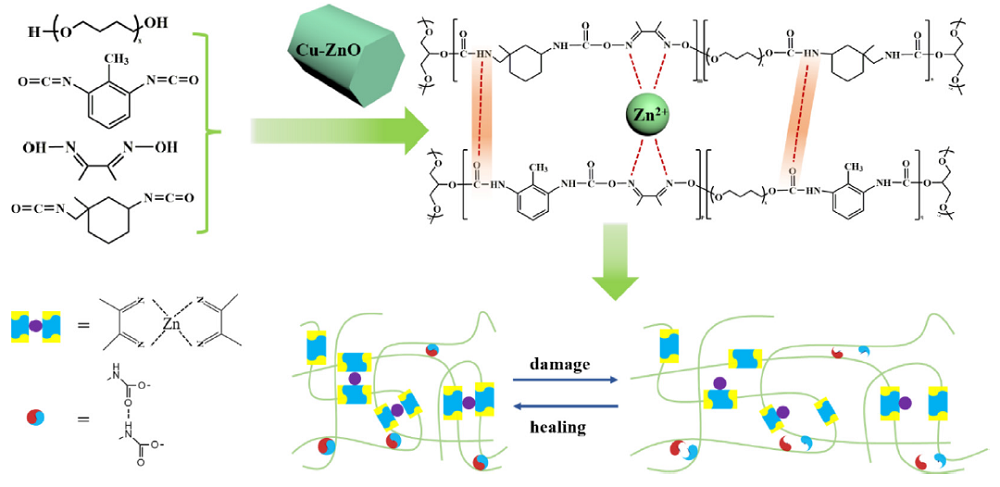
Fig. 1. Illustration of synthesis procedures of the polyurethane and the self-healing mechanism of polyurethane.
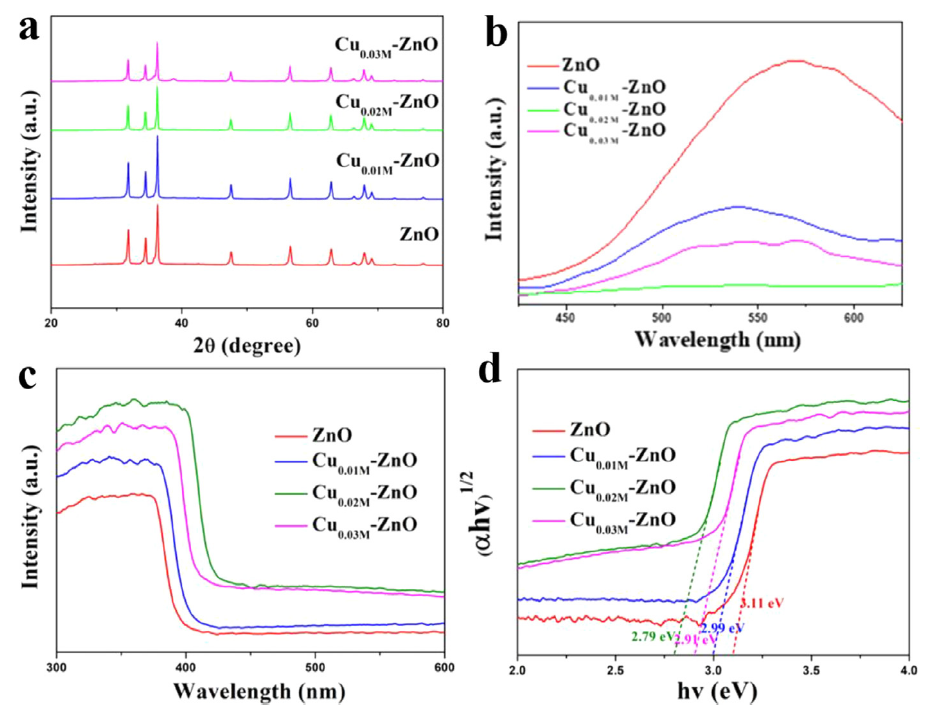
Fig. 2. (a) XRD patterns of ZnO and Cu-ZnO. (b) PL spectrogram of ZnO and Cu-ZnO. (c) UV-vis DRS spectra of ZnO and Cu-ZnO. (d) Kubelka-Munk curve of ZnO and Cu-ZnO.
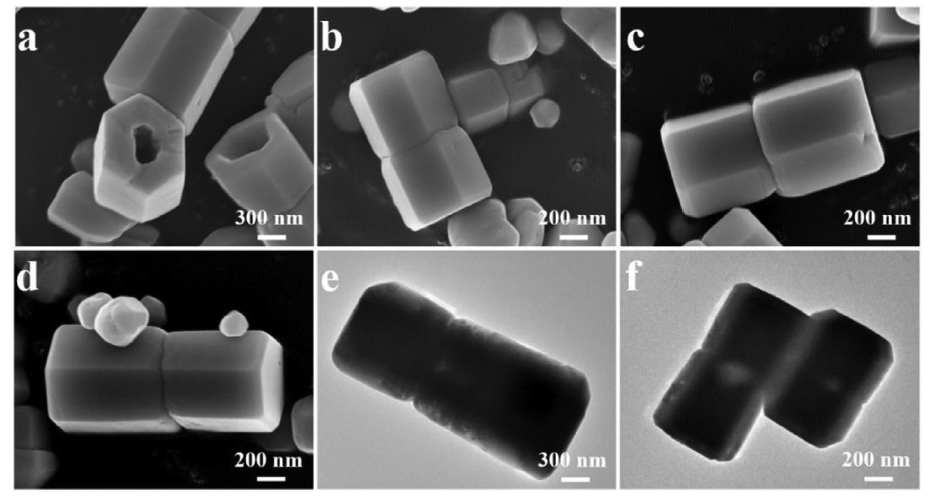
Fig. 3. (a-d) FESEM image of ZnO and Cu-ZnO. (e, f) TEM images of ZnO and Cu0.02M-ZnO.

Fig. 4. (a, b) HRTEM image of Cu0.02M-ZnO. (c) SAED pattern of Cu0.02M-ZnO. (d) Elemental mapping results of Cu0.02M-ZnO.
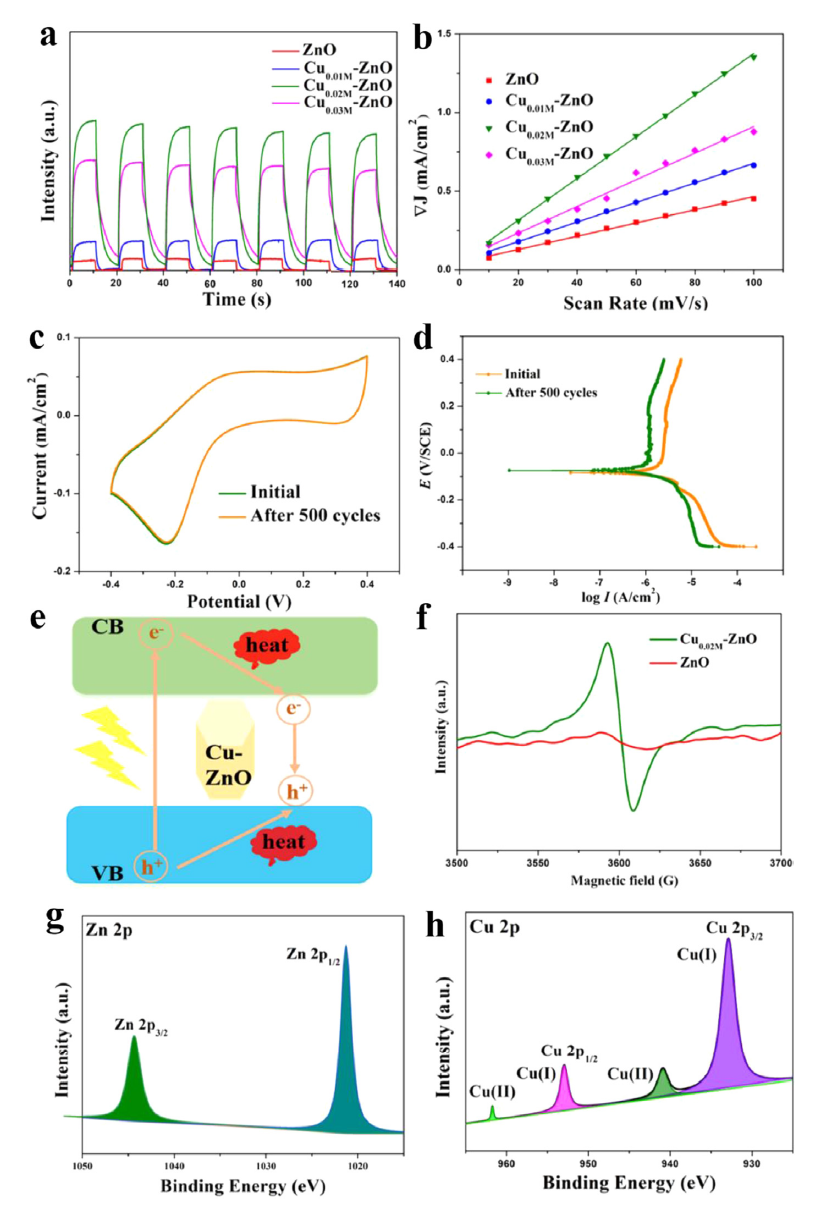
Fig. 5. (a) Transient photocurrent response of ZnO and Cu-ZnO. (b) Charging current density differences plotted against scan rates. The linear slope, equivalent to twice the double-layer capacitance, Cdl, was used to represent the ECSA. (c) Polarization curves for the Cu0.02M-ZnO before and after 500 CV cycles. (d) Polarization curves of Cu0.02M-ZnO. (e) Schematic illustrations of the photothermal mechanism of Cu-ZnO. (f) Oxygen vacancy EPR signals of ZnO and Cu0.02M-ZnO. (g, h) High-resolution XPS spectra of Zn 2p (g) and Cu 2p (h) of Cu0.02M-ZnO.
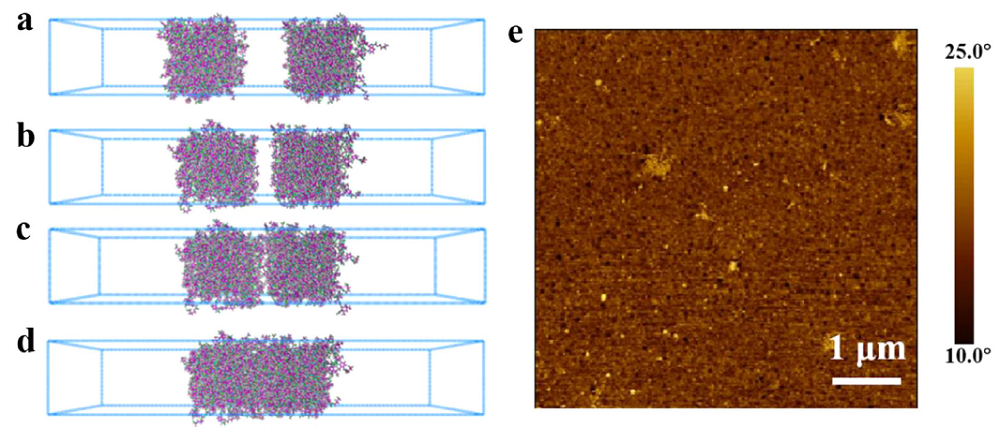
Fig. 6. (a-d) Motion trajectories of PU at 5 ps, 100 ps, 200 ps, and 500 ps. (e) AFM phase images of PU with soft and hard phases.
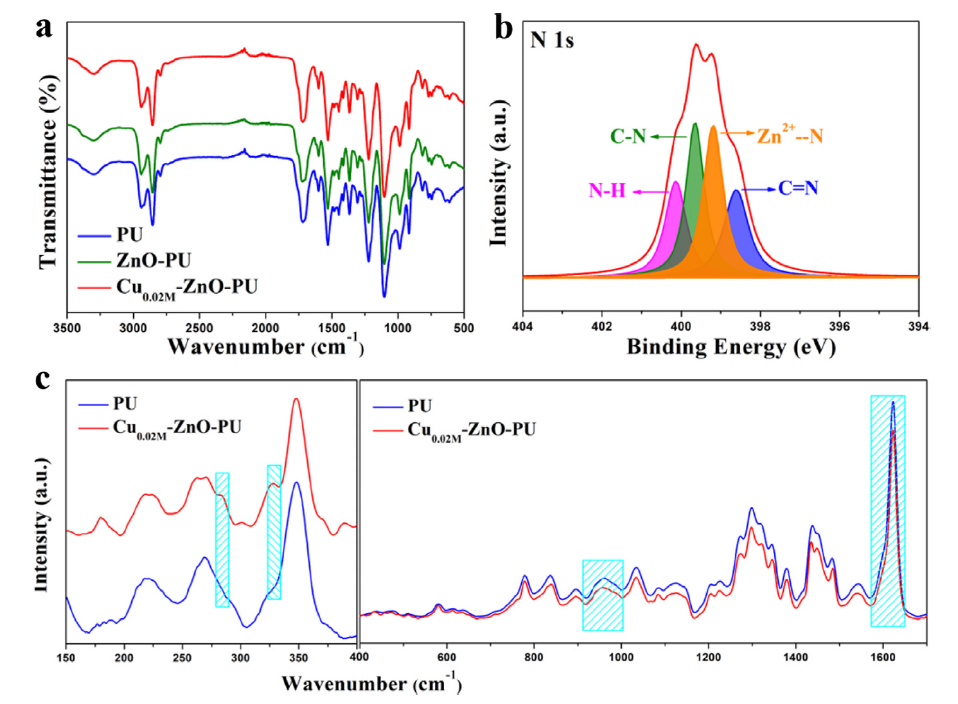
Fig. 7. (a) FT-IR spectra of PU, ZnO-PU and Cu0.02M-ZnO-PU. (b) High-resolution XPS spectra of N 1s of Cu0.02M-ZnO-PU. (c) Raman spectra of PU and Cu0.02M-ZnO-PU samples.
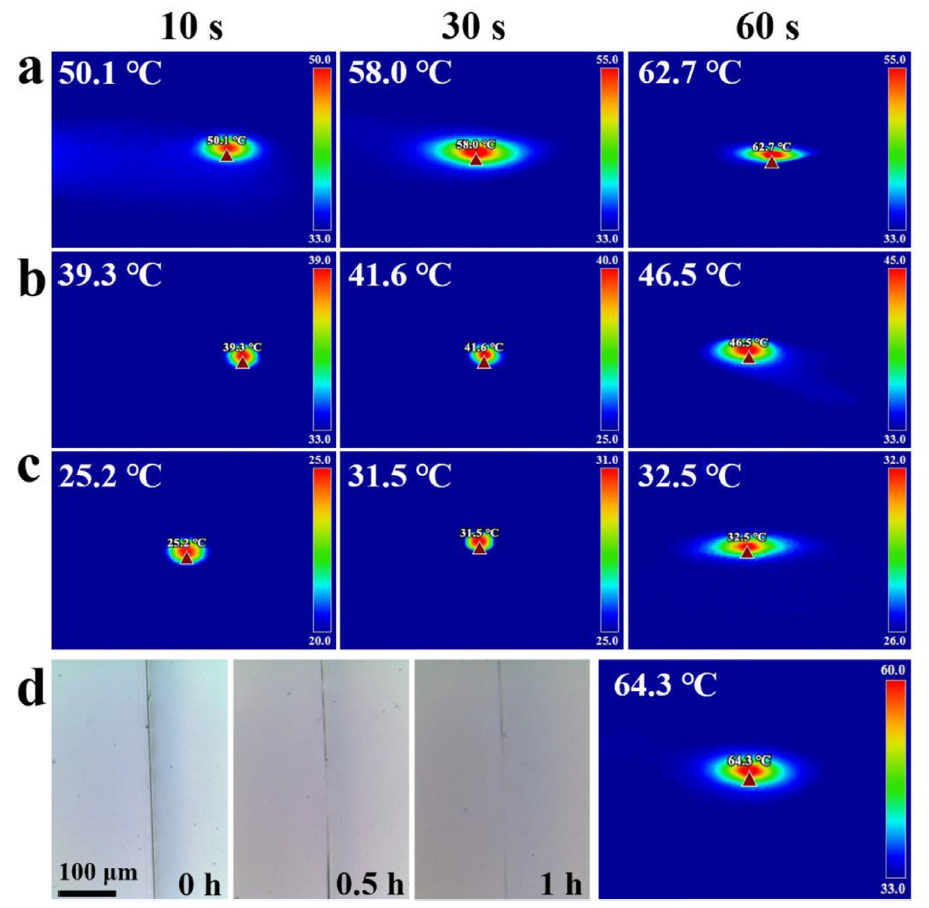
Fig. 8. (a-c) Thermal camera images of PU, ZnO-PU and Cu0.02M-ZnO-PU over different irradiation time intervals at 405 nm. (d) OM images of self-healing process of Cu0.02M-ZnO-PU upon UV irradiation.
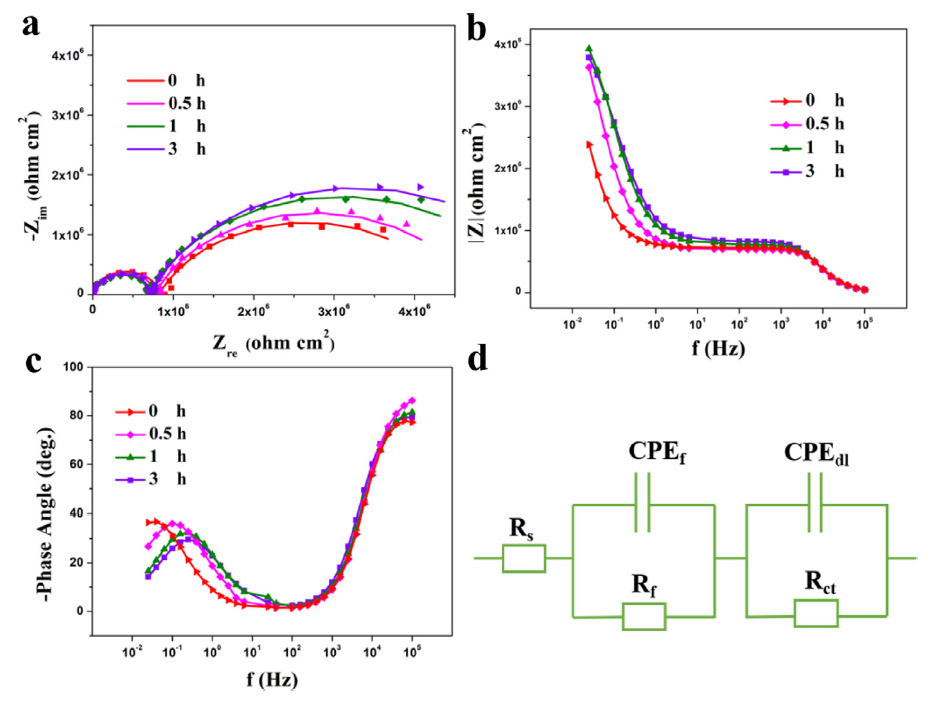
Fig. 9. (a-c) Electrochemical properties of self-healing Cu0.02M-ZnO-PU coating in seawater: (a) Nyquist spectra, (b, c) Bode plots; (d) equivalent circuit models for the samples. The points and lines represent the original experimental data and corresponding fitting, respectively.
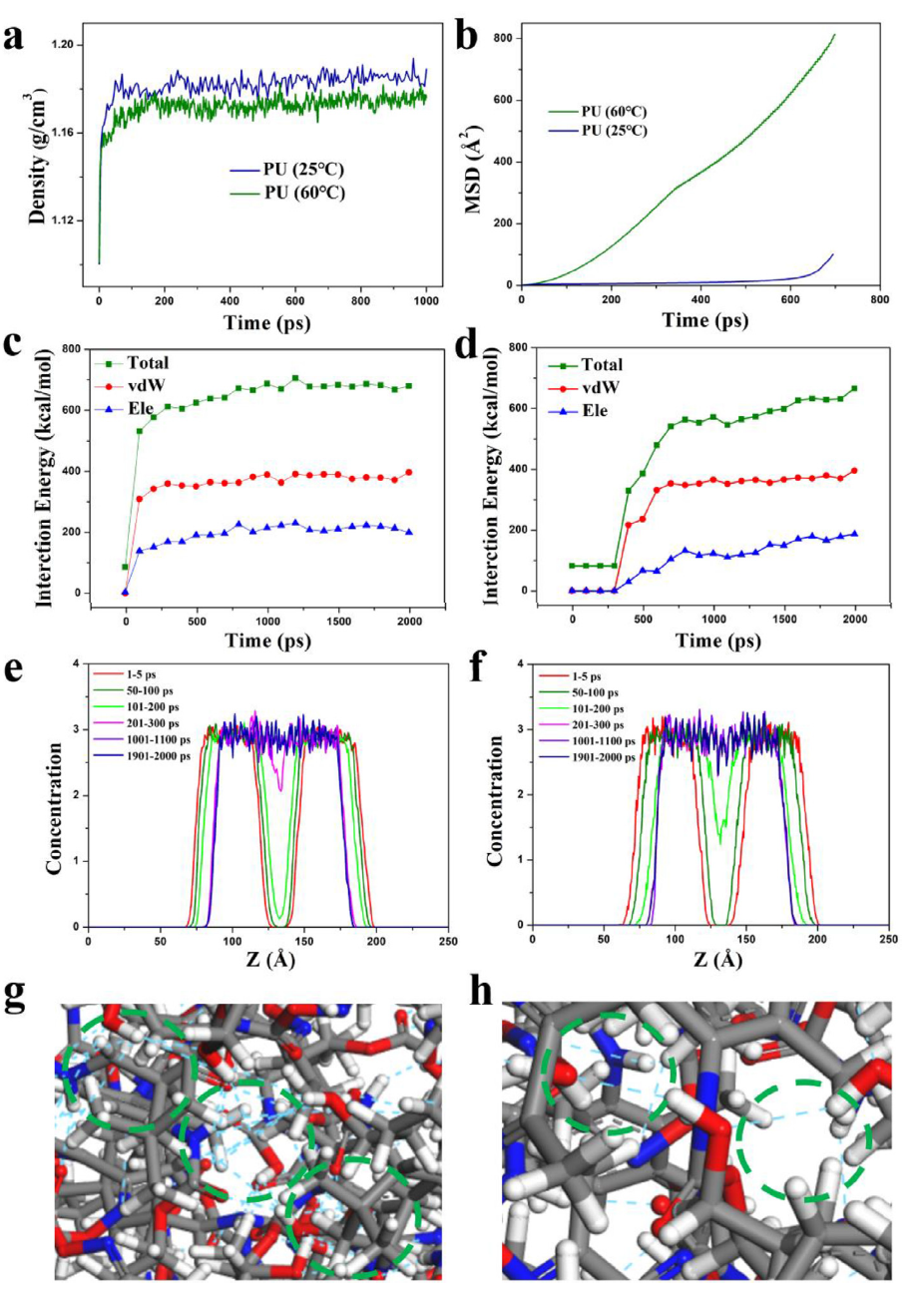
Fig. 10. (a) Time evolution of the densities. (b) MSD curves for PU in the 3D micro-crack models. (c, d) Time evolution of the interaction energies and vdW and electrostatic interaction energies between two parts in PU system at 25 °C (c) and 60 °C (d). (e, f) Relative concentrations of parts in the Z direction of PU system at 25 °C and 60 °C, respectivly. (g, h) Schematic diagrams of hydrogen bonds. The dotted line represents a hydrogen bond.
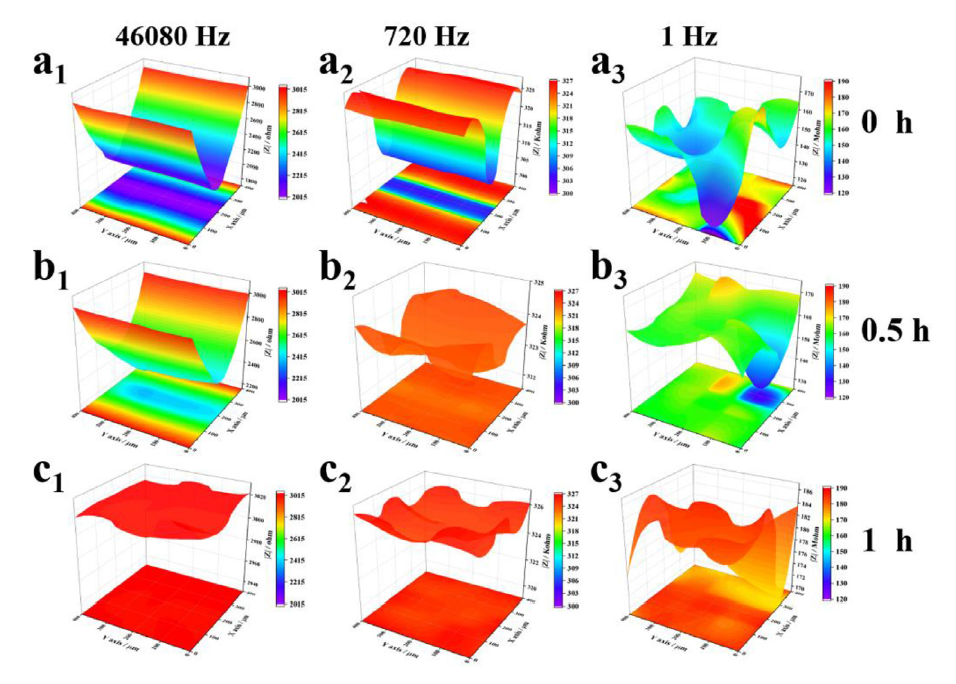
Fig. 11. |Z| images of AC-SECM tests for 0 h (a1, a2, a3), 1 h (b1, b2, b3) and 3 h (c1, c2, c3) immersions at the frequency of 46,080 (a1, b1, c1), 720 (a2, b2, c2), and 1 (a3, b3, c3) Hz, respectively. DC potential: 0 V; amplitude of the AC potential signal: 10 mV; tip diameter: 25 mm; tip-substrate distance: 15 mm; scanning area: 400 μm × 400 μm.
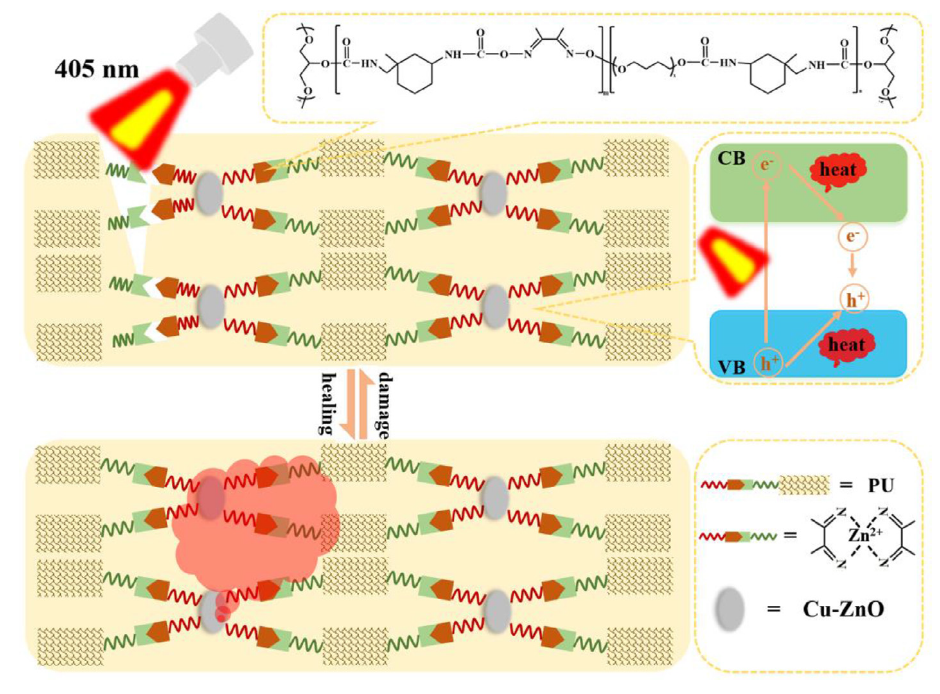
Fig. 12. The photothermal self-healing mechanism of polyurethane.

Fig. 13. The number of S. aureus (a) and P. aeruginosa (c) colonies in LB medium for 18 h containing nothing, PU, and Cu0.02M-ZnO-PU, respectively. The antibacterial rate of PU, and Cu0.02M-ZnO-PU against S. aureus (b) and P. aeruginosa (d), respectively.
| [1] |
Y. Wang, Q. Guo, G. Su, J. Cao, J. Liu, X. Zhang, Adv. Funct. Mater. 29 (2019) 1906198.
DOI URL |
| [2] |
L. Ma, J. Wang, D. Zhang, Y. Huang, L. Huang, P. Wang, H. Qian, X. Li, H.A. Ter- ryn, J.M. Mol, Chem. Eng. J. 404 (2021) 127118.
DOI URL |
| [3] |
L. Huang, J. Li, W. Yuan, X. Liu, Z. Li, Y. Zheng, Y. Liang, S. Zhu, Z. Cui, X. Yang, Corros. Sci. 163 (2020) 108257.
DOI URL |
| [4] |
S.H. Cho, S.R. White, P.V. Braun, Adv. Mater. 21 (2009) 645-649.
DOI URL |
| [5] | H. Ying, Y. Zhang, J. Cheng, Nat. Commun. 5 (2014) 1-9. |
| [6] | R.P. Wool, Soft Matter 4 (2008) 400-418. |
| [7] |
D. Mozhdehi, S. Ayala, J. Am. Chem. Soc. 136 (2014) 16128-16131.
DOI PMID |
| [8] |
D.L. Taylor, M.H. Panhuis, Adv. Mater. 28 (2016) 9060-9093.
DOI URL |
| [9] |
L. Zhang, Z. Liu, X. Wu, Q. Guan, S. Chen, L. Sun, Y. Guo, S. Wang, J. Song, E. M. Jeffries, Adv. Mater. 31 (2019) 1901402.
DOI URL |
| [10] |
S. Wang, M.W. Urban, Nat. Rev. Mater. 5 (2020) 562-583.
DOI URL |
| [11] |
C. Jiang, L. Zhang, Q. Yang, S. Huang, H. Shi, Q. Long, B. Qian, Z. Liu, Q. Guan, M. Liu, Nat. Commun. 12 (2021) 4395.
DOI URL |
| [12] |
M. Nakahata, Y. Takashima, H. Yamaguchi, A. Harada, Nat. Commun. 2 (2011) 511.
DOI PMID |
| [13] |
X. Yang, X. Zhong, J. Zhang, J. Gu, J. Mater. Sci. Technol. 68 (2021) 209-215.
DOI URL |
| [14] |
C. Xiong, M. Li, Q. Han, W. Zhao, L. Dai, Y. Ni, J. Mater. Sci. Technol. 97 (2022) 190-200.
DOI URL |
| [15] |
L. Cao, Z. Gong, C. Liu, J. Fan, Y. Chen, Compos. Sci. Technol. 207 (2021) 108750.
DOI URL |
| [16] | L. Zhang, B. Tang, J. Wu, R. Li, P. Wang, Adv. Mater. 27 (2015) 4 889-4 894. |
| [17] |
D. Weng, F. Xu, X. Li, Y. Li, J. Sun, J. Mater. Chem. A 6 (2018) 24 4 41-24 451.
DOI URL |
| [18] |
J. Yang, T. Wang, R. Guo, D. Yao, W. Guo, S. Liu, Z. Li, Y. Wang, H. Li, ACS Appl. Mater. Interfaces 12 (2020) 54026-54034.
DOI URL |
| [19] |
J. Du, Y. Li, J. Wang, C. Wang, D. Liu, G. Wang, S. Liu, ACS Appl. Mater. Interfaces 12 (2020) 26966-26972.
DOI URL |
| [20] |
X. Qiu, Q. Guo, Y. Wang, X. Huang, J. Cao, Z. Zheng, X. Zhang, ACS Appl. Mater. Interfaces 12 (2020) 41981-41990.
DOI URL |
| [21] | P. Shi, Y. Wang, W.W. Tjiu, C. Zhang, T. Liu, ACS Appl. Mater. Interfaces 13 (2021) 4 9358-4 936 8. |
| [22] |
N. Kouklin, Adv. Mater. 20 (2008) 2190-2194.
DOI URL |
| [23] |
H. Sun, Z. Yang, Y. Pu, W. Dou, C. Wang, W. Wang, X. Hao, S. Chen, Q. Shao, M. Dong, J. Colloid. Interface Sci. 547 (2019) 40-49.
DOI URL |
| [24] | S.J. Pearton, D.P. Norton, F. Ren, Small 3 (2007) 1144-1150. |
| [25] |
Z. Zhang, X. Chen, J. Kang, Z. Yu, J. Tian, Z. Gong, A. Jia, R. You, K. Qian, S. He, Nat. Commun. 12 (2021) 4331.
DOI URL |
| [26] |
R. Chen, F. Luo, Y. Liu, Y. Song, Y. Dong, S. Wu, J. Cao, F. Yang, A. N’Diaye, P. Shafer, Nat. Commun. 12 (2021) 3952.
DOI PMID |
| [27] |
V. Vaiano, G. Iervolino, L. Rizzo, Appl. Catal. B-Environ. 238 (2018) 471-479.
DOI URL |
| [28] | S. Kattel, P.J. Ramírez, J.G. Chen, J.A. Rodriguez, P. Liu, Science 355 (2017) 1296-1299. |
| [29] |
T. Lunkenbein, J. Schumann, M. Behrens, R. Schlögl, M.G. Willinger, Angew. Chem. Int. Ed. 127 (2015) 4627-4631.
DOI URL |
| [30] | G.M. Neelgund, A. Oki, ACS Omega 4 (2019) 5696-5704. |
| [31] | H. Feng, W. Wang, W. Wang, M. Zhang, C. Wang, C. Ma, W. Li, S. Chen, J. Col- loid. Interface Sci. 601 (2021) 531-543. |
| [32] |
Y. Xiang, Q. Zhou, Z. Li, Z. Cui, X. Liu, Y. Liang, S. Zhu, Y. Zheng, K.W.K. Yeung, S. Wu, J. Mater. Sci. Technol. 57 (2020) 1-11.
DOI URL |
| [33] |
T.N.Q. Trang, T.B. Phan, N.D. Nam, V.T.H. Thu, ACS Appl. Mater. Interfaces 12 (2020) 12195-12206.
DOI URL |
| [34] |
F. Zhang, Y.H. Li, M.Y. Qi, Z.R. Tang, Y.J. Xu, Appl. Catal. B-Environ. 268 (2020) 118380.
DOI URL |
| [35] |
X. Long, G. Li, Z. Wang, H. Zhu, T. Zhang, S. Xiao, W. Guo, S. Yang, J. Am. Chem. Soc. 137 (2015) 11900-11903.
DOI PMID |
| [36] | C. Ma, Z. Yang, W. Wang, M. Zhang, X. Hao, S. Zhu, S. Chen, J. Mater. Chem. C 8 (2020) 2888-2898. |
| [37] |
Y. Cheng, Y. Chang, Y. Feng, H. Jian, Z. Tang, H. Zhang, Angew. Chem. Int. Ed. 57 (2018) 246-251.
DOI PMID |
| [38] |
R.A. Li, K. Zhang, G. Chen, B. Su, M. He, Chem. Mater. 33 (2021) 5189-5196.
DOI URL |
| [39] |
J. Xu, W. Chen, C. Wang, M. Zheng, C. Ding, W. Jiang, L. Tan, J. Fu, Chem. Mater. 30 (2018) 6026-6039.
DOI URL |
| [40] |
J. Li, Z. Li, X. Liu, C. Li, Y. Zheng, K.W.K. Yeung, Z. Cui, Y. Liang, S. Zhu, W. Hu, Nat. Commun. 12 (2021) 1224.
DOI URL |
| [41] |
H. Liu, B. Xu, X. Yang, Z. Li, Z. Mo, Y. Yao, S. Lin, Compos. Commun. 19 (2020) 233-238.
DOI URL |
| [42] |
Q. Wang, W. Wang, X. Ji, X. Hao, C. Ma, W. Hao, X. Li, S. Chen, ACS Appl. Mater. Interfaces 13 (2021) 3139-3152.
DOI URL |
| [43] |
W. Fan, Y. Zhang, W. Li, W. Wang, X. Zhao, L. Song, Chem. Eng. J. 368 (2019) 1033-1044.
DOI URL |
| [44] |
X. Chen, J. Zhu, Y. Luo, J. Chen, X. Ma, D. Bukhvalov, H. Liu, M. Zhang, Z. Luo, Phys. Chem. Chem. Phys. 22 (2020) 17620-17631.
DOI URL |
| [45] |
W. Wang, H. Wang, J. Zhao, X. Wang, C. Xiong, L. Song, R. Ding, P. Han, W. Li, Chem. Eng. J. 361 (2019) 792-804.
DOI |
| [1] | Kui Xue, Pei-Hong Tan, Ze-Hui Zhao, Lan-Yue Cui, M Bobby Kannan, Shuo-Qi Li, Cheng-Bao Liu, Yu-Hong Zou, Fen Zhang, Zhuo-Yuan Chen, Rong-Chang Zeng. In vitro degradation and multi-antibacterial mechanisms of β-cyclodextrin@curcumin embodied Mg(OH)2/MAO coating on AZ31 magnesium alloy [J]. J. Mater. Sci. Technol., 2023, 132(0): 179-192. |
| [2] | Yuancheng Lin, Haixin Zhang, Yi Zou, Kunyan Lu, Luohuizi Li, Yan Wu, Jingjing Cheng, Yanxia Zhang, Hong Chen, Qian Yu. Superhydrophobic photothermal coatings based on candle soot for prevention of biofilm formation [J]. J. Mater. Sci. Technol., 2023, 132(0): 18-26. |
| [3] | Fan Wang, Mengyao Wang, Qingsong He, Xuehong Wang, Ping Sun, Yinjun Ji, Yunfei Niu, Fengqian Li, Jie Wei. Black tantalic oxide submicro-particles coating on PEEK fibers woven into fabrics as artificial ligaments with photothermal antibacterial effect and osteogenic activity for promoting ligament-bone healing [J]. J. Mater. Sci. Technol., 2023, 133(0): 195-208. |
| [4] | Yuan Zhang, Shan Fu, Lei Yang, Gaowu Qin, Erlin Zhang. A nano-structured TiO2/CuO/Cu2O coating on Ti-Cu alloy with dual function of antibacterial ability and osteogenic activity [J]. J. Mater. Sci. Technol., 2022, 97(0): 201-212. |
| [5] | Yonghua Sun, Yuyu Zhao, He Zhang, Youjie Rong, Runhua Yao, Yi Zhang, Xiaohong Yao, Ruiqiang Hang. Corrosion behavior, antibacterial ability, and osteogenic activity of Zn-incorporated Ni-Ti-O nanopore layers on NiTi alloy [J]. J. Mater. Sci. Technol., 2022, 97(0): 69-78. |
| [6] | Huihui Bai, Zhixing Zhang, Yajie Huo, Yongtao Shen, Mengmeng Qin, Wei Feng. Tetradic double-network physical crosslinking hydrogels with synergistic high stretchable, self-healing, adhesive, and strain-sensitive properties [J]. J. Mater. Sci. Technol., 2022, 98(0): 169-176. |
| [7] | Jingbo Gao, Yuting Jin, Yongqiang Fan, Dake Xu, Lei Meng, Cong Wang, Yuanping Yu, Deliang Zhang, Fuhui Wang. Fabricating antibacterial CoCrCuFeNi high-entropy alloy via selective laser melting and in-situ alloying [J]. J. Mater. Sci. Technol., 2022, 102(0): 159-165. |
| [8] | Chunbo Wang, Yuqing Liang, Ying Huang, Meng Li, Baolin Guo. Porous photothermal antibacterial antioxidant dual-crosslinked cryogel based on hyaluronic acid/ polydopamine for non-compressible hemostasis and infectious wound repair [J]. J. Mater. Sci. Technol., 2022, 121(0): 207-219. |
| [9] | Chen Ya, Lin Jing, A.M. Mersal Gaber, Zuo Jianliang, Li Jialin, Wang Qiying, Feng Yuhong, Liu Jianwei, Liu Zili, Wang Bin, Bin Xu Ben, Guo Zhanhu. “Several birds with one stone” strategy of pH/thermoresponsive flame-retardant/photothermal bactericidal oil-absorbing material for recovering complex spilled oil [J]. J. Mater. Sci. Technol., 2022, 128(0): 82-97. |
| [10] | Yi Wan, Zihe Zhao, Mingzhi Yu, Zhenbing Ji, Teng Wang, Yukui Cai, Chao Liu, Zhanqiang Liu. Osteogenic and antibacterial ability of micro-nano structures coated with ZnO on Ti-6Al-4V implant fabricated by two-step laser processing [J]. J. Mater. Sci. Technol., 2022, 131(0): 240-252. |
| [11] | Guanpeng Liu, Yulong Li, Ming Yan, Jicai Feng, Jian Cao, Min Lei, Quanwen Liu, Xiaowu Hu, Wenqin Wang, Xuewen Li. Vacuum wetting of Ag/TA2 to develop a novel micron porous Ti with significant biocompatibility and antibacterial activity [J]. J. Mater. Sci. Technol., 2022, 116(0): 180-191. |
| [12] | Inime Ime Udoh, Hongwei Shi, Enobong Felix Daniel, Jianyang Li, Songhua Gu, Fuchun Liu, En-Hou Han. Active anticorrosion and self-healing coatings: A review with focus on multi-action smart coating strategies [J]. J. Mater. Sci. Technol., 2022, 116(0): 224-237. |
| [13] | Guangyu Ren, Lili Huang, Kunling Hu, Tianxin Li, Yiping Lu, Dongxu Qiao, Haitao Zhang, Dake Xu, Tongmin Wang, Tingju Li, Peter K. Liaw. Enhanced antibacterial behavior of a novel Cu-bearing high-entropy alloy [J]. J. Mater. Sci. Technol., 2022, 117(0): 158-166. |
| [14] | Chengxiong Wei, Xin Jin, Chengwei Wu, Wei Zhang. Injectable composite hydrogel based on carbon particles for photothermal therapy of bone tumor and bone regeneration [J]. J. Mater. Sci. Technol., 2022, 118(0): 64-72. |
| [15] | Shan Fu, Yuan Zhang, Yi Yang, Xiaomeng Liu, Xinxin Zhang, Lei Yang, Dake Xu, Fuhui Wang, Gaowu Qin, Erlin Zhang. An antibacterial mechanism of titanium alloy based on micro-area potential difference induced reactive oxygen species [J]. J. Mater. Sci. Technol., 2022, 119(0): 75-86. |
| Viewed | ||||||
|
Full text |
|
|||||
|
Abstract |
|
|||||
 WeChat
