
J. Mater. Sci. Technol. ›› 2023, Vol. 133: 77-88.DOI: 10.1016/j.jmst.2022.05.053
• Research article • Previous Articles Next Articles
Yi Yanga,b,c, Yuxin Qiand, Mingxing Zhangb,c, Shuang Haoa, Hui Wange, Yongqiang Fana,b,*( ), Runhui Liud,f,**(), Dake Xub,c,***(), Fuhui Wangb,c
Received:2022-03-23
Revised:2022-05-05
Accepted:2022-05-06
Published:2022-07-06
Online:2022-07-06
Contact:
Yongqiang Fan,Runhui Liu,Dake Xu
About author:Shenyang National Laboratory for Materials Science, Northeastern Univer- sity, Shenyang, 110819, China. Electrobiomaterials Institute, Key Laboratory for Anisotropy and Texture of Materials, (Ministry of Education), Northeastern Univer- sity, Shenyang, 110819, China. xudake@mail.neu.edu.cn (D. Xu).Yi Yang, Yuxin Qian, Mingxing Zhang, Shuang Hao, Hui Wang, Yongqiang Fan, Runhui Liu, Dake Xu, Fuhui Wang. Host defense peptide-mimicking β-peptide polymer displaying strong antibacterial activity against cariogenic Streptococcus mutans[J]. J. Mater. Sci. Technol., 2023, 133: 77-88.
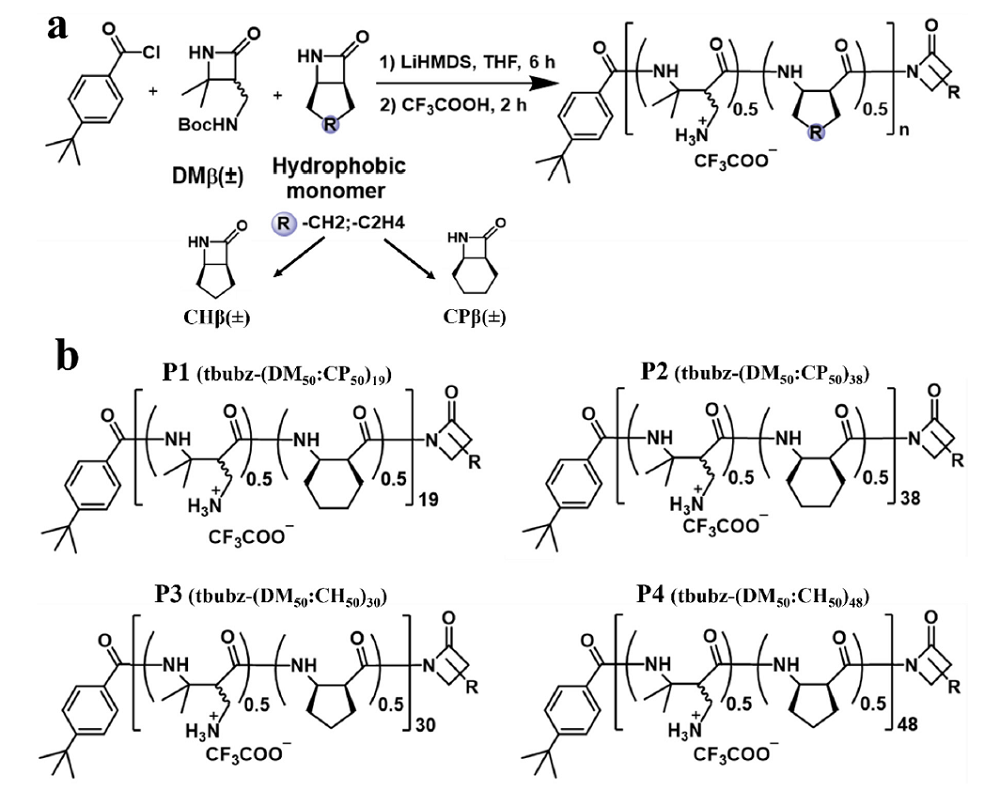
Fig. 1. Synthesis pathway and structures of β-peptide polymers. (a) Synthesis pathway of β-peptide polymer. (b) Molecular structures of β-peptide polymers (P1-P4).
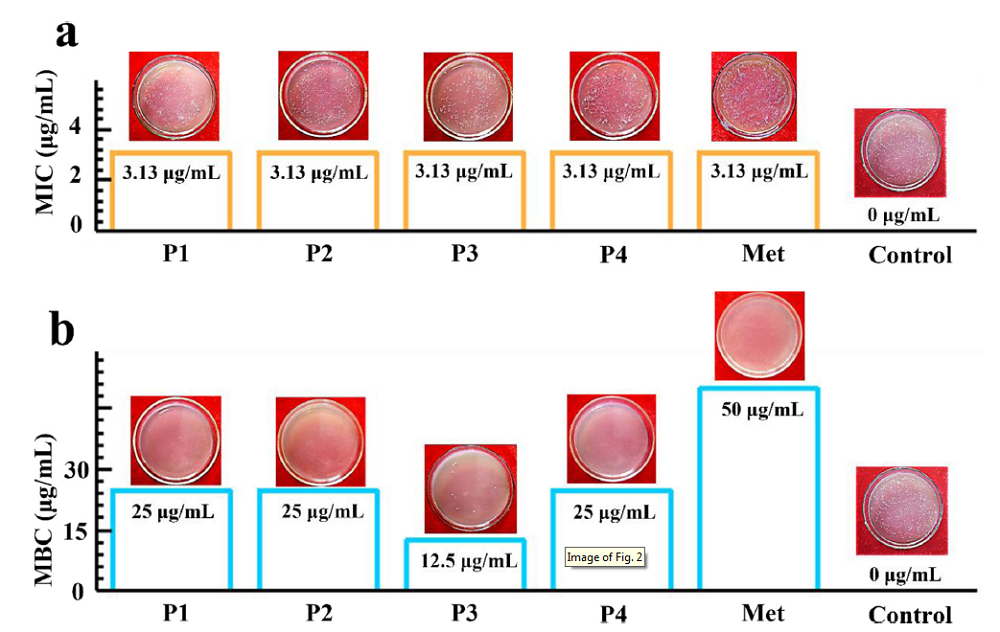
Fig. 2. Antibacterial concentration of these agents. (a) Minimum inhibitory concentration (MIC) and (b) minimum bactericidal concentration (MBC) of β-peptide polymers and metronidazole.
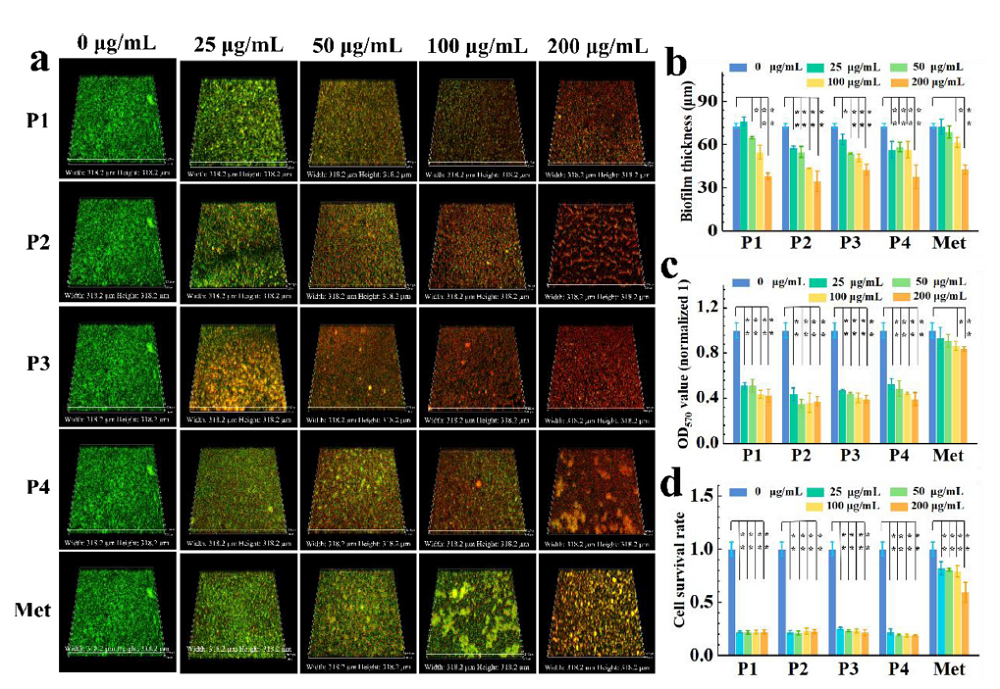
Fig. 3. Inhibition of biofilm-forming tests. (a) CLSM analysis of biofilm after incubated with different concentrations of β-peptide polymers in IB. The live cell was green; the dead cell was red; yellow was the overlap of the live and dead cells. (b) Biofilm thickness measurement in IB. (c) Crystal violet analysis of biofilm in IB. (d) CCK-8 analysis of biofilm in IB. P < 0.05 *, P < 0.01 **.

Fig. 4. Elimination of mature biofilm tests. (a) CLSM analysis of biofilm after incubated with different concentrations of β-peptide polymers in EB. The live cell was green; the dead cell was red cells; yellow was the overlap of the live and dead cells. (b) biofilm thickness measurement in EB. (c) Crystal violet analysis of biofilm in EB. (d) CCK-8 analysis of biofilm in EB. P < 0.05 *, P < 0.01 **.
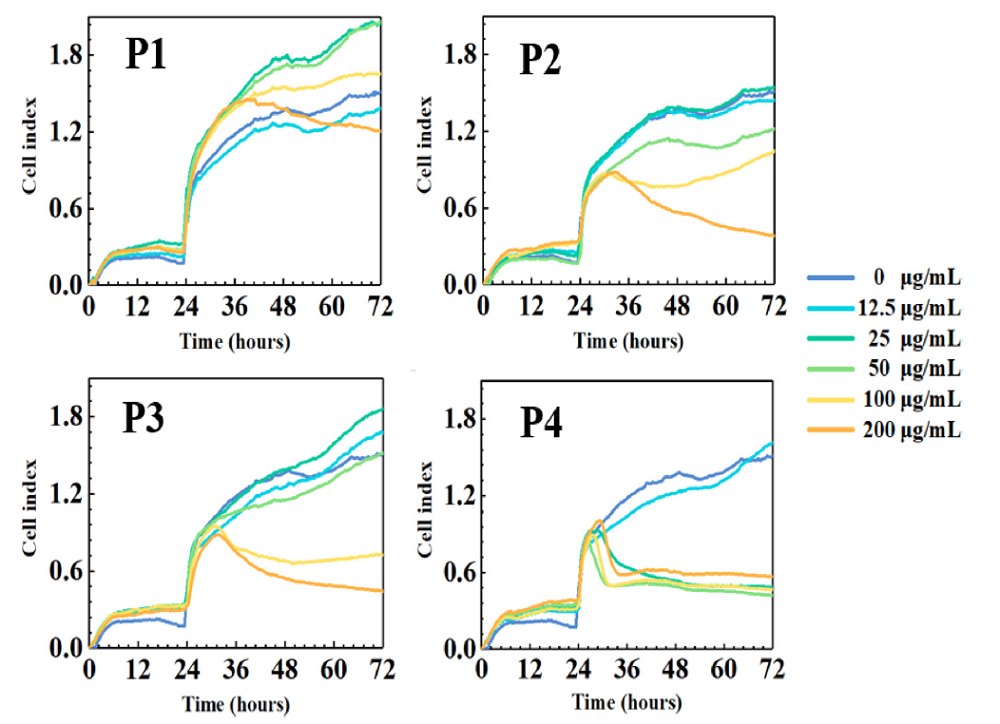
Fig. 5. RTCA analysis of the toxicity of different concentrations of β-peptide polymers on HPLF cells after incubation at 37 °C and 5% CO2 for 72 h.

Fig. 6. Hydrophobicity of planktonic S. mutans after 10 min incubation with different concentrations of antibiotics. P < 0.05 *, P < 0.01 **.
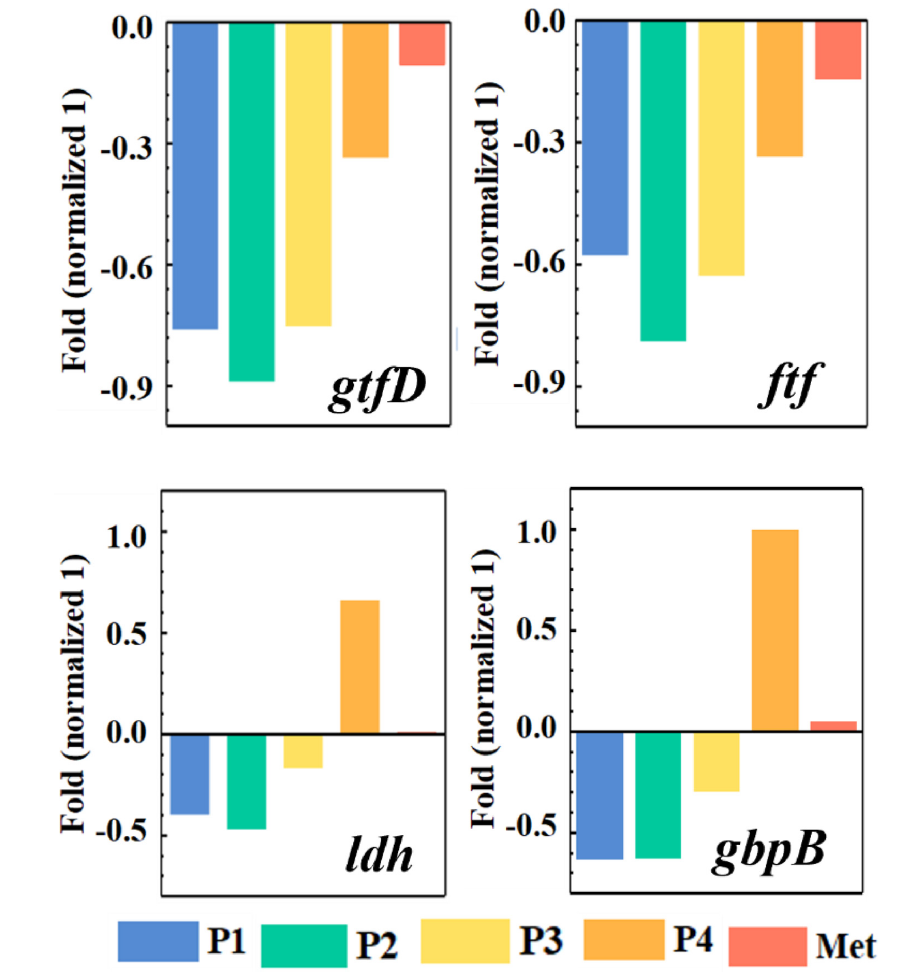
Fig. 7. gtfD, ftf, ldh, and gbpB genes of S. mutans detected by RT-PCR after incubation with 12.5 μg/mL of β-peptide polymers.
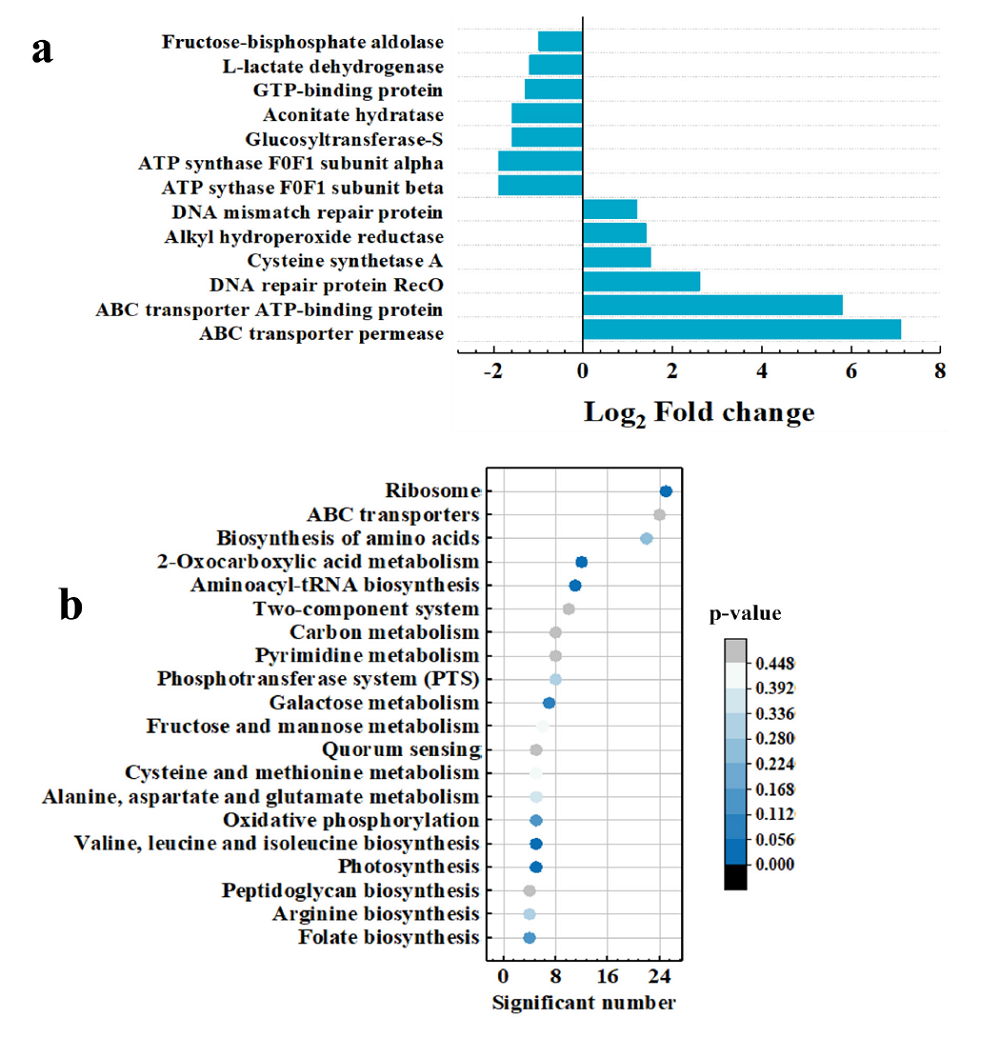
Fig. 8. Transcriptome analysis of S. mutans. (a) Up and down-regulation of transcription level of pathway related to acid-producing and metabolism of S. mutans. (b) Top 20 highest enrichment of significant differently expressed of the pathway of S. mutants.
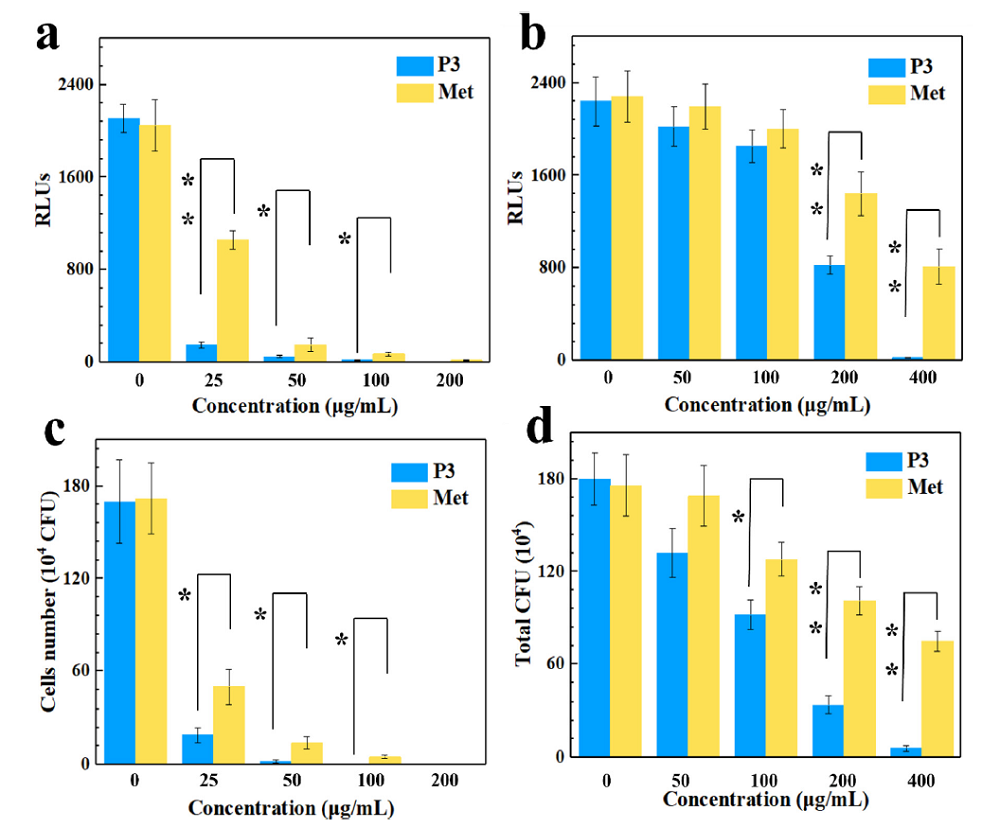
Fig. 9. IB and EB tests of P3 and metronidazole on isolated teeth. ATP fluorescence detection of biofilms on teeth after incubated with different concentrations of P3 and Met in (a) IB test and (b) EB test. Total CFU on teeth after incubation with different concentrations of P3 and Met in (c) IB test and (d) EB test. P < 0.05 *, P < 0.01 **.
| [1] | M.A. Peres, L.M.D. Macpherson, R.J. Weyant, B. Daly, R. Venturelli, M.R. Mathur, S. Listl, R.K. Celeste, C.C. Guarnizo-Herreño, C. Kearns, H. Benzian, P. Allison, R.G. Watt, Lancet 394 (2019) 249-260. |
| [2] | R. Lozano, M. Naghavi, K. Foreman, S. Lim, K. Shibuya, V. Aboyans, et al., Lancet 380 (2012) 2095-2128. |
| [3] |
M. Costalonga, M.C. Herzberg, Immunol. Lett. 162 (2014) 22-38.
DOI PMID |
| [4] |
L. Xiaojing, M.K. Kristin, T. Lief, I. Olsen, Clin. Microbiol. Rev. 13 (20 0 0) 547-558.
DOI URL |
| [5] | A. Mane, A. Karmarkar, R. Bharadwaj, J. Oral Health Community Dent. 3 (2009) 49-51. |
| [6] | D. Kinane, P. Stathopoulou, P. Papapanou, Nat. Rev. Dis. Prim. 3 (2017) 17038. |
| [7] |
A.S. Cousin, P. Bouletreau, J. Giai, B. Ibrahim, A. Louvrier, N. Sigaux, Sci. Rep. 10 (2020) 12015.
DOI URL |
| [8] |
D. Laskin, C. Dent, H. Morris, S. Ochi, J. Olson, Ann. Periodontol. 5 (2001) 166-174.
DOI URL |
| [9] | H.N. Bhargava, P.A. Leonard, Am. J. Infect. Control 24 (1996) 209-218. |
| [10] | F.A. Scannapieco, J. Yu, K. Raghavendran, A. Vacanti, S.I. Owens, K. Wood, J. M. Mylotte, Crit. Care 13 (2009) R117. |
| [11] | M.I. Williams, J. Clin. Dent. 22 (2011) 179-182. |
| [12] |
W.J. Loesche, N. Grossman, J. Giordano, J. Clin. Periodontol. 20 (1993) 96-104.
PMID |
| [13] | M.A. Rose, T. Garcez, S. Savic, L.H. Garvey, Br. J. Anaesth. 123 (2019) e95-e103. |
| [14] | E.A. Kotsailidi, E.M. Kalogirou, D. Michelogiannakis, D. Vlachodimitropoulos, K. I. Tosios,Oral Surg. Oral Med. Oral Pathol. 130 (2020) 156-160. |
| [15] | C.M.J. Potting, R. Uitterhoeve, W.S. Op Reimer, T. Van Achterberg, Eur. J. Cancer Care 15 (2006) 431-439. |
| [16] |
L. Flötr a, P. Gjermo, G. Rölla, J. Waerhaug, Scand. J. Dent. Res. 79 (1971) 119-125.
PMID |
| [17] |
Y. Zou, K.Y. Lu, Y.C. Lin, Y. Wu, Y.R. Wang, L.H. Li, C.B. Huang, Y.X. Zhang, J. L. Brash, H. Chen, Q. Yu, ACS Appl. Mater. Interfaces 13 (2021) 45191-45200.
DOI URL |
| [18] | Y.R. Wang, Y. Zou, Y. Wu, T. Wei, K.Y. Lu, L.H.Z. Li, Y.C. Lin, Y. Wu, C.B. Huang, Y. X. Zhang, H. Chen, Q. Yu, ACS Appl. Mater. Interfaces 13 (2021) 4 8403-4 8413. |
| [19] |
S.B. Chinnaraj, P.G. Jayathilake, J. Dawson, Y. Ammar, J. Portoles, N. Jakubovics, J. Chen, J. Mater. Sci. Technol. 81 (2021) 151-161.
DOI |
| [20] | M. Zasloff, Nature 415 (2002) 389-395. |
| [21] | H.G. Boman, J. Intern. Med. 254 (2003) 197-215. |
| [22] |
R.E.W. Hancock, M.A. Alford, E.F. Haney, Nat. Rev. Microbiol. 19 (2021) 786-797.
DOI PMID |
| [23] |
M.A. Gelman, B. Weisblum, D.M. Lynn, S.H. Gellman, Org. Lett. 6 (2004) 557-560.
DOI URL |
| [24] |
R. Liu, J.M. Suarez, B. Weisblum, S.H. Gellman, S.M. Mcbride, J. Am. Chem. Soc. 136 (2014) 14498.
DOI URL |
| [25] | A.C. Engler, N. Wiradharma, Z.Y. Ong, D.J. Coady, J.L. Hedrick, Y.Y. Yang, Nano Today 7 (2012) 201-222. |
| [26] |
Q. Zhang, P.C. Ma, J.Y. Xie, S. Zhang, X.M. Xiao, Z.Q. Qiao, N. Shao, M. Zhou, W.J. Zhang, C.Z. Dai, Y.X. Qian, F. Qi, R.H. Liu, Biomater. Sci. 7 (2019) 2144.
DOI URL |
| [27] | Y.C. Yang, Z.G. Cai, Z.H. Huang, X.Y. Tang, X. Zhang, Polym. J. 50 (2018) 33-44. |
| [28] |
R. Liu, X. Chen, S.P. Falk, K.S. Masters, B. Weisblum, S.H. Gellman, J. Am. Chem. Soc. 137 (2015) 2183-2186.
DOI URL |
| [29] |
R. Liu, X. Chen, Z. Hayouka, S. Chakraborty, S.P. Falk, B. Weisblum, K.S. Masters, S.H. Gellman, J. Am. Chem. Soc. 135 (2013) 5270-5273.
DOI URL |
| [30] |
R. Liu, X. Chen, S.P. Falk, B.P. Mowery, A.J. Karlsson, B. Weisblum, S.P. Palecek, K.S. Masters, S.H. Gellman, J. Am. Chem. Soc. 136 (2014) 4333-4342.
DOI URL |
| [31] |
J.A. Banas, Front. Biosci. 9 (2004) 1267-1277.
DOI URL |
| [32] |
J. Zhang, D. Kissounko, S. Lee, S. Gellman, S. Stahl, J. Am. Chem. Soc. 131 (2009) 1589-1597.
DOI URL |
| [33] |
V. Nadithe, R. Liu, B. Killinger, S. Movassaghian, N. Kim, A. Moszczynska, K. Masters, S. Gellman, O. Merkel, Mol. Pharm. 12 (2014) 362-374.
DOI URL |
| [34] | J.Y. Gal, Y. Fovet, M. Adib-Yadzi, Talanta 53 (2001) 1103-1115. |
| [35] | X.H. Yang, Y.P. Zhong, D. Wang, Z.T. Lu, Anal. Methods 13 (2021) 5211-5215. |
| [36] | S. Stepanovic, D. Vukovic, I. Dakic, B. Savic, M. Svabic-Vlahovic, J. Microbiol. Methods 40 (20 0 0) 175-179. |
| [37] | Z. Teng, X.Z. Kuang, J.Y. Wang, X. Zhang, J. Virol. Methods 193 (2013) 364-370. |
| [38] |
M. Rosenberg, FEMS Microbiol. Lett. 22 (1984) 289-295.
DOI URL |
| [39] | H. Liu, T.L. Shen, X.K. Li, H.C. Fu, J.L. Dai, Chin. J. Appl. Biol. 17 (2011) 918-922. |
| [40] |
Z.Y. He, Z.W. Huang, W. Jiang, W. Zhou, Front. Microbiol. 10 (2019) 2241.
DOI URL |
| [41] | S.M. Zhang, J. Qiu, Y.F. Ren, W.Q. Yu, F.Q. Zhang, X.X. Liu, J. Mater. Sci.: Mater. Med. 27 (2016) 78. |
| [42] | K.J. Livak, T.D. Schmittgen, Methods 25 (2001) 402-408. |
| [43] |
D.Q. Sun, H.F. Li, D.W. Song, L.P. Zhang, X. Zhao, X.X. Xu, Biochem. Biophys. Res. Commun. 519 (2019) 351-357.
DOI URL |
| [44] |
B.P. Mowery, A.H. Lindner, B. Weisblum, S.S. Stahl, S.H. Gellman, J. Am. Chem. Soc. 131 (2009) 9735.
DOI URL |
| [45] | E. Fernández, F. Lombó, C. Méndez, J.A. Salas, Mol. Gen. Genet. 251 (1996) 692-698. |
| [46] |
J.F. Collet, S.H. Cho, B.I. Iorga, C.V. Goemans, J. Biol. Chem. 295 (2020) 11984-11994.
DOI URL |
| [47] | M. Higuchi, Y. Yamamoto, Y. Kamio, J. Biosci. Bioeng. 90 (20 0 0) 4 84-4 93. |
| [48] |
D. Slade, M. Radman, Microbiol. Mol. Biol. Rev. 75 (2011) 133-191.
DOI URL |
| [49] | Z. Ahmad, Faseb J. 29 (2015) 14. |
| [50] | PATHWAY KEGG. 020. |
| [51] |
Z. Yan, M. Pijuan, A. Oehmen, Z.G. Yuan, Water Sci. Technol. 61 (2010) 1653-1662.
DOI URL |
| [52] |
C. Dawes, A.M.L. Pedersen, A. Villa, J. Ekstrom, G.B. Proctor, A. Vissink, D. Aframian, R. McGowan, A. Aliko, N. Narayana, Y.W. Sia, R.K. Joshi, S.B. Jensen, A.R. Kerr, A. Wolff, Arch. Oral Biol. 60 (2015) 863-874.
DOI PMID |
| [1] | Chengzhi Dai, Min Zhou, Weinan Jiang, Ximian Xiao, Jingcheng Zou, Yuxin Qian, Zihao Cong, Zhemin Ji, Longqiang Liu, Jiayang Xie, Zhongqian Qiao, Runhui Liu. Breaking or following the membrane-targeting mechanism: Exploring the antibacterial mechanism of host defense peptide mimicking poly(2-oxazoline)s [J]. J. Mater. Sci. Technol., 2020, 59(0): 220-226. |
| Viewed | ||||||
|
Full text |
|
|||||
|
Abstract |
|
|||||
 WeChat
