
J. Mater. Sci. Technol. ›› 2022, Vol. 101: 95-106.DOI: 10.1016/j.jmst.2021.05.063
• Research Article • Previous Articles Next Articles
Libo Fua, Deli Konga, Chengpeng Yanga, Jiao Tengb, Yan Lua, Yizhong Guoa, Guo Yanga, Xin Yanc,*( ), Pan Liud, Mingwei Chene, Ze Zhangf, Lihua Wanga,*(), Xiaodong Hana,*()
Received:2021-03-20
Revised:2021-03-02
Accepted:2021-03-05
Published:2022-02-28
Online:2021-08-06
Contact:
Xin Yan,Lihua Wang,Xiaodong Han
About author:xdhan@bjut.edu.cn (X. Han).Libo Fu, Deli Kong, Chengpeng Yang, Jiao Teng, Yan Lu, Yizhong Guo, Guo Yang, Xin Yan, Pan Liu, Mingwei Chen, Ze Zhang, Lihua Wang, Xiaodong Han. Ultra-high strength yet superplasticity in a hetero-grain-sized nanocrystalline Au nanowire[J]. J. Mater. Sci. Technol., 2022, 101: 95-106.

Fig. 1. Ultra-high plasticity of a hetero-grain-sized nanocrystalline Au NW. (a-f) Series of TEM images showing the tensile deformation of the Au NW. The references are indicated by short red lines. The symbol ε represents the total strain during each tensile stage. The scale bar is 5 nm. (g) Grain size distribution of the hetero-grain-sized Au NW. (h) Curve of elongation strain vs. diameter reduction.

Fig. 2. GB migration-induced grain growth in a hetero-grain-sized nanocrystalline Au NW. (a, b) HRTEM images showing grain boundary plasticity leading to grain growth in the heterogeneous- structured nanocrystalline Au NW subjected to strain. The scale bar is 5nm. (c-f) Enlarged HRTEM images of the white framed regions in (a) and (b) show the GB migration and grain growth more clearly. The scale bar is 2 nm.
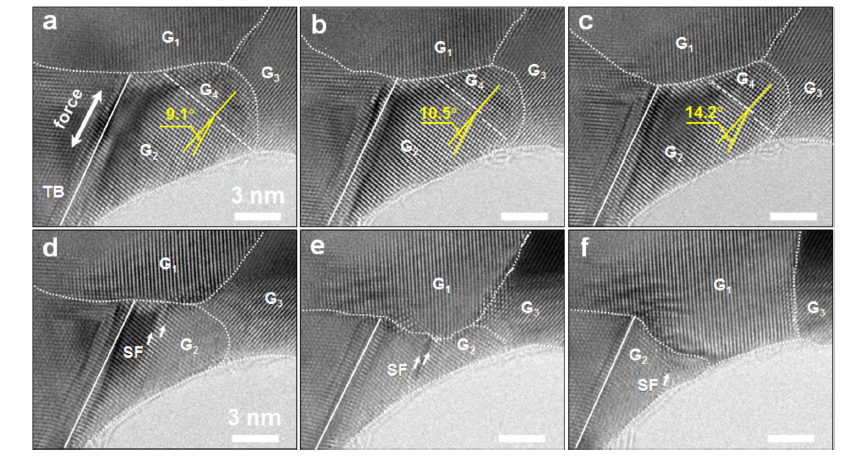
Fig. 3. (a) Four grains labeled G1-G4. Their GBs are indicated by a white dotted line. (b, c) With further loading, the orientation angle between G2 and G4 increased from ~9.1° to ~ 14.2°. Simultaneously, the GB also migrated. (d-f) Movement of the GB of G1-2 toward the surface of the NW, GBs of G2-3 and G1-3 simultaneously changed dramatically.

Fig. 4. In situ atomic-scale observation of full dislocation activities in a large grain. (a) Full dislocation D1 (labeled “T”) with a Burgers vector of $b=\frac{1}{2}[011](11\bar{1})$ was observed in the large grain. (b) With continued strain, two full dislocations, D2 and D3, nucleated near D1. (c) With further loading, D3 disappeared and a new dislocation, D4, nucleated. (d) With further loading, D2 disappeared and a new dislocation, D5, nucleated. (e-h) Enlarged HRTEM images corresponding to the red-framed regions in (a-d). These are in situ atomic-scale observation of the LD lock generation and destruction processes.

Fig. 5. In situ atomic-scale observation of full dislocation activities in a large grain near the NW surface. (a-c) Three HRTEM images captured ~1 s apart showing full dislocation activities: nucleation and a slide toward the surface. (d-f) Another typical example of dislocation. The dislocation labeled D8 remained in the same region and another full dislocation, D9, slipped toward the surface and disappeared.

Fig. 6. (a) Statistical data of dislocation density vs. uniform elongation. At first, dislocation density increased as the strain increased. Then it remained high as deformation continued. (b) Statistical data show the proportion of full dislocations, partial dislocations resulting in stacking faults, and dislocation locks at different strains.

Fig. 7. In situ atomic-scale observation of surface diffusion during tensile deformation of a hetero-grain-sized NW. The surface of the NW displayed steps with different lengths and heights. The steps are indicated by the white zigzag line, and each step's length is represented numerically. During straining, diffusion of the surface atoms led to changes in the lengths and heights of the steps.

Fig. 12. (a) Statistical data for elastic strain and stress vs. uniform elongation. (b) Properties (elongation and the product of strength and ductility) of heterogeneously structured nanocrystalline Au NW compared with those of other high-performing materials, including different metals and alloys. The materials represented by the statistical data are divided into nine categories [2,3,[7], [8],[10], [11], [12], [13], [14], [15], [16], [17], [18], [19], [20], [21], [22], [23], [24],[30], [31], [32], [33], [34], [35],[55], [56], [57], [58], [59], [60], [61], [62], [63], [64], [65], [66], [67], [68], [69], [70], [71], [72], [73], [74], [75], [76], [77], [78], [79]]: Metallic NWs (dark yellow), GNS Metals (red), Entropy Alloys (wine), BCC Metals (orange), Steels (olive), Al/Al Alloys (blue), Cu/Cu Alloys (magenta), HCP Metals (black), and This Work (stars).

Fig. 8. Tensile deformation of a heterogeneously structured nanocrystalline Au sample in a MD simulation. MD result of the sample subjected to a tensile strain of 0 to ~29.6%. The nanocrystalline structure was subjected to tension. Small grains tended to fuse via GB plastic deformation to form large grains.

Fig. 9. Typical example of GB migration promoting grain growth in small grains in the MD simulation.

Fig. 10. Dynamic grain growth is dominated by GB migration and grain rotation. The GB position is indicated by the red dotted line. The grain boundary angles G1-4 and G4-5 decreased from 14° to 8.7° and from 16° to 5.5°, respectively.
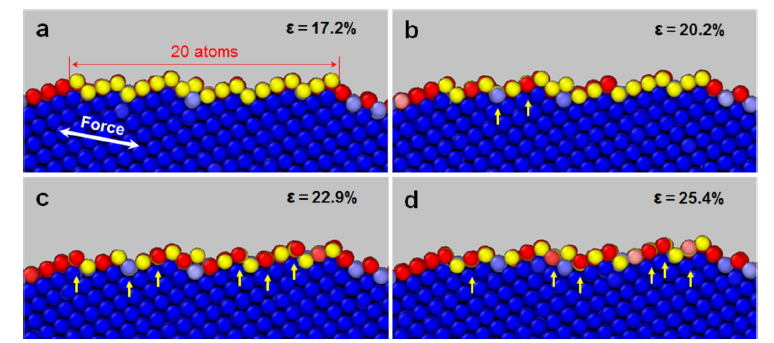
Fig. 11. Typical example showing surface diffusion both parallel to and vertical to the tensile direction.
| [1] | S. Yip, Nature 391 (1998) 532-533. |
| [2] | I.A. Ovid’ko, R.Z. Valiev, Y.T. Zhu, Prog. Mater. Sci. 94 (2018) 462-540. |
| [3] | Y. Cao, S. Ni, X.Z. Liao, M. Song, Y.T. Zhu, Mater. Sci. Eng. R 133 (2018) 1-59. |
| [4] | Q. Zhu, G. Cao, J.W. Wang, C. Deng, J.X. Li, Z. Zhang, S.X. Mao, Nat. Commun. 10 (2019) 156. |
| [5] | L. Zhong, F. Sansoz, Y. He, C. Wang, Z. Zhang, S.X. Mao, Nat. Mater. 16 (2017) 439-445. |
| [6] | S.C. Zhao, Q. Zhu, X.H. An, H. Wei, K.X. Song, S.X. Mao, J.W. Wang, J. Mater. Sci. Technol. 53 (2020) 118-125. |
| [7] | S.J. Hao, L.S. Cui, D.Q. Jiang, X.D. Han, Y. Ren, J. Jiang, Y.N. Liu, Z.Y. Liu, S.C. Mao, Y.D. Wang, Y. Li, X.B. Ren, X.D. Ding, S. Wang, C. Yu, X.B. Shi, M.S. Du, F. Yang, Y.J. Zheng, Z. Zhang, X.D. Li, D.E. Brown, J. Li, Science 339 (2013) 1191-1194. |
| [8] | S.D. Sun, D.L. Kong, D.H. Li, X.Z. Liao, D.M. Liu, S. Mao, Z. Zhang, L.H. Wang, X.D. Han, ACS Nano 13 (2019) 8708-8716. |
| [9] | H. Zheng, A.J. Cao, C.R. Weinberger, J.Y. Huang, K. Du, J.B. Wang, Y.Y. Ma, Y.N. Xia, S.X. Mao, Nat. Commun. 1 (2010) 144. |
| [10] | Y. Lu, J. Song, J.Y. Huang, J. Lou, Adv. Funct. Mater. 21 (2011) 3982-3989. |
| [11] | J.W. Wang, Z. Zeng, C.R. Weinberger, Z. Zhang, T. Zhu, S.X. Mao, Nat. Mater. 14 (2015) 594-600. |
| [12] | C. Deng, F. Sansoz, ACS Nano 3 (2009) 3001-3008. |
| [13] | Z.X. Wu, Y.W. Zhang, M.H. Jhon, J.R. Greer, D.J. Srolovitz, Acta Mater. 61 (2013) 1831-1842. |
| [14] | Y. Lu, C. Peng, Y. Ganesan, J.Y. Huang, J. Lou, Nanotechnology 22 (2011) 355702. |
| [15] | C. Deng, F. Sansoz, Nano Lett. 9 (2009) 1517-1522. |
| [16] | K. Cao, Y. Han, H. Zhang, L. Gao, Y. Lu, Nanotechnology 29 (2018) 295703. |
| [17] | Y.T. Zhu, K. Ameyama, P.M. Anderson, I.J. Beyerlein, H.J. Gao, H.S. Kim, E. Lav- ernia, S. Mathaudhu, H. Mughrabi, R.O. Ritchie, N. Tsuji, X.Y. Zhang, X.L. Wu, Mater. Res. Lett. 9 (2021) 1-31. |
| [18] | E. Ma, T. Zhu, Mater. Today 20 (2017) 323-331. |
| [19] | J.R. Greer, J.T.M. De Hosson, Prog. Mater. Sci. 56 (2011) 654-724. |
| [20] | X.L. Wu, P. Jiang, L. Chen, F.P. Yuan, Y.T. Zhu, Proc. Natl. Acad. Sci. USA 111 (2014) 7197-7201. |
| [21] | Y. Wei, Y. Li, L. Zhu, Y. Liu, X. Lei, G. Wang, Y. Wu, Z. Mi, J. Liu, H. Wang, H. Gao, Nat. Commun. 5 (2014) 3580. |
| [22] | T.H. Fang, W.L. Li, N.R. Tao, K. Lu, Science 331 (2011) 1587-1590. |
| [23] | P.H. Cao, Nano Lett. 20 (2020) 1440-1446. |
| [24] | Z. Cheng, H.F. Zhou, Q.H. Lu, H.J. Gao, L. Lu, Science 362 (2018) 559-567. |
| [25] | K. Lu, Science 345 (2014) 1455-1456. |
| [26] | J. Schiotz, K.W. Jacobson, Science 301 (2003) 1357-1359. |
| [27] | T.J. Rupert, D.S. Gianola, Y. Gan, K.J. Hemker, Science 326 (2009) 1686-1690. |
| [28] | P. Hidalgo-Manrique, A. Orozco-Caballero, C.M. Cepeda-Jiménez, O.A. Ruano, F. Carreño, J. Mater. Sci. Technol. 32 (2016) 774-782. |
| [29] | H. Masuda, T. Kanazawa, H. Tobe, E. Sato, Scr. Mater. 149 (2018) 84-87. |
| [30] | J.W. Liang, Y.F. Shen, R.D.K. Misra, P.K. Liaw, J. Mater. Sci. Technol. 83 (2021) 131-144. |
| [31] | J.H. Seo, Y. Yoo, N.Y. Park, S.W. Yoon, H. Lee, S. Han, S.W. Lee, T.Y. Seong, S.C. Lee, K. Lee, P.R. Cha, H.S. Park, B. Kim, J.P. Ahn, Nano Lett. 11 (2011) 3499-3502. |
| [32] | D.C. Jang, X.Y. Li, H.J. Gao, J.R. Greer, Nat. Nanotechnology 7 (2012) 594-601. |
| [33] | F. Sansoz, V. Dupont, Scr. Mater. 63 (2010) 1136-1139. |
| [34] | Y. Zhu, Z. Li, M. Huang, Scr. Mater. 68 (2013) 663-666. |
| [35] | W.W. Tao, P.K. Cao, H.S. Park, Nano Lett. 18 (2018) 1296-1304. |
| [36] | L.H. Wang, J. Teng, X.C. Sha, J. Zou, Z. Zhang, X.D. Han, Nano Lett 17 (2017) 4733-4739. |
| [37] | D. Li, X. Shu, D. Kong, H. Zhou, Y. Chen, J. Mater. Sci. Technol. 34 (2018) 2027-2034. |
| [38] | L. Sun, F. Banhart, A.V. Krasheninnikov, J.A. Rodríguez-Manzo, M. Terrones, P.M. Ajayan, Science 312 (2006) 1199-1202. |
| [39] | S. Plimpton, J. Comput. Phys. 117 (1995) 1-19. |
| [40] | G. Grochola, S.P. Russo, I.K. Snook, J. Chem. Phys. 123 (2005) 204719. |
| [41] | X. Li, Y. Wei, W. Yang, H. Gao, Proc. Natl. Acad. Sci. USA 106 (2009) 16108-16113. |
| [42] | A. Stukowski, Model. Simul. Mater. Sci. Eng. 18 (2010) 1. |
| [43] | Z.Q. Fu, L. Jiang, J.L. Wardini, B.E. Macdonald, H.M. Wen, W. Xiong, D.L. Zhang, Y.Z. Zhou, T.J. Rupert, W.P. Chen, E.J. Lavernia, Sci. Adv. 4 (2018) eaat8712. |
| [44] | Y. Zhang, N.R. Tao, K. Lu, Acta Mater. 59 (2011) 6048-6058. |
| [45] | B. Chen, J.N. Hu, Y.Q. Wang, S.Y. Zhang, S.V. Petegem, A.C.F. Cocks, D.J. Smith, P.E.J. Flewitt, Acta Mater. 85 (2015) 229-242. |
| [46] | J.P. Hirth, J. Lothe, Theory of Dislocations, 2nd ed., Krieger Publishing, Malabar, UK, 1992. |
| [47] | L. Wang, X. Han, P. Liu, Y. Yue, E. Ma, Phys. Rev. Lett. 105 (2010) 135501. |
| [48] | R. Yuan, I.J. Beyerlein, C. Zhou, ActaMater. 90 (2015)169-181. |
| [49] | C.R. Weinberger, W. Cai, Proc. Natl. Acad. Sci. USA 105 (2008) 14304-14307. |
| [50] | C.Z. Zhou, I.J. Beyerlein, R. Lesar, ActaMater. 59 (2011)7673-7682. |
| [51] | M. Yaghoobi, G.Z. Voyiadjis, Acta Mater. 121 (2016) 190-201. |
| [52] | W.D. Nix, Metall. Trans. A 20 (1989) 2217-2245. |
| [53] | H.D. Espinosa, B.C. Prorok, B. Peng, J.Mech.Phys. Solids 52 (2004)667-689. |
| [54] | Y.J. Chen, Q. Gao, Y.B. Wang, X.H. An, X.Z. Liao, Y.W. Mai, H.H. Tan, J. Zou, S.P. Ringer, C. Jagadish, Nano Lett. 15 (2015) 5279-5283. |
| [55] | K. Aaron, B. Thorsten, K. Tobias, P. Robby, Acta Mater. 92 (2015) 299-308. |
| [56] | J.W. Wang, F. Sansoz, C. Deng, G. Xu, G.R. Han, S.X. Mao, Nano Lett. 15 (2015) 3865-3870. |
| [57] | C. Ni, Q. Zhu, J. Wang, Mater. Sci. Eng. A 733 (2018) 164-169. |
| [58] | Z. Wu, Y.W. Zhang, M.H. Jhon, H.J. Gao, D.J. Srolovitz, Nano Lett. 12 (2012) 910-914. |
| [59] | J.Y. Wu, S. Nagao, J.Y. He, Z.L. Zhang, Nano Lett 11 (2011) 5264-5273. |
| [60] | G. Cao, J.W. Wang, K. Du, X.L. Wang, J.X. Li, Z. Zhang, S.X. Mao, Adv. Funct. Mater. 28 (2018) 1805258. |
| [61] | Y.H. Wen, Z.Z. Zhu, G.F. Shao, R.Z. Zhu, Phys. E 27 (2005) 113-120. |
| [62] | S. Saha, M.A. Motalab, M. Mahboob, Comput. Mater. Sci. 136 (2017) 52-59. |
| [63] | S.H. Jiang, H. Wang, Y. Wu, X.J. Liu, H.H. Chen, M.J. Yao, B. Gault, D. Ponge, D. Raabe, A. Hirata, M.W. Chen, Y.D. Wang, Z.P. Lu, Nature 544 (2017) 460-464. |
| [64] | Y. Lu, J. Song, J.Y. Huang, J. Lou, Nano Res. 4 (2011) 1261-1267. |
| [65] | C. Peng, Y. Zhong, Y. Lu, S. Narayanan, T. Zhu, J. Lou, App. Phys. Lett. 102 (2013) 083102. |
| [66] | Z. Liu, L. Cui, Y. Liu, D. Jiang, J. Jiang, Scr. Mater. 77 (2014) 75-78. |
| [67] | S. Yin, G. Cheng, G. Richter, H. Gao, Y. Zhu, ACS Nano 13 (2019) 9082-9090. |
| [68] | S. Wang, Z. Shan, H. Huang, Adv. Sci. 4 (2017) 1600332. |
| [69] | W. Tao, P. Cao, H.S. Park, ACS Nano 12 (2018) 4984-4992. |
| [70] | T. Yang, Y.L. Zhao, Y. Tong, Z.B. Jiao, J. Wei, J.X. Cai, X.D. Han, D. Chen, A. Hu, J.J. Kai, K. Lu, Y. Liu, C.T. Liu, Science 362 (2018) 933-937. |
| [71] | C.M. Cepeda-Jiménez, M.T. Pérez-Prado, Acta Mater. 108 (2016) 304-316. |
| [72] | G. Singh, U. Ramamurty, Prog. Mater. Sci. 111 (2020) 100653. |
| [73] | L. Li, Q.H. Fang, J. Li, H. Wu, J. Alloys Compd. 775 (2019) 270-280. |
| [74] | J.W. Bae, J.B. Seol, J. Moon, S.S. Sohn, M.J. Jang, H.Y. Um, B.J. Lee, H.S. Kim, Acta Mater. 161 (2018) 388-399. |
| [75] | X.C. Lu, F. Roters, G.Z. Kang, D. Raabe, Int. J. Plast. 113 (2019) 52-73. |
| [76] | H.X. Jin, J.Q. Zhou, Y.Q. Chen, Mater. Sci. Eng. A 725 (2018) 1-7. |
| [77] | G.H. Zhao, X. Xu, D. Dye, E.J.R. Pedro, Acta Mater. 183 (2020) 155-164. |
| [78] | J.J. Wang, N.R. Tao, Scr. Mater. 149 (2018) 16-20. |
| [79] | Z.F. Lei, X.J. Liu, Y. Wu, H. Wang, S.H. Jiang, S.D. Wang, X.D. Hui, Y.D. Wu, B. Gault, P. Kontis, D. Raabe, L. Gu, Q.H. Zhang, H.W. Chen, H.T. Wang, J.B. Liu, K. An, Q.S. Zeng, T.G. Nieh, Z.P. Lu, Nature 563 (2018) 546-550. |
| [80] | X. Zhou, X.Y. Li, K. Lu, Phys. Rev. Lett. 122 (2019) 126101. |
| [81] | Y.T. Zhu, X.L. Wu, Mater. Today Nano 2 (2018) 15-20. |
| [82] | C.H. Liu, W.J. Lu, G.J. Weng, J.J. Li, Mater. Sci. Eng. A 756 (2019) 284-290. |
| [83] | U.F. Kocks, H. Mecking, Prog. Mater. Sci. 48 (2003) 171-273. |
| [84] | P. Shanthraj, M.A. Zikry, Acta Mater. 59 (2011) 7695-7702. |
| [85] | S.Y. Kim, I.H. Lee, S. Jun, Phys. Rev. B 76 (2007) 245407. |
| [86] | S.Y. Kim, I.H. Lee, S. Jun, Phys. Rev. B 76 (2007) 245408. |
| [1] | J.F. Zhao, H.P. Wang, B. Wei. A new thermodynamically stable Nb2Ni intermetallic compound phase revealed by peritectoid transition within binary Nb-Ni alloy system [J]. J. Mater. Sci. Technol., 2022, 100(0): 246-253. |
| [2] | Y.T. Zhou, X.H. Shao, S.J. Zheng, X.L. Ma. Structure evolution of the Fe3C/Fe interface mediated by cementite decomposition in cold-deformed pearlitic steel wires [J]. J. Mater. Sci. Technol., 2022, 101(0): 28-36. |
| [3] | Xuelian Wu, Si Lan, Xiyang Li, Ming Yang, Zhenduo Wu, Xiaoya Wei, Haiyan He, Muhammad Naeem, Jie Zhou, Zhaoping Lu, Elliot Paul Gilbert, Dong Ma, Xun-Li Wang. Continuous chemical redistribution following amorphous-to-crystalline structural ordering in a Zr-Cu-Al bulk metallic glass [J]. J. Mater. Sci. Technol., 2022, 101(0): 285-293. |
| [4] | Yijing Wang, Enkang Hao, Xiaoqin Zhao, Yun Xue, Yulong An, Huidi Zhou. Effect of microstructure evolution of Ti6Al4V alloy on its cavitation erosion and corrosion resistance in artificial seawater [J]. J. Mater. Sci. Technol., 2022, 100(0): 169-181. |
| [5] | Sibing Wang, Wenchen Xu, Bin Shao, Guoping Yang, Yingying Zong, Wanting Sun, Zhongze Yang, Debin Shan. Process design and microstructure-property evolution during shear spinning of Ti2AlNb-based alloy [J]. J. Mater. Sci. Technol., 2022, 101(0): 1-17. |
| [6] | Wei Wu, Wanjing Zhao, Xianjing Gong, Qijun Sun, Xianwu Cao, Yujun Su, Bin Yu, Robert K.Y. Li, Roy A.L. Vellaisamy. Surface decoration of Halloysite nanotubes with POSS for fire-safe thermoplastic polyurethane nanocomposites [J]. J. Mater. Sci. Technol., 2022, 101(0): 107-117. |
| [7] | T. Fang X., K. Li Z., F. Wang Y., M. Ruiz, L. Ma X., Y. Wang H., Y. Zhu, R. Schoell, C. Zheng, D. Kaoumi, T. Zhu Y.. Achieving high hetero-deformation induced (HDI) strengthening and hardening in brass by dual heterostructures [J]. J. Mater. Sci. Technol., 2022, 98(0): 244-247. |
| [8] | Huang Chunping, Liang Renyu, Liu Fenggang, Yang Haiou, Lin Xin. Effect of dimensionless heat input during laser solid forming of high-strength steel [J]. J. Mater. Sci. Technol., 2022, 99(0): 127-137. |
| [9] | Haibo Zhang, Metin Örnek, Simanta Lahkar, Shuangxi Song, Xiaodong Wang, Richard A. Haber, Kolan Madhav Reddy. Enhanced densification and mechanical properties of β-boron by in-situ formed boron-rich oxide [J]. J. Mater. Sci. Technol., 2022, 99(0): 148-160. |
| [10] | Xiang Peng, Wencai Liu, Guohua Wu, Hao Ji, Wenjiang Ding. Plastic deformation and heat treatment of Mg-Li alloys: a review [J]. J. Mater. Sci. Technol., 2022, 99(0): 193-206. |
| [11] | Li Liu, Jian-Tang Jiang, Xiang-Yuan Cui, Bo Zhang, Liang Zhen, Simon P. Ringer. Correlation between precipitates evolution and mechanical properties of Al-Sc-Zr alloy with Er additions [J]. J. Mater. Sci. Technol., 2022, 99(0): 61-72. |
| [12] | Yuankui Cao, Weidong Zhang, Bin Liu, Yong Liu, Meng Du, Ao Fu. Phase decomposition behavior and its effects on mechanical properties of TiNbTa0.5ZrAl0.5 refractory high entropy alloy [J]. J. Mater. Sci. Technol., 2021, 66(0): 10-20. |
| [13] | Changhong Cai, Marta M. Alves, Renbo Song, Yongjin Wang, Jingyuan Li, M. Fátima Montemor. Non-destructive corrosion study on a magnesium alloy with mechanical properties tailored for biodegradable cardiovascular stent applications [J]. J. Mater. Sci. Technol., 2021, 66(0): 128-138. |
| [14] | Chendong Zhao, Jinshan Li, Yudong Liu, Xiao Ma, Yujie Jin, William Yi Wang, Hongchao Kou, Jun Wang. Optimizing mechanical and magnetic properties of AlCoCrFeNi high-entropy alloy via FCC to BCC phase transformation [J]. J. Mater. Sci. Technol., 2021, 86(0): 117-126. |
| [15] | C.J. Barr, K. Xia. Grain refinement in low SFE and particle-containing nickel aluminium bronze during severe plastic deformation at elevated temperatures [J]. J. Mater. Sci. Technol., 2021, 82(0): 57-68. |
| Viewed | ||||||
|
Full text |
|
|||||
|
Abstract |
|
|||||
 WeChat
