
J. Mater. Sci. Technol. ›› 2022, Vol. 100: 216-223.DOI: 10.1016/j.jmst.2021.06.002
• Research Article • Previous Articles Next Articles
Yun Tiana,b, Zhengyu Weia, Fan Lia, Songjie Lia,b,*( ), Lixiang Shaoa, Mengyuan Hea, Panfei Suna, Yuanyuan Lia
Received:2021-03-15
Revised:2021-06-08
Accepted:2021-06-09
Published:2022-02-20
Online:2022-02-15
Contact:
Songjie Li
About author:*School of Chemical Engineering, Zhengzhou University, Zhengzhou 450001, China. E-mail address: songjie@zzu.edu.cn (S. Li).1 Both the authors contributed equally to this work.
Yun Tian, Zhengyu Wei, Fan Li, Songjie Li, Lixiang Shao, Mengyuan He, Panfei Sun, Yuanyuan Li. Enhanced multiple anchoring and catalytic conversion of polysulfides by SnO2-decorated MoS2 hollow microspheres for high-performance lithium-sulfur batteries[J]. J. Mater. Sci. Technol., 2022, 100: 216-223.
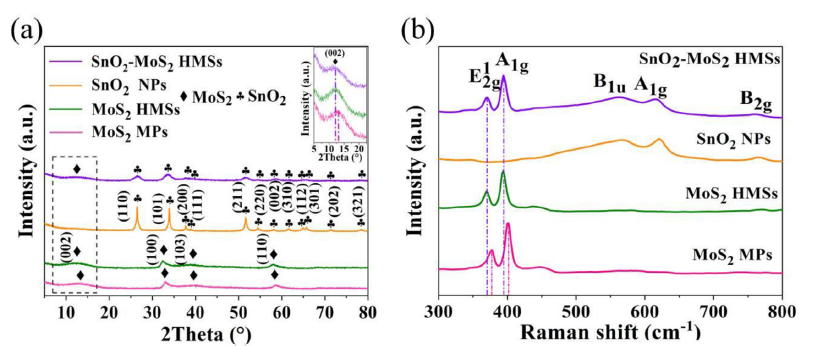
Fig. 1. (a) XRD patterns and (b) Raman spectra of SnO2-MoS2 HMSs, SnO2 NPs, MoS2 HMSs, and MoS2 MPs.
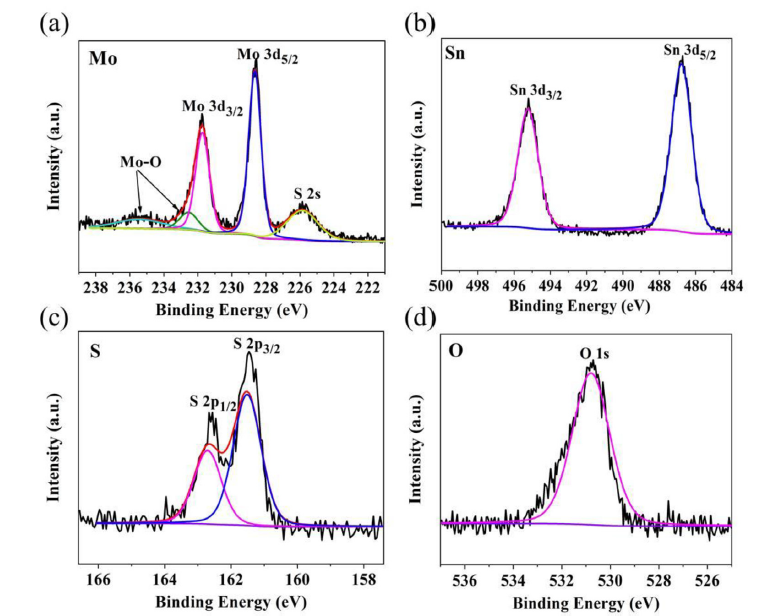
Fig. 2. XPS spectra of SnO2-MoS2 HMSs from Mo 3d region (a), Sn 3d region (b), S 2p region (c), and O 1s region (d).
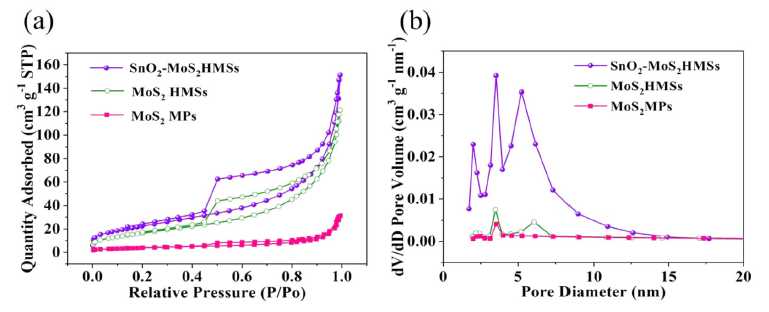
Fig. 3. N2 adsorption-desorption isotherms (a) and the pore size distributions (b) of SnO2-MoS2 HMSs, MoS2 HMSs, and MoS2 MPs.
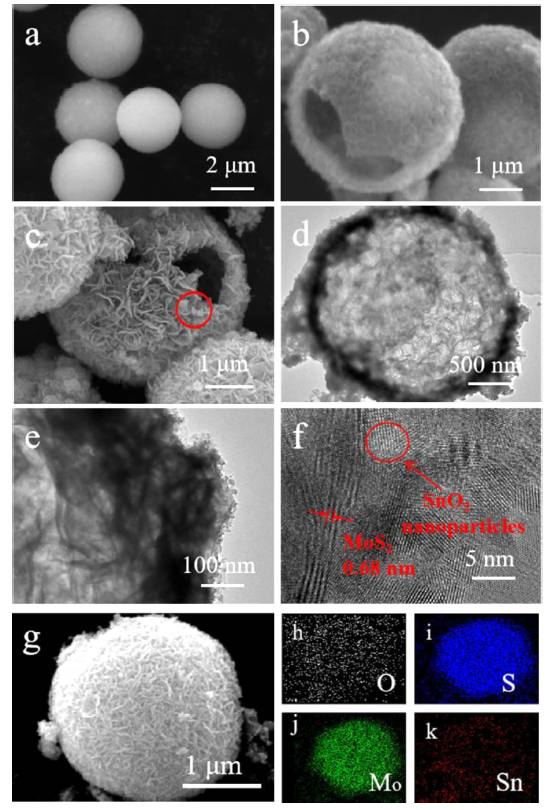
Fig. 4. SEM images of (a) MnCO3 microspheres templates, (b) MoS2 HMSs, (c, g) SnO2-MoS2 HMSs, TEM images of (d, e) SnO2-MoS2 HMSs, and HRTEM images of (f) SnO2-MoS2 HMSs. (h) O element, (i) S element, (j) Mo element and (k) Sn element mapping of the SnO2-MoS2 HMSs.
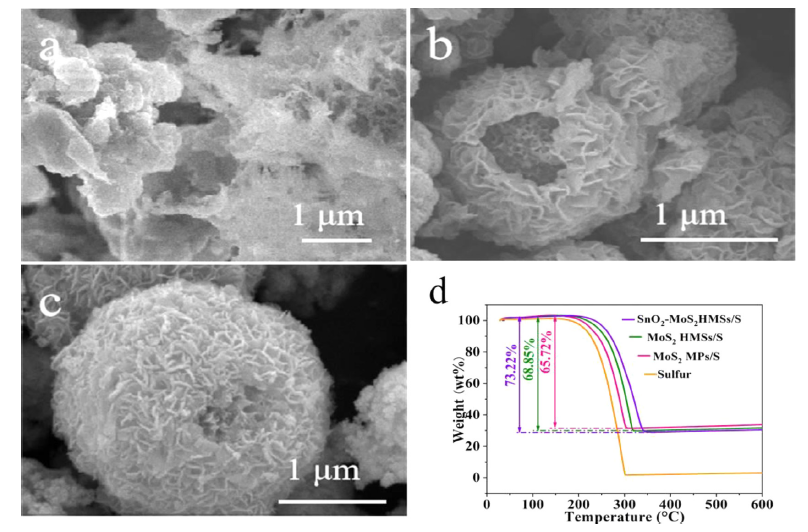
Fig. 5. SEM images of (a) MoS2 MPs/S, (b) MoS2 HMSs/S and (c) SnO2-MoS2 HMSs/S, and TGA curves (d) of the three materials.
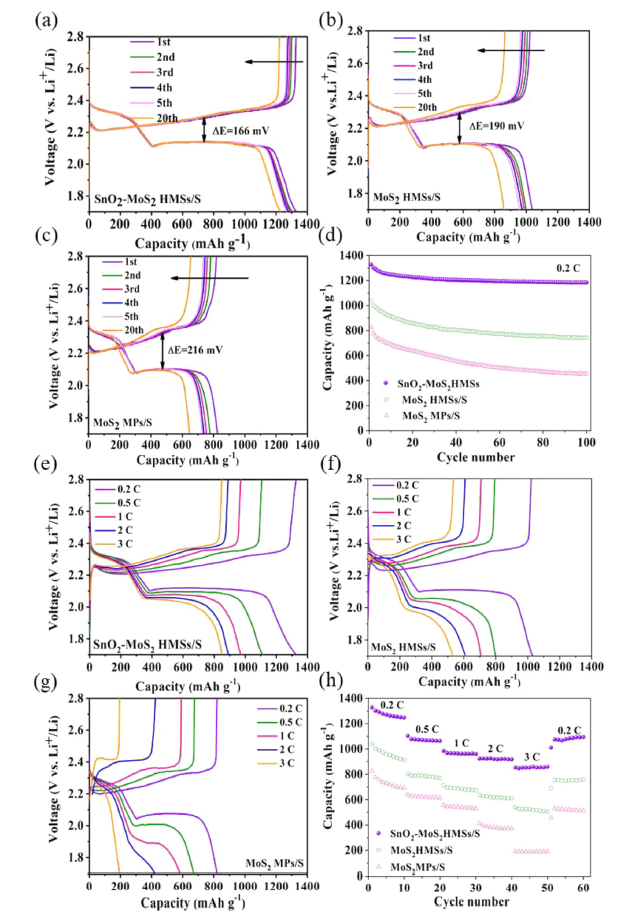
Fig. 6. Charge/discharge curves at 0.2 C of SnO2-MoS2 HMSs/S (a), MoS2 HMSs/S cathodes (b) and MoS2 MPs/S cathodes (c), cyclic performance at 0.2 C over 100 cycles (d), charge/discharge curves of SnO2-MoS2 HMSs/S (e), MoS2 HMSs/S cathodes (f) and MoS2 MPs/S cathodes (g), rate performance of three materials at different rates (h).

Fig. 7. CV curves (a), and Nyquist plots (b) of SnO2-MoS2 HMSs/S, MoS2 HMSs/S, and MoS2 MPs/S cathodes; The curves of polarization redox on SnO2-MoS2 HMSs/S, MoS2 HMSs/S, and MoS2 MPs/S derived from symmetrical cells (c); The color change after adsorption by SnO2-MoS2 HMSs, MoS2 HMSs and MoS2 MPs for 9 h (d); Optical images of the three electrodes after 100 cycles at 0.2 C(e).
| [1] |
A. Bhargav, J. He, A. Gupta, A. Manthiram, Joule 4 (2020) 285-291.
DOI URL |
| [2] |
H.J. Peng, J.Q. Huang, Q. Zhang, Chem. Soc. Rev. 46 (2017) 5237-5288.
DOI URL |
| [3] | H. Li, S. Ma, J. Li, F. Liu, H. Zhou, Z. Huang, S. Jiao, Y. Kuang, Energy Storage Mater. 26 (2020) 203-212. |
| [4] |
H. Zhao, N. Deng, J. Yan, W. Kang, J. Ju, Y. Ruan, X. Wang, X. Zhuang, Q. Li, B. Cheng, Chem. Eng. J. 347 (2018) 343-365.
DOI URL |
| [5] |
Y. Li, Z. Dong, L. Jiao, Adv. Energy Mater. 10 (2020) 1902104.
DOI URL |
| [6] |
C. Wang, Y. Yi, H. Li, P. Wu, M. Li, W. Jiang, Z. Chen, H. Li, W. Zhu, S. Dai, Nano Energy 67 (2020) 104253.
DOI URL |
| [7] |
T. Guo, Y. Song, Z. Sun, Y. Wu, Y. Xia, Y. Li, J. Sun, K. Jiang, S. Dou, J. Sun, J. Energy Chem. 42 (2020) 34-42.
DOI URL |
| [8] |
B. Zhang, C. Luo, Y. Deng, Z. Huang, G. Zhou, W. Lv, Y.-B. He, Y. Wan, F. Kang, Q.H. Yang, Adv. Energy Mater. 10 (2020) 2000091.
DOI URL |
| [9] |
J.D. Liu, X.S. Zheng, Z.F. Shi, S.Q. Zhang, Ionics 20 (2014) 659-664.
DOI URL |
| [10] |
K. Sun, D. Su, Q. Zhang, D.C. Bock, A.C. Marschilok, K.J. Takeuchi, E.S. Takeuchi, H. Gan, J. Electrochem. Soc. 162 (2015) A2834-A2839.
DOI URL |
| [11] |
Y. Lu, X. Li, J. Liang, L. Hu, Y. Zhu, Y. Qian, Nanoscale 8 (2016) 17616-17622.
DOI URL |
| [12] |
J. Liu, S.H. Xiao, Z. Zhang, Y. Chen, Y. Xiang, X. Liu, J.S. Chen, P. Chen, Nanoscale 12 (2020) 5114-5124.
DOI URL |
| [13] |
S.S. Zhang, D.T. Tran, J. Mater. Chem. A 4 (2016) 4371-4374.
DOI URL |
| [14] |
L. Ma, S. Wei, H.L. Zhuang, K.E. Hendrickson, R.G. Hennig, L.A. Archer, J. Mater. Chem. A 3 (2015) 19857-19866.
DOI URL |
| [15] |
Z.L. Xu, N. Onofrio, J. Wang, J. Mater. Chem. A 8 (2020) 17646-17656.
DOI URL |
| [16] |
M.H. Hsieh, G.A. Li, W.C. Chang, H.Y. Tuan, J. Mater. Chem. A 5 (2017) 4114-4121.
DOI URL |
| [17] |
W. Li, D. Wang, Z. Song, Z. Gong, X. Guo, J. Liu, Z. Zhang, G. Li, Nano Res. 12 (2019) 2908-2917.
DOI URL |
| [18] |
H. Ahn, Y. Kim, J. Bae, Y.K. Kim, W.B. Kim, Chem. Eng. J. 401 (2020) 126042.
DOI URL |
| [19] |
W. Wei, J. Li, Q. Wang, D. Liu, J. Niu, P. Liu, ACS Appl. Mater. Interfaces 12 (2020) 6362-6370.
DOI URL |
| [20] |
M. Wang, L. Fan, D. Tian, X. Wu, Y. Qiu, C. Zhao, B. Guan, Y. Wang, N. Zhang, K. Sun, ACS Energy Lett. 3 (2018) 1627-1633.
DOI URL |
| [21] |
D.A. Zhang, Q. Wang, Q. Wang, J. Sun, L.L. Xing, X.Y. Xue, Electrochim. Acta 173 (2015) 476-482.
DOI URL |
| [22] |
J.B. Fei, Y. Cui, X.H. Yan, W. Qi, Y. Yang, K.W. Wang, Q. He, J.B. Li, Adv. Mater. 20 (2008) 452-456.
DOI URL |
| [23] |
W. Wang, X. Yue, J. Meng, X. Wang, Y. Zhou, Q. Wang, Z. Fu, J. Phys. Chem. C 123 (2019) 250-257.
DOI URL |
| [24] |
T. Zhao, P. Zhai, Z. Yang, J. Wang, L. Qu, F. Du, J. Wang, Nanoscale 10 (2018) 22954-22962.
DOI URL |
| [25] |
F. Pei, T. An, J. Zang, X. Zhao, X. Fang, M. Zheng, Q. Dong, N. Zheng, Adv. Energy Mater. 6 (2016) 1502539.
DOI URL |
| [26] |
Y. Yang, S. Wang, S. Lin, Y. Li, W. Zhang, Y. Chao, M. Luo, Y. Xing, K. Wang, C. Yang, P. Zhou, Y. Zhang, Z. Tang, S. Guo, Small Methods 2 (2018) 1800119.
DOI URL |
| [27] |
L.Z. Liu, X.L. Wu, F. Gao, J.C. Shen, T.H. Li, P.K. Chu, Solid State Commun. 151 (2011) 811-814.
DOI URL |
| [28] |
K.J. Czech, B.J. Thompson, S. Kain, Q. Ding, M.J. Shearer, R.J. Hamers, S. Jin, J.C. Wright, ACS Nano 9 (2015) 12146-12157.
DOI PMID |
| [29] |
R. Sanikop, C. Sudakar, ACS Appl, Nano Mater. 3 (2020) 576-587.
DOI URL |
| [30] |
Y. Wei, Z. Kong, Y. Pan, Y. Cao, D. Long, J. Wang, W. Qiao, L. Ling, J. Mater. Chem. A 6 (2018) 5899-5909.
DOI URL |
| [31] |
L. Hu, C. Dai, J.M. Lim, Y. Chen, X. Lian, M. Wang, Y. Li, P. Xiao, G. Henkelman, M. Xu, Chem. Sci. 9 (2018) 666-675.
DOI URL |
| [32] |
S. Cheng, X. Xia, H. Liu, Y. Chen, J. Mater. Sci. Technol. 34 (2018) 1912-1918.
DOI URL |
| [33] |
C. Chai, H. Tan, X. Fan, K. Huang, J. Alloys Compd. 820 (2020) 153144.
DOI URL |
| [34] |
Z. Fang, X. Hu, C. Shu, J. Jian, J. Liu, D. Yu, J. Mater. Chem. A 8 (2020) 19262-19268.
DOI URL |
| [35] |
C. Deng, Z. Wang, L. Feng, S. Wang, J. Yu, J. Mater. Chem. A 8 (2020) 19704-19728.
DOI URL |
| [36] |
Y. Feng, G. Wang, L. Wang, J. Ju, W. Kang, N. Deng, B. Cheng, J. Alloys Compd. 851 (2021) 156859.
DOI URL |
| [37] |
Y. Zuo, Y. Zhu, Q. Wang, K. Lv, W. Su, Y. Tang, Y. Chen, J. Mater. Chem. A 8 (2020) 20111-20121.
DOI URL |
| [1] | Jingqi Chen, Xianlei Hu, Haitao Gao, Shu Yan, Shoudong Chen, Xianghua Liu. Graphene-wrapped MnCO3/Mn3O4 nanocomposite as an advanced anode material for lithium-ion batteries: Synergistic effect and electrochemical performances [J]. J. Mater. Sci. Technol., 2022, 99(0): 9-17. |
| [2] | Bo Yu, Fei Ma, Dongjiang Chen, Katam Srinivas, Xiaojuan Zhang, Xinqiang Wang, Bin Wang, Wanli Zhang, Zegao Wang, Weidong He, Yuanfu Chen. MoP QDs@graphene as highly efficient electrocatalyst for polysulfide conversion in Li-S batteries [J]. J. Mater. Sci. Technol., 2021, 90(0): 37-44. |
| [3] | Ning Zhang, Ying Li, Yifan Qiao. Boosting the electrochemical performance of LiNi0.6Mn0.2Co0.2O2 through a trace amount of Mg-B co-doping [J]. J. Mater. Sci. Technol., 2021, 89(0): 167-178. |
| [4] | Limin Zhu, Zhen Li, Guochun Ding, Lingling Xie, Yongxia Miao, Xiaoyu Cao. Review on the recent development of Li3VO4 as anode materials for lithium-ion batteries [J]. J. Mater. Sci. Technol., 2021, 89(0): 68-87. |
| [5] | Mingxing Liang, Yongcong Huang, Yuda Lin, Guisheng Liang, Cihui Huang, Lan Chen, Jiaxin Li, Qian Feng, Chunfu Lin, Zhigao Huang. Micro-nano structured VNb9O25 anode with superior electronic conductivity for high-rate and long-life lithium storage [J]. J. Mater. Sci. Technol., 2021, 83(0): 66-74. |
| [6] | Ji Won Kim, Kwangeun Jung, Taeeun Yim. Dually-functionalized Ni-rich layered oxides for high-capacity lithium-ion batteries [J]. J. Mater. Sci. Technol., 2021, 86(0): 70-76. |
| [7] | Di Wu, Wen Ren, Yanna NuLi, Jun Yang, Jiulin Wang. Recent progress on selenium-based cathode materials for rechargeable magnesium batteries: A mini review [J]. J. Mater. Sci. Technol., 2021, 91(0): 168-177. |
| [8] | Zhuosen Wang, Xijun Xu, Shaomin Ji, Zhengbo Liu, Dechao Zhang, Jiadong Shen, Jun Liu. Recent progress of flexible sulfur cathode based on carbon host for lithium-sulfur batteries [J]. J. Mater. Sci. Technol., 2020, 55(0): 56-72. |
| [9] | Xiayu Lu, Li Liu, Xuan Xie, Yu Cui, Emeka E. Oguzie, Fuhui Wang. Synergetic effect of graphene and Co(OH)2 as cocatalysts of TiO2 nanotubes for enhanced photogenerated cathodic protection [J]. J. Mater. Sci. Technol., 2020, 37(0): 55-63. |
| [10] | Bozhou Chen, Bangchuan Zhao, Jiafeng Zhou, Zhitang Fang, Yanan Huang, Xuebin Zhu, Yuping Sun. Surface modification with oxygen vacancy in Li-rich layered oxide Li1.2Mn0.54Ni0.13Co0.13O2 for lithium-ion batteries [J]. J. Mater. Sci. Technol., 2019, 35(6): 994-1002. |
| [11] | Chongjia Zhu, Zhiqiu Wu, Jian Xie, Zhen Chen, Jian Tu, Gaoshao Cao, Xinbing Zhao. Solvothermal-assisted morphology evolution of nanostructured LiMnPO4 as high-performance lithium-ion batteries cathode [J]. J. Mater. Sci. Technol., 2018, 34(9): 1544-1549. |
| [12] | Jun-Rui Wang, Feng Wan, Qiu-Feng Lü, Fei Chen, Qilang Lin. Self-nitrogen-doped porous biochar derived from kapok (Ceiba insignis) fibers: Effect of pyrolysis temperature and high electrochemical performance [J]. J. Mater. Sci. Technol., 2018, 34(10): 1959-1968. |
| [13] | Opra Denis P., Gnedenkov Sergey V., Sinebryukhov Sergey L., Voit Elena I., Sokolov AlexanderA., Modin Evgeny B., Podgorbunsky Anatoly B., Sushkov Yury V., Zheleznov Veniamin V.. Characterization and Electrochemical Properties of Nanostructured Zr-Doped Anatase TiO2 Tubes Synthesized by Sol-Gel Template Route [J]. J. Mater. Sci. Technol., 2017, 33(6): 527-534. |
| [14] | Peiyi Zhu, Shuangyu Liu, Jian Xie, Shichao Zhang, Gaoshao Cao, Xinbing Zhao. Facile Synthesis of NiFe2O4/Reduced Graphene Oxide Hybrid with Enhanced Electrochemical Lithium Storage Performance [J]. J. Mater. Sci. Technol., 2014, 30(11): 1078-1083. |
| [15] | Lijun Gong, Yuxi Chen, Hongjiang Yu, Hongbo Liu, Caifu Li, Zhi-Quan Liu. Carbon-coated Li4Ti5O12 Anode Materials Synthesized Using H2TiO3as Ti Source [J]. J. Mater. Sci. Technol., 2014, 30(11): 1092-1095. |
| Viewed | ||||||
|
Full text |
|
|||||
|
Abstract |
|
|||||
 WeChat
