, Xiaofeng Sun
High temperature stress rupture anisotropies of a second generation Ni-base single crystal (SC) superalloy specimens with [001], [011] and [111] orientations under 900 °C/445 MPa and 1100 °C/100 MPa have been investigated in the present study, with attentions to the evolution of γ/γ′ microstructure observed by scanning electron microscopy and the dislocation configuration characterized by transmission electron microscopy in each oriented specimen. At 1100 °C/100 MPa as well as 900 °C/445 MPa, the single crystal superalloy exhibits obvious stress rupture anisotropic behavior. The [001] oriented specimen has the longest rupture lifetime at 900 °C/445 MPa, and the [111] oriented sample shows the best rupture strength at 1100 °C/100 MPa. While the [011] oriented specimen presents the worst rupture lifetime at each testing condition, its stress rupture property at 1100 °C/100 MPa is clearly improved, compared with 900 °C/445 MPa. The evident stress rupture anisotropy at 900 °C/445 MPa is mainly attributed to the distinctive movement way of dislocations in each oriented sample. Whereas, at 1100 °C/100 MPa, together with the individual dislocation configuration, the evolution of γ/γ′ microstructure in each orientation also plays a key role in the apparent stress rupture anisotropy.
Nickel-based single crystal (SC) superalloys have been one of key materials for advanced aeronautic and industrial gas turbine blades and vanes because of their excellent mechanical properties, creep as well as fatigue properties in particular, at elevated temperatures under the corrosive and oxidized condition. These outstanding mechanical properties of SC superalloys are mainly inherited from the particular γ/γ′ microstructure where ordered strengthening γ′ particles with cubic shape normally are coherently embedded in the disordered γ matrix. In other words, the nano-scale γ matrix channel, coherent γ/γ′ interface and strengthening γ′ precipitate can all effectively hinder movements of dislocations, enhancing these superb properties of SC superalloys[1], [2], [3] and [4].
Considering the fact that blades and vanes with complicated shapes are subjected to a multi-axial stress state during service, the creep or stress rupture anisotropy of SC superalloys has been receiving more and more attention. There have been extensive studies on this topic at immediate temperature regime (760 °C-850 °C), and the consensus is that the creep or stress rupture anisotropy at this condition is obvious due to the distinguishing deformation mechanism dominant in each orientation. While at high temperature regime, some apparent contradictory results have been reported, especially those of the [001] and [111] oriented specimens. Sass et al.[5] and [6] found that the CMSX-4 alloy exhibits a weaken creep anisotropy at 980 °C/350 MPa, yet the [111] oriented specimen displays a poor creep strength. Similarly, the creep anisotropy of SRR99 alloy at 1040 °C/165 MPa becomes unobvious, but the [111] oriented specimen shows a good creep elongation[7]. However, Liu et al.[8] investigated that the rupture lifetime of [111] oriented sample of an SC superalloy (without Re) is two times as much as that of the [001] oriented ones at 1010 °C/280 MPa. Yu et al.[9] reported that the [111] oriented specimen of the SC superalloy (without Re) has a far shorter creep lifetime than the [001] oriented one at 1040 °C/160 MPa because of the difference in the morphology of γ′-rafts and the movement of dislocations. For the LEK 94 alloy[10], [11] and [12], there is a higher increase in creep rate with strain in the [110] tensile creep test compared with the [001] tensile creep test at 1020 °C/160 MPa, and the phenomenon mainly arises from the large number of cutting γ′-rafts events and the high mobility of superdislocation segments in γ′-rafts in the [110] oriented specimen. Overall, the high temperature creep or stress rupture anisotropy of SC superalloys may be largely affected by the testing condition, and it also indicates that, for a specific SC superalloy, its creep or stress rupture anisotropy is needed to be further studied in detail.
Therefore, in this work, the influence of orientation (normally [001], [011] and [111]) was investigated on the stress rupture property of a second generation SC superalloy tested at 900 °C/445 MPa and 1100 °C/100 MPa, and attentions were paid to the evolution of γ/γ′ microstructure as well as the movement of dislocations after rupture, by scanning electron microscopy (SEM) and transmission electron microscopy (TEM), respectively, which are responsible for the stress rupture property of each orientated specimen under given testing conditions.
An SC superalloy with composition of Ni-7Cr-8Co-2Mo-5W-7Ta-6Al-3Re-0.05C-0.004B (in wt%) was investigated in this study. SC rods with [001] orientation were produced with selecting crystal technique, while SC rods with [011] and [111] orientations were grown on pre-fabricated seeds. By electron backscattered diffraction (EBSD) technique, the cast bars within 5° deviation from normal orientation were selected and subjected to homogenization (1300 °C/2 h + 1310 °C/2 h, air cooling (AC)) and two-step annealing (1130 °C/4 h, AC + 900 °C/16 h, AC). This heat treatment produced cubic γ′ precipitates with the average edge of 0.45 µm and volume fraction of 69%, while the width of γ channels was only about 60 nm.
The cylindrical testing samples with a gauge length of 25 mm and a diameter of 5 mm were deformed to fracture in air at 900 °C/445 MPa and 1100 °C/100 MPa using constant-loading creep testing machines with clamping device, allowing rotation and ensuring uniaxial loading. In detail, the ratio of applied loading stress to engineering yield stress of specimens at 900 °C and 1100 °C is about 0.75 and 0.28, respectively, regardless of [001], [011] and [111] orientation. In addition, another [111] oriented specimen was interrupted after 2-h deformation at 900 °C/445 MPa and then cooled to room temperature.
Metallographic specimens along specific longitudinal sections of ruptured samples were first mechanically ground and polished, and then chemically etched by the etchant (4 g Cu2SO4 + 20 mL HCl + 20 mL H2O). The feature of γ/γ′ microstructure was observed by field emission scanning electron microscopy (FE-SEM, Inspect F50) operating at 30 kV.
Thin discs for TEM observation were cut along given sections, with at least 10 mm apart from the fracture surface. These foils were first mechanically ground to about 50 µm and then electrochemically thinned in the solution of 10 mL perchloric acid and 90 mL ethanol at -15 °C. The dislocation configuration in each oriented specimen was observed by TEM (JEOL 2100) operating at 200 kV.
Stress rupture properties of the [001], [011] and [111] oriented specimens under two testing conditions are all listed in

Table 1
Stress rupture properties of the SC superalloy specimens with three orientations:
The morphology of γ/γ′ microstructure for each oriented specimen ruptured at 900 °C /445 MPa has a discrete character, as seen in

Fig. 1.
SEM micrographs on (a) (100) plane of the [001] oriented specimen, (b) (100) plane of the [011] oriented specimen and (c) ( ) plane of the [111] oriented specimen (c) after rupture at 900 °C/445 MPa. Stress parallel to vertical direction.
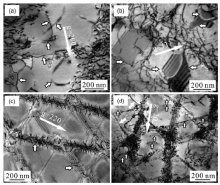
Dislocation configurations in these three oriented specimens after rupture at 900 °C/445 MPa are shown in
The γ/γ′ microstructures in three oriented samples ruptured at 1100 °C/100 MPa also have distinctive characters, as illustrated in 

Fig. 3.
SEM micrographs on (a) (100) plane of the [001] oriented specimen, (b) ( ) plane of the [011] oriented specimen and (c) (
 ) plane of the [111] oriented specimen after rupture at 1100 °C/100 MPa. Stress parallel to the vertical direction.
Fig. 4 exhibits morphologies of γ/γ′ interface dislocation networks and superdislocation segments in γ′-rafts in these three oriented samples after rupture at 1100 °C/100 MPa. These features are also different from those at 900 °C/445 MPa, but interfacial dislocation networks with individual feature are all observed in each specimen. In the [001] orientation, regular dislocation networks (
In the high temperature regime, where it highlights the effect of thermal activation on the stability of γ/γ′ microstructure in SC superalloys, the isolated γ′ precipitates inevitably become unstable and have a trend to rafting. The driving force of rafting is considered to originate from the difference between chemical potentials in matrix channels as a result of the interface misfit relaxation anisotropy, which attributes to the superposition of coherency stress and applied stress[16] and [17]. It is found that the rafting of γ′ phase in SC superalloys is also dependent on orientation, as the orientation plays a significant role in the chemical potential in each matrix channel[9], [18] and [19].
In the [001] oriented specimen, because the SC superalloy investigated here has a negative misfit in γ/γ′ microstructure[20], dislocation loops from different <110 > {111} slip systems activated in this oriented sample prefer to multiply in horizontal matrix channels as a result of coherency and external stresses[16] and [17], leaving dislocation segments with 60° character at the γ/γ′ interface. It is noted that the 60° dislocation segments cannot cross-slip. These dislocation segments can move slightly along the interfaces and interact with fitting partners under the action of thermal activation, gradually building up low-energy interfacial dislocation networks to minimize the misfit stress and dislocation line energy[3] and [16]. This process is sluggish under current condition due to the insufficient thermal activation, so the interfacial dislocation networks finally present irregularity, as shown in
In the [001] oriented specimen, the plastic deformation is predominantly concentrated in the horizontal matrix channels since interfacial dislocation networks and continuous lamellar structure of γ′-rafts both effectively prevent dislocations from bypassing. It is reasonably theorized from the fact that certain different slip systems are activated in this oriented sample that dislocations, including superdislocation segments (dislocation pairs with APB) shearing into γ′-rafts, are more likely to interact with each other and block further movement, which results in dislocation hardening. So the [001] oriented specimen has a good deformation strength.
In the [011] oriented specimen, there are two types of matrix channels called roof channels (inclined to stress axis with 45° angle) and gable channel (parallel to stress axis). Roof channels experience a higher resolved shear stress as a result of superposition of external and coherency stresses[21], and thus the plastic deformation mainly concentrates in the roof channels. In fact, the leading screw dislocation segments in one roof channel can easily cross-slip toward the immobile 60° interfacial dislocations in the other roof channel and some of these coplanar matrix dislocations with different Burgers vectors can further react at the γ/γ′ interface once the local stress concentration is adequate, producing two partial dislocations[12], [22] and [23]. A typical reaction might then be given by[24]:

In general, a/3〈112〉a/3〈112〉 partial dislocation is able to enter the γ′ precipitates, leaving an SF behind it, and a/6〈112〉a/6〈112〉 partial dislocation remains at the γ/γ′ interface. Due to the high sensitivity to misorientation from the ideal [011] orientation, it is possible for the [011] oriented specimen that the conjugate slip systems, where one of these two slip systems is generally dominant, are activated and take parts in deformation. As a result, lots of coplanar matrix dislocations are easily formed, with screw or 60° character, and many of them with different Burger vectors can react as mentioned above and further shear into the γ′ precipitates, causing γ′ precipitates populated with SFs. Since significant amount of local strain is accumulated as SFs are produced in γ′ precipitates, this deform mechanism largely deteriorates the stress rupture property of [011] oriented sample. In addition, because the chemical potentials in two roof channels are nearly equivalent, γ′ precipitates in the [011] orientation are found to keep cubic on the (100) plane in
Initially, in the [111] oriented sample, screw dislocations in matrix channels can easily cross-slip on {111} slip planes mainly due to the nearly equivalent Schmid factor for primary glide and cross-slip planes, which produces dislocation segments at the interface are parallel, at least their projections, as seen as in 
In the [001] oriented specimen, with the help of sufficient thermal activation, 60° interfacial dislocation segments can easily interact with each other to build up periodic low-energy networks[3] and [16]. The regular interfacial dislocation networks play an important role in the superior creep strength of SC superalloy, because they can effectively prevent matrix dislocations from approaching or shearing into γ′-rafts[25]. However, as the deformation continues, the γ′-edges gradually dissolve and γ′-forming solutes diffuse toward local dislocation concentrations in the γ-matrix, and thus neighboring γ′-rafts are connected by formation of γ′-junctions. This process is named as topological inversion[14] and [15]. The topological inversion of γ/γ′ microstructure seriously impairs deformation capability, because it largely accelerates the slip-climb motion of interfacial dislocation segments[26]. So the stress rupture property of the [001] oriented specimen is largely impaired by the topological inversion of γ/γ′ microstructure.
In the [011] oriented specimen, because of the quiet difference in chemical potentials between roof channels and gable channels, neighboring γ′ precipitates interlink with each other mainly in the [100] direction[19] and [21], and finally the rod γ′-rafts become perpendicular to the direction of external stress, as seen in
For the [111] oriented specimen, γ′ precipitates keep isotropic growth mode when applied stresses are symmetrically distributed in three matrix channels. However, there inevitably is a misorientation from the accurate [111] orientation in the specimen. In fact, the plastic deformation is asymmetrically contributed in matrix channels. The difference in chemical potentials in matrix channels as a result of the asymmetric plastic deformation in the [111] orientation leads to the rafting of γ′ precipitates with the help of thermal activation. It is noted that, compared with the [001] and [011] oriented specimens, the driving force in the [111] oriented specimen is less significant, and this finally leads to the formation of irregular γ′-rafts but is still embedded in the γ matrix. Meanwhile, trailing segments as a result of movement of matrix dislocation loops are also dominant in the formation of interfacial dislocation networks, and thus dislocation networks are gradually formed at the γ/γ′ interface as several slip systems are activated with the action of sufficient thermal activation. The low resolved shear stress, irregular γ′-rafts embedded in γ matrix and interfacial dislocation networks can all provide resistances to the movement of dislocations, and therefore, the [111] oriented specimen exhibits a good strength and low plasticity.
(1) The SC superalloy specimens with [001], [011] and [111] orientations exhibit obvious stress rupture anisotropy at 1100 °C/100 MPa as well as at 900 °C/445 MPa.
(2) At 900 °C/445 MPa, in the [001] oriented sample, certain different slip systems are activated and the movement of dislocations mainly concentrates in the horizontal channels, producing a good rupture strength. Cutting γ′ precipitates by

(3) At 1100 °C/100 MPa, although regular interfacial dislocation networks impede the movement of dislocations to some extent initially, the topological inversion of γ/γ′ microstructure, causing the accelerating movement of dislocation segments, impairs the rupture strength of the [001] oriented specimen. The relatively short rupture lifetime of the [011] oriented specimen is mainly due to high γ′-rafts cutting events as a result of limited slip systems activated. Whereas, the inclined γ′-rafts embedded in γ matrix, interfacial dislocation networks and the low resolved shear stress all contribute to the long rupture lifetime and poor elongation of the [111] oriented sample.
This work was financially supported by the National High Technology Research and Development Program of China (“863 Program”, No. 20102014AA041701) and the National Natural Science Foundation of China (No. 51331005) and (No. 51401210). The authors are also grateful to D.Q. Qi, Dr. X.G. Wang and Pro. J.J. Yu for the salutary discussion.
The authors have declared that no competing interests exist.

| Related articles: |