
J. Mater. Sci. Technol. ›› 2023, Vol. 133: 41-57.DOI: 10.1016/j.jmst.2022.05.056
• Research article • Previous Articles Next Articles
Shuo Wanga, Xianghai Yanga, Junsheng Wanga,b,*( ), Chi Zhanga, Chengpeng Xuea
Received:2022-04-12
Revised:2022-05-19
Accepted:2022-05-23
Published:2022-07-09
Online:2022-07-09
Contact:
Junsheng Wang
About author:School of Materials Science and Engineering, Beijing Institute of Technology, Beijing 100081, China. E-mail address: junsheng.wang@bit.edu.cn (J. Wang).Shuo Wang, Xianghai Yang, Junsheng Wang, Chi Zhang, Chengpeng Xue. Identifying the crystal structure of T1 precipitates in Al-Li-Cu alloys by ab initio calculations and HAADF-STEM imaging[J]. J. Mater. Sci. Technol., 2023, 133: 41-57.

Fig. 1. Five atomic models of the T1 phase in hexagonal symmetry, where (d) is an improved Van Smaalen model based on the work by Kim et al. [33], called the Modified Van Smaalen model. Given that this modified structure has lower formation energy than the raw one, it was taken for the subsequent investigations unless otherwise stated. The notation to the right of the atomic stacking layer in each model corresponds to the mixed Al-Cu sub-lattices and possible atomic composition ratios as reported in previous literature. The corrugated layers indicate that the constituent atoms (i.e. Al-Li and Al(Cu)-Li) are not in the same plane.
| Models | Al:Cu(1) | Number | Al:Cu(2) | Number | Stoichiometry | Objective function |
|---|---|---|---|---|---|---|
| Huang | 0.5:0.5 | 6Al-6Cu | - | - | Al2CuLi | Matched |
| How | 0.5:0.5 | 6Al-6Cu | - | - | Al2CuLi | - |
| Modified van smaalen | 0.5:0.5 | 6Al-6Cu | - | - | Al7Cu3Li3 | -6.06 |
| Donnadieu | 0.5:0.5 | 6Al-6Cu | - | - | Al8Cu3Li2 | Matched |
| 0.9:0.1 | 2Al-10Cu | - | - | Al6Cu5Li2 | -2.83 | |
| 1Al-11Cu | - | - | Al11Cu11Li4 | -2.87 | ||
| Dwyer | 0.5:0.5 | 6Al-6Cu | 1.0 | 8Al | Al15Cu3Li4 | -7.21 |
| 0.8:0.2 | 9Al-3Cu | Al17CuLi4 | -2.86 | |||
| 10Al-2Cu | Al33Cu3Li8 | -2.83 | ||||
| 0.6:0.4 | 7Al-5Cu | Al31Cu5Li8 | -2.92 | |||
| Modified Dwyer | 0.5:0.5 | 6Al-6Cu | 0.8:0.2 | 6Al-2Li | Al27Cu13Li12 | -7.21 |
| 0.8:0.2 | 9Al-3Cu | Al17Cu3Li6 | -2.86 | |||
| 10Al-2Cu | Al8Cu4Li3 | -2.83 | ||||
| 0.6:0.4 | 7Al-5Cu | Al7Cu3Li3 | -2.92 | |||
| 0.5:0.5 | 6Al-6Cu | 0.9:0.1 | 7Al-1Li | Al7Cu3Li3 | -7.21 | |
| 0.8:0.2 | 9Al-3Cu | Al35Cu5Li12 | -2.86 | |||
| 10Al-2Cu | Al33Cu7Li12 | -2.83 | ||||
| 0.6:0.4 | 7Al-5Cu | Al29Cu11Li12 | -2.92 | |||
| 0.5:0.5 | 6Al-6Cu | 1.0 | 8Al | Al29Cu11Li12 | -7.21 |
Table 1. Atomic assignments of Al-Cu(1) and Al-Cu(2) sub-lattices in T1 models with various Al:Cu(1) and Al:Cu(2) ratios from literature, and the objective function from SQS simulations.
| Models | Al:Cu(1) | Number | Al:Cu(2) | Number | Stoichiometry | Objective function |
|---|---|---|---|---|---|---|
| Huang | 0.5:0.5 | 6Al-6Cu | - | - | Al2CuLi | Matched |
| How | 0.5:0.5 | 6Al-6Cu | - | - | Al2CuLi | - |
| Modified van smaalen | 0.5:0.5 | 6Al-6Cu | - | - | Al7Cu3Li3 | -6.06 |
| Donnadieu | 0.5:0.5 | 6Al-6Cu | - | - | Al8Cu3Li2 | Matched |
| 0.9:0.1 | 2Al-10Cu | - | - | Al6Cu5Li2 | -2.83 | |
| 1Al-11Cu | - | - | Al11Cu11Li4 | -2.87 | ||
| Dwyer | 0.5:0.5 | 6Al-6Cu | 1.0 | 8Al | Al15Cu3Li4 | -7.21 |
| 0.8:0.2 | 9Al-3Cu | Al17CuLi4 | -2.86 | |||
| 10Al-2Cu | Al33Cu3Li8 | -2.83 | ||||
| 0.6:0.4 | 7Al-5Cu | Al31Cu5Li8 | -2.92 | |||
| Modified Dwyer | 0.5:0.5 | 6Al-6Cu | 0.8:0.2 | 6Al-2Li | Al27Cu13Li12 | -7.21 |
| 0.8:0.2 | 9Al-3Cu | Al17Cu3Li6 | -2.86 | |||
| 10Al-2Cu | Al8Cu4Li3 | -2.83 | ||||
| 0.6:0.4 | 7Al-5Cu | Al7Cu3Li3 | -2.92 | |||
| 0.5:0.5 | 6Al-6Cu | 0.9:0.1 | 7Al-1Li | Al7Cu3Li3 | -7.21 | |
| 0.8:0.2 | 9Al-3Cu | Al35Cu5Li12 | -2.86 | |||
| 10Al-2Cu | Al33Cu7Li12 | -2.83 | ||||
| 0.6:0.4 | 7Al-5Cu | Al29Cu11Li12 | -2.92 | |||
| 0.5:0.5 | 6Al-6Cu | 1.0 | 8Al | Al29Cu11Li12 | -7.21 |

Fig. 2. Formation energy of the T1 structures with defined atomic assignments for Al-Cu(1) and Al-Cu(2) sub-lattices shown in Table 1. For comparative purposes, the formation energy of the Modified Van Smaalen model is used as a reference with an energy expansion of ± 0.02 eV/atom, as marked in the gray shaded area.
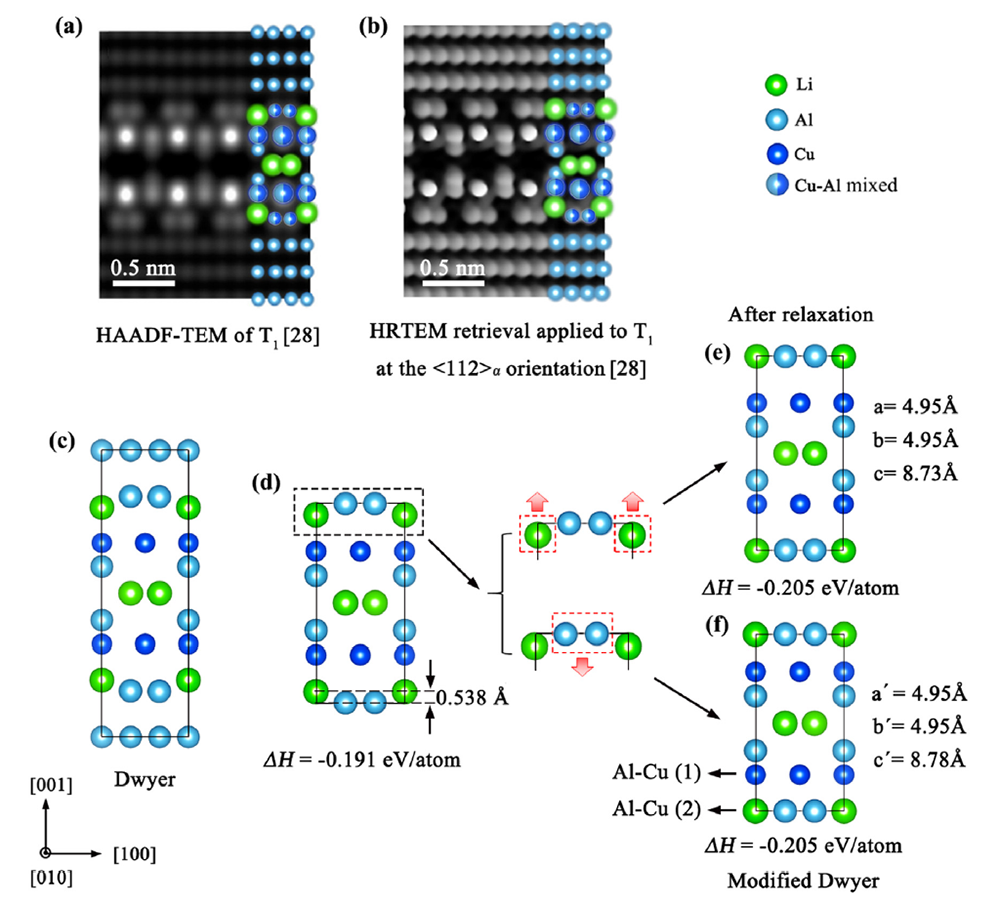
Fig. 3. Atomic-resolution (a) HAADF-STEM and (b) HRTEM retrieval applied to T1 precipitates viewed at the $ \langle 112\rangle_{\mathrm{Al}}$ orientation for Dwyer's model, respectively. The atoms labeled in the images repeat from Ref. [28]. (c) Atomic structure extracted from the experimental images. (d) Reconstructed Dwyer's model by removing the edge Al layers. Moving the mixed Cu-Al and Li atoms along the [001]-axis to the same plane yield two atomic structures that correspond to (e) and (f), respectively. After relaxation, these two structures are equivalent by comparing the ΔH and lattice parameters. The new structure without corrugated layers has lower ΔH than that in the (d). Therefore, we choose the flat Dwyer model instead of the corrugated one in the following and denote the Modified Dwyer.
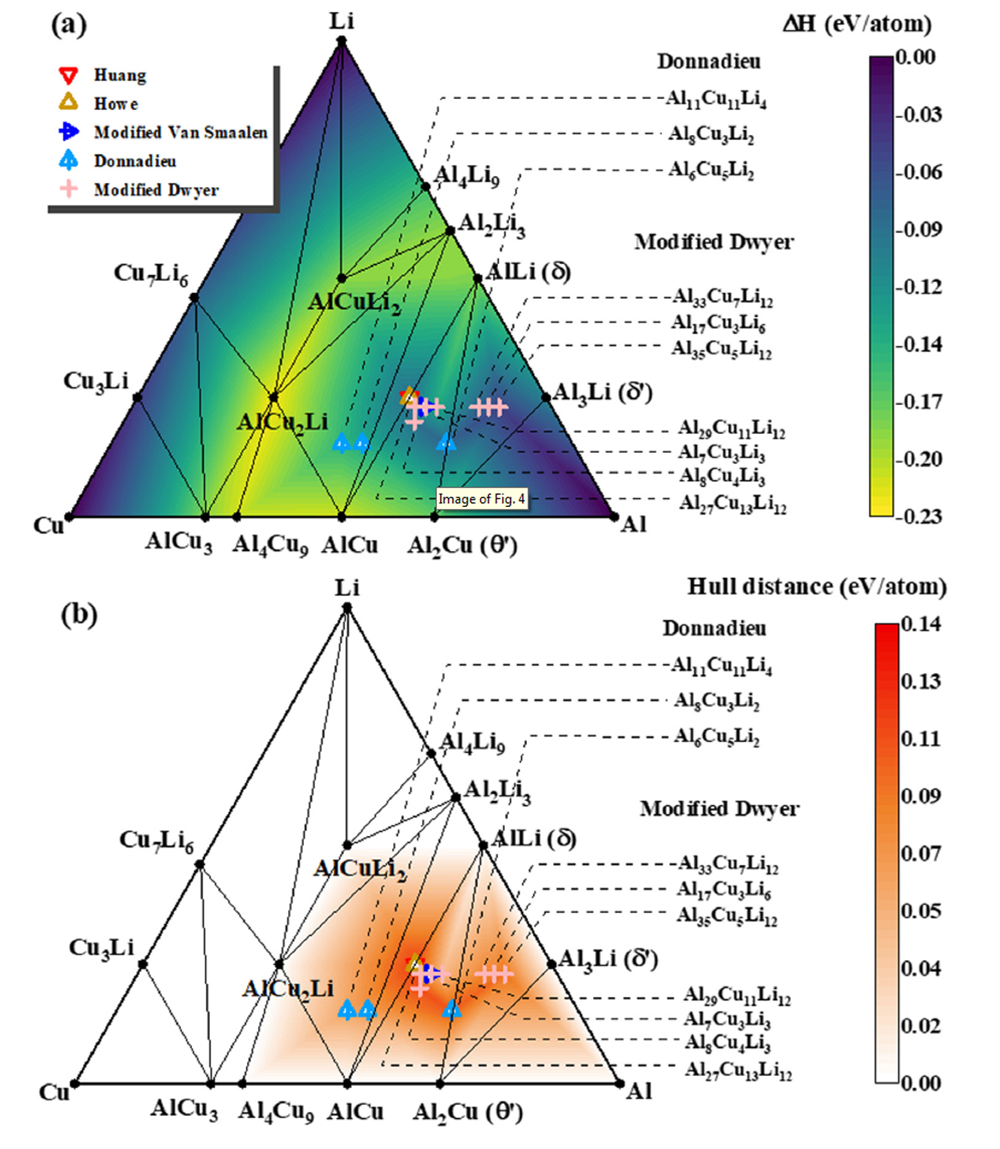
Fig. 4. (a) Al-Cu-Li ternary convex hull at 0 K without zero-point energy. Stable competing phases (black-filled circles) are connected by tie lines, and the simulated T1 structures are marked by colorful symbols. The background of the ternary phase diagram corresponds to the depth of the ternary convex hull as a function of composition; color-coded by the formation energy as shown on the right color bar (in units of eV/atom). (b) Hull distances in the context of the Al-Cu-Li ternary phase diagrams are mapped by the color legend on the right (in units of eV/atom).
| Models | Al:Cu(1) | Al:Cu(2) | Stoichiometry | ΔH | Hull distance | Stable phases (on the convex hull) |
|---|---|---|---|---|---|---|
| Huang | 0.5:0.5 | - | Al2CuLi | -0.112 | 0.087 | AlCu, δ |
| How | 0.5:0.5 | - | Al2CuLi | -0.057 | 0.143 | AlCu, δ |
| Modified Van Smaalen | 0.5:0.5 | - | Al7Cu3Li3 | -0.16 | 0.032 | AlCu, δ, θ′ |
| Donnadieu | 0.5:0.5 | - | Al8Cu3Li2 | -0.076 | 0.103 | δ, θ′ |
| 0.9:0.1 | - | Al6Cu5Li2 | -0.141 | 0.067 | AlCu2Li, AlCu, Al2Li3 | |
| - | Al11Cu11Li4 | -0.151 | 0.061 | AlCu2Li, AlCu, Al2Li3 | ||
| Dwyer | 0.5:0.5 | 1.0 | Al15Cu3Li4 | 0.154 | 0.296 | Al, θ′, δ′ |
| 0.8:0.2 | Al17CuLi4 | 0.196 | 0.291 | Al, θ′, δ′ | ||
| Al33Cu3Li8 | 0.128 | 0.235 | Al, θ′, δ′ | |||
| 0.6:0.4 | Al31Cu5Li8 | 0.119 | 0.250 | θ′, δ′, δ | ||
| Modified Dwyer | 0.5:0.5 | 0.8:0.2 | Al27Cu13Li12 | -0.150 | 0.047 | AlCu, δ, θ′ |
| 0.8:0.2 | Al17Cu3Li6 | -0.065 | 0.084 | δ, θ′, δ′ | ||
| Al8Cu4Li3 | -0.087 | 0.108 | AlCu, δ, θ′ | |||
| 0.6:0.4 | Al7Cu3Li3 | -0.145 | 0.047 | AlCu, δ, θ′ | ||
| 0.5:0.5 | 0.9:0.1 | Al7Cu3Li3 | -0.151 | 0.042 | AlCu, δ, θ′ | |
| 0.8:0.2 | Al35Cu5Li12 | -0.047 | 0.093 | δ, θ′, δ′ | ||
| Al33Cu7Li12 | -0.077 | 0.082 | δ, θ′, δ′ | |||
| 0.6:0.4 | Al29Cu11Li12 | -0.130 | 0.058 | AlCu, δ, θ′ | ||
| 0.5:0.5 | 1.0 | Al29Cu11Li12 | -0.150 | 0.038 | AlCu, δ, θ′ |
Table 2. Formation energy ΔH (eV/atom), hull distances (eV/atom), and decomposition products for T1 structures simulated by SQS (listed in Table 1) at 0 K without the zero-point energy.
| Models | Al:Cu(1) | Al:Cu(2) | Stoichiometry | ΔH | Hull distance | Stable phases (on the convex hull) |
|---|---|---|---|---|---|---|
| Huang | 0.5:0.5 | - | Al2CuLi | -0.112 | 0.087 | AlCu, δ |
| How | 0.5:0.5 | - | Al2CuLi | -0.057 | 0.143 | AlCu, δ |
| Modified Van Smaalen | 0.5:0.5 | - | Al7Cu3Li3 | -0.16 | 0.032 | AlCu, δ, θ′ |
| Donnadieu | 0.5:0.5 | - | Al8Cu3Li2 | -0.076 | 0.103 | δ, θ′ |
| 0.9:0.1 | - | Al6Cu5Li2 | -0.141 | 0.067 | AlCu2Li, AlCu, Al2Li3 | |
| - | Al11Cu11Li4 | -0.151 | 0.061 | AlCu2Li, AlCu, Al2Li3 | ||
| Dwyer | 0.5:0.5 | 1.0 | Al15Cu3Li4 | 0.154 | 0.296 | Al, θ′, δ′ |
| 0.8:0.2 | Al17CuLi4 | 0.196 | 0.291 | Al, θ′, δ′ | ||
| Al33Cu3Li8 | 0.128 | 0.235 | Al, θ′, δ′ | |||
| 0.6:0.4 | Al31Cu5Li8 | 0.119 | 0.250 | θ′, δ′, δ | ||
| Modified Dwyer | 0.5:0.5 | 0.8:0.2 | Al27Cu13Li12 | -0.150 | 0.047 | AlCu, δ, θ′ |
| 0.8:0.2 | Al17Cu3Li6 | -0.065 | 0.084 | δ, θ′, δ′ | ||
| Al8Cu4Li3 | -0.087 | 0.108 | AlCu, δ, θ′ | |||
| 0.6:0.4 | Al7Cu3Li3 | -0.145 | 0.047 | AlCu, δ, θ′ | ||
| 0.5:0.5 | 0.9:0.1 | Al7Cu3Li3 | -0.151 | 0.042 | AlCu, δ, θ′ | |
| 0.8:0.2 | Al35Cu5Li12 | -0.047 | 0.093 | δ, θ′, δ′ | ||
| Al33Cu7Li12 | -0.077 | 0.082 | δ, θ′, δ′ | |||
| 0.6:0.4 | Al29Cu11Li12 | -0.130 | 0.058 | AlCu, δ, θ′ | ||
| 0.5:0.5 | 1.0 | Al29Cu11Li12 | -0.150 | 0.038 | AlCu, δ, θ′ |
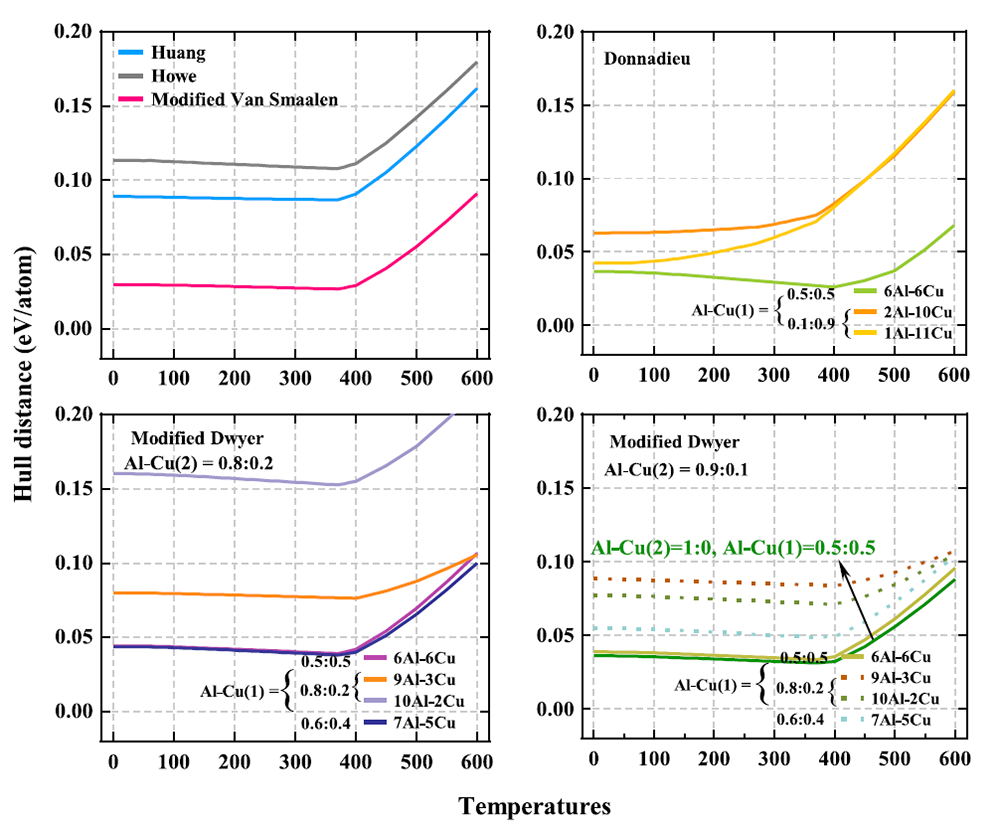
Fig. 5. Temperature-dependent hull distances for T1 structures (in Table 2). All structures are above the convex hull tie-line, suggesting that they are phase instability over this temperature range. The solid line corresponds to a dynamically stable structure, while the dashed line corresponds to the opposite, i.e., imaginary phonon frequencies present in their dynamical matrix, as shown in Fig. S1 of the Supplementary Materials.

Fig. 6. Five atomic models of the T1 phase with orthorhombic symmetry properties.
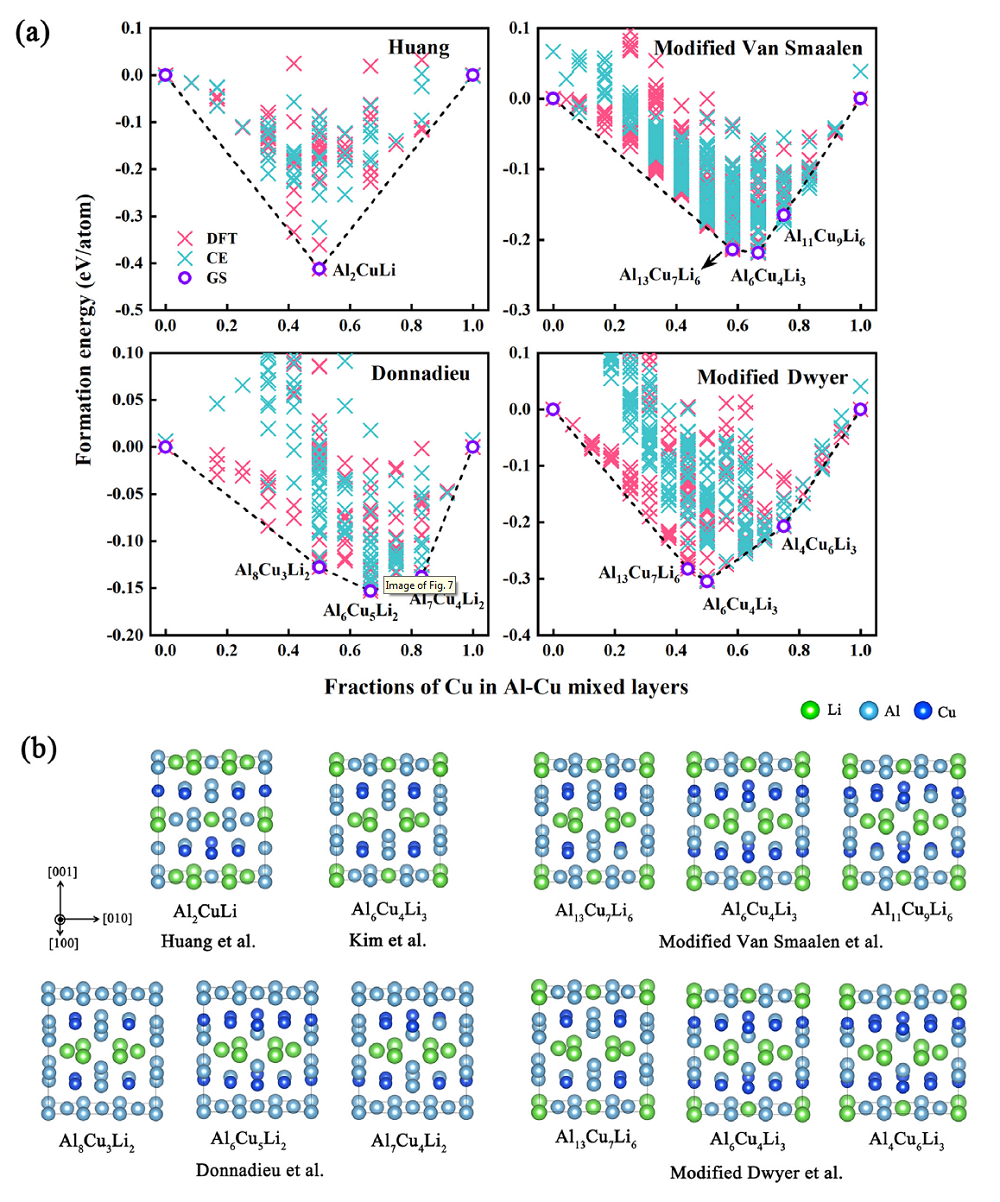
Fig. 7. (a) Formation energy as a function of different fractions of Cu in Al-Cu mixed layers from DFT calculations (magenta crosses) and CE predictions (light-green crossed). The ground-state structures on the convex hull are marked with purple balls. (b) Schematic diagram of the atomic structures of all predicted ground-state phases in each model (For interpretation of the references to color in this figure legend, the reader is referred to the web version of this article).
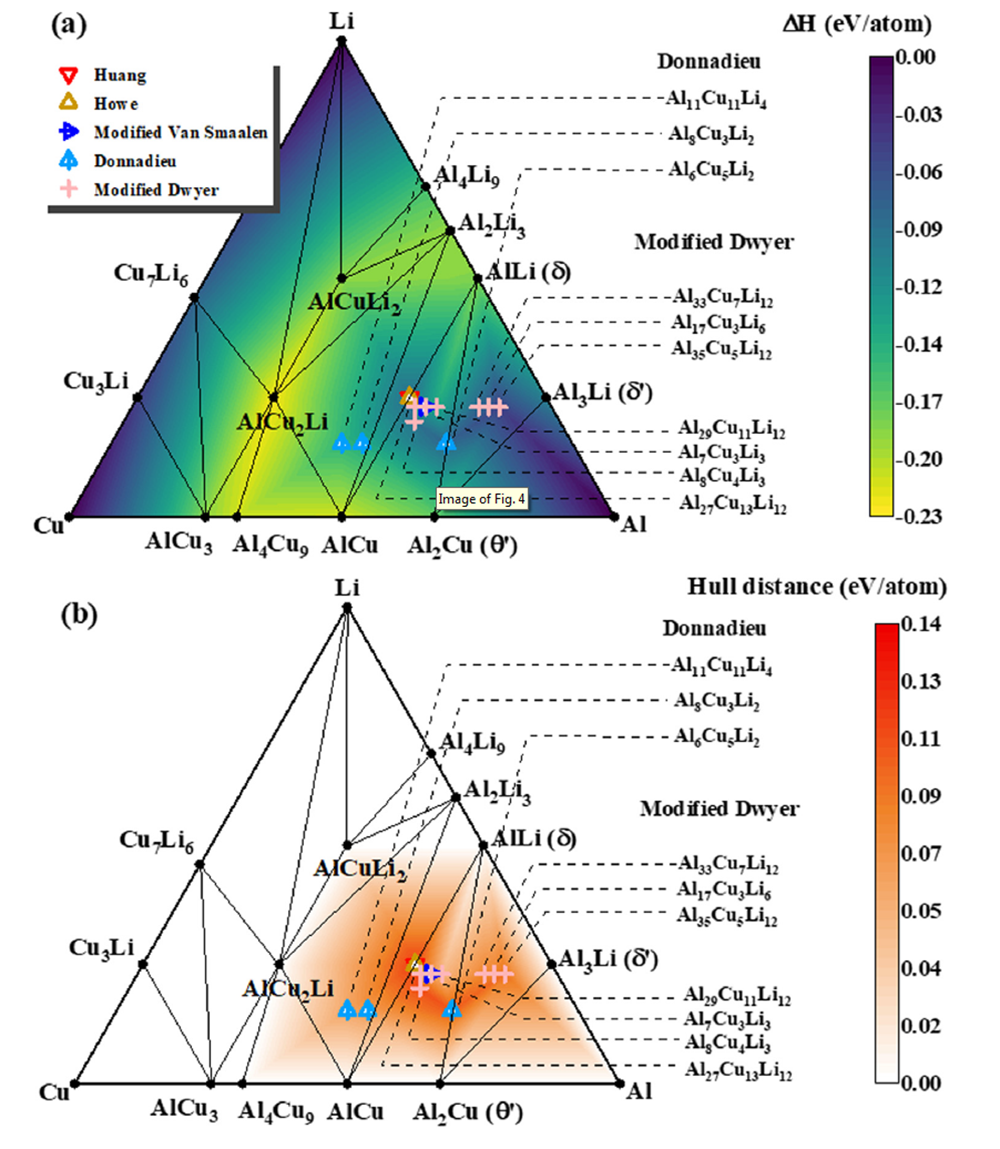
Fig. 8. (a) Al-Cu-Li ternary convex hull at 0 K without zero-point energy. In addition to the stable phases (black-filled circles connected by tie lines), we indicate the predicted T1 structures by CE. The background of the ternary phase diagram corresponds to the depth of the ternary convex hull as a function of composition; color-coded by the formation energy as shown on the right color bar (in units of eV/atom). (b) Hull distances in the context of the Al-Cu-Li ternary phase diagrams are mapped by the color bar on the right (in units of eV/atom).
| Models | Stoichiometry | ΔH (eV/atom) | Hull distance (eV/atom) | Stable phases (on the convex hull) |
|---|---|---|---|---|
| Huang | Al2CuLi | -0.169 | 0.05 | AlCu, δ |
| Modified Van Smaalen | Al13Cu7Li6 | -0.217 | 0.005 | AlCu, δ |
| Al6Cu4Li3 | -0.240 | 0 | Al6Cu4Li3 (this work) | |
| Al11Cu9Li6 | -0.230 | 0.007 | AlCu2Li, AlCu, Al2Li3 | |
| Donnadieu | Al8Cu3Li2 | -0.091 | 0.089 | θ′, δ′ |
| Al6Cu5Li2 | -0.172 | 0.058 | AlCu2Li, AlCu, Al2Li3 | |
| Al7Cu4Li2 | -0.140 | 0.074 | AlCu, δ, θ′ | |
| Modified Dwyer | Al13Cu7Li6 | -0.217 | 0.005 | AlCu, δ |
| Al6Cu4Li3 | -0.240 | 0 | Al6Cu4Li3 (this work) | |
| Al4Cu6Li3 | -0.207 | 0.021 | AlCu2Li, AlCu, Al2Li3 |
Table 3. Formation energy ΔH (eV/atom), hull distances (eV/atom), and decomposition products of the new T1 structures predicted by CE (Fig. 7) at 0 K without the zero-point energy.
| Models | Stoichiometry | ΔH (eV/atom) | Hull distance (eV/atom) | Stable phases (on the convex hull) |
|---|---|---|---|---|
| Huang | Al2CuLi | -0.169 | 0.05 | AlCu, δ |
| Modified Van Smaalen | Al13Cu7Li6 | -0.217 | 0.005 | AlCu, δ |
| Al6Cu4Li3 | -0.240 | 0 | Al6Cu4Li3 (this work) | |
| Al11Cu9Li6 | -0.230 | 0.007 | AlCu2Li, AlCu, Al2Li3 | |
| Donnadieu | Al8Cu3Li2 | -0.091 | 0.089 | θ′, δ′ |
| Al6Cu5Li2 | -0.172 | 0.058 | AlCu2Li, AlCu, Al2Li3 | |
| Al7Cu4Li2 | -0.140 | 0.074 | AlCu, δ, θ′ | |
| Modified Dwyer | Al13Cu7Li6 | -0.217 | 0.005 | AlCu, δ |
| Al6Cu4Li3 | -0.240 | 0 | Al6Cu4Li3 (this work) | |
| Al4Cu6Li3 | -0.207 | 0.021 | AlCu2Li, AlCu, Al2Li3 |

Fig. 9. Temperature-dependent hull distances of the T1 structures. As seen, the newly proposed Al6Cu4Li3 is phase stability within the precipitation temperature range of 411-530 K marked by shaded boxes.
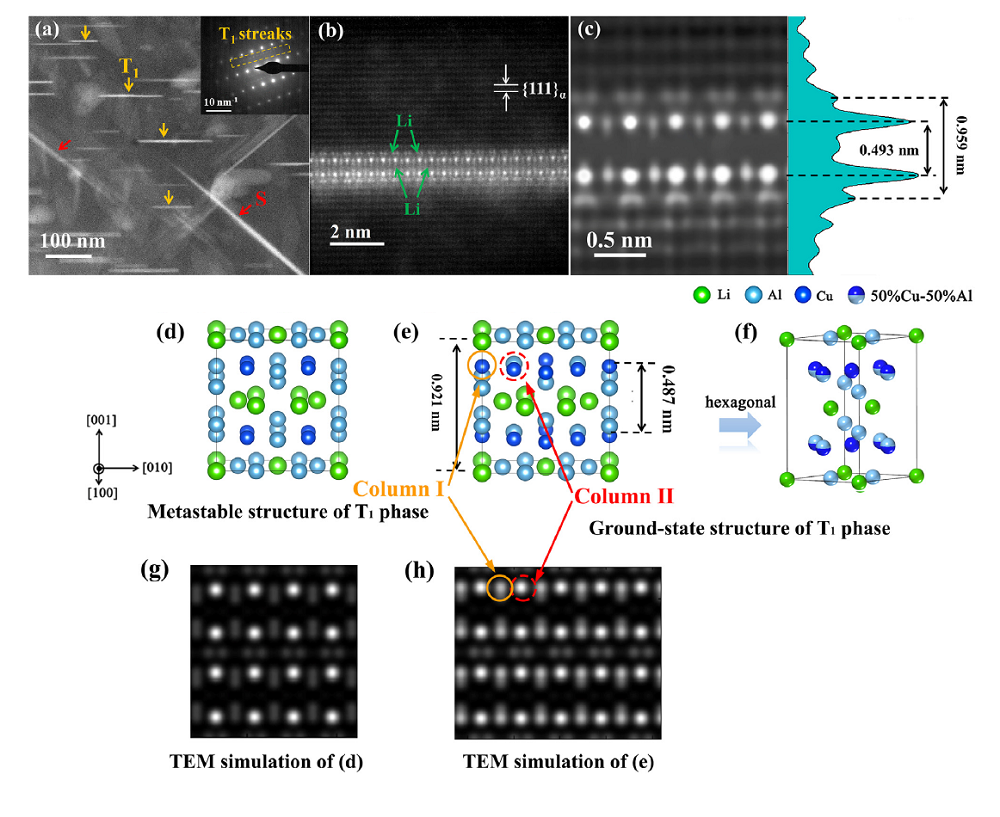
Fig. 10. Comparison of the T1 atomic structure proposed by DFT with experimental HAADF-STEM images. (a) TEM images viewed at the $ \langle 112\rangle_{\mathrm{Al}}$ orientation. The selected area diffraction pattern (SADP) of the T1 phase is shown in the upper right inset. (b) Atomic-resolution HAADF-STEM image of T1 precipitates embedded in the Al matrix scaling up from (a). (c) FFT filtered image of T1 precipitates, the intensity profile across the T1 precipitate is used to measure characteristic distances. As seen, the layer distances of Al-Cu(1) and Al-Cu(2) mixed layers are generally consistent with those in our proposed ground-state structure. (d) and (e) are atomic structures of the metastable and ground-state T1 structure with the chemical formula the Al6Cu4Li3, respectively, corresponding to the CE predictions in Fig. 7(a). (f) Hexagonal modes of the ground-state T1 structure after symmetry transformation, in which 6i positions are made of equal proportions of Cu and Al contents with a point symmetry of 2mm. (g) and (h) are simulated TEM images obtained using the structures of (d) and (e) along [100] projection, respectively.

Fig. 11. (a) T1/Al-matrix interface supercell composed of our proposed stable T1 structure (Al6Cu4Li3). (b) After DFT-relaxation at 0 K, Al-Li corrugated layers come out with the space of d0K = 0.555 ?. (c) Atomic trajectories of the interfacial supercell that was extracted from the AIMD simulation at 300 K for 5 ps. (d) Displacement Δd300K of the four representative atoms, corresponding to (c), relative to their initial positions in the direction of [001]-axis from the AIMD simulation. (e) Mean value of Δd300K within 2 to 5 ps. By analyzing, the maximum and minimum Al-Li layer spacings are 0.584 ? and 0.571 ?, respectively. Apparently, this is difficult to observe in experiments.

Fig. 12. Atomic forces of four atoms at the interface corresponding to Fig. 11(c) during the AIMD simulation. Where the positive and negative values of the force are directly correlated with the definition of atomic orientation axes. The enlarged view of the red dashed box is on the right, indicating the change in atomic force from 0 to 20 fs (For interpretation of the references to color in this figure legend, the reader is referred to the web version of this article).
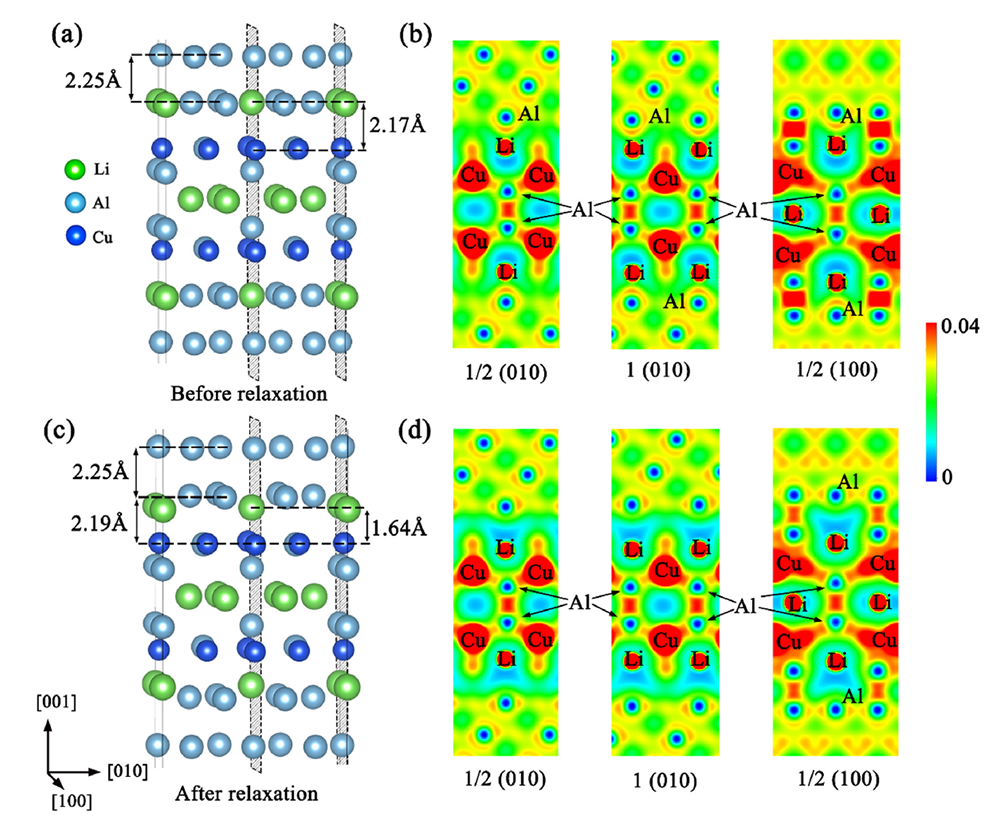
Fig. 13. Calculated charge density distributions of T1/Al-matrix interfacial structure in the 1/2 (010) and (010) planes before and after relaxation at 0 K. The unit is in e/bohr3.
| [1] | T. Dorin, A. Vahid, in: Fundamentals of Aluminium Metallurgy, Woodhead Publishing, Cambridge, 2018, pp. 387-438. |
| [2] | A .A. El-Aty, Y. Xu, X.Z. Guo, S.H. Zhang, Y. Ma, D.Y. Chen, J. Adv. Res. 10 (2018) 49-67. |
| [3] |
R. Yoshimura, T.J. Konno, E. Abe, K. Hiraga, Acta Mater. 51 (2003) 4251-4266.
DOI URL |
| [4] |
S. Wang, J.S. Wang, C. Zhang, C.P. Xue, J. Alloy. Compd. 904 (2022) 163800.
DOI URL |
| [5] |
R. Yoshimura, T.J. Konno, E. Abe, K. Hiraga, Acta Mater. 51 (2003) 4251-4266.
DOI URL |
| [6] |
E. Gumbmann, W. Lefebvre, F.D. Geuser, C. Sigli, A. Deschamps, Acta Mater. 115 (2016) 104-114.
DOI URL |
| [7] |
P.P. Ma, L.H. Zhan, C.H. Liu, Q. Wang, H. Li, D.B. Liu, Z. Hu, J. Alloy. Compd. 790 (2019) 8-19.
DOI URL |
| [8] |
Y.J. Deng, J.H. Bai, X.D. Wu, G.J. Huang, L.F. Cao, L. Huang, J. Alloy. Compd. 723 (2017) 661-666.
DOI URL |
| [9] |
Z. Gao, J.Z. Liu, J.H. Chen, S.Y. Duan, Z.R. Liu, W.Q. Ming, C.L. Wu, J. Alloy. Compd. 624 (2015) 22-26.
DOI URL |
| [10] |
A. Deschamps, B. Decreus, F. De Geuser, T. Dorin, M. Weyland, Acta Mater. 61 (2013) 4010-4021.
DOI URL |
| [11] |
W.A. Cassada, G.J. Shiflet, J.E.A. Starke, Met. Trans. A 22 (1991) 287-297.
DOI URL |
| [12] |
L. Wu, Y.G. Li, X.F. Li, N.H. Ma, H.W. Wang, J. Mater. Sci. Technol. 46 (2020) 44-49.
DOI URL |
| [13] |
S.Y. Duan, Z. Le, Z.K. Chen, Z. Gao, J.H. Chen, W.Q. Ming, S.Y. Li, C.L. Wu, N. Yan, Mater. Charact. 121 (2016) 207-212.
DOI URL |
| [14] |
B. Jiang, H.S. Wang, D.Q. Yi, Y. Tian, F.H. Shen, B. Wang, H.Q. Liu, Z. Hu, Mater. Charact. 162 (2020) 110184.
DOI URL |
| [15] |
D. Tsivoulas, Metall. Mater. Trans. A 46 (2015) 2342-2346.
DOI URL |
| [16] |
V. Araullo-Peters, B. Gault, F. de Geuser, A. Deschamps, J.M. Cairney, Acta Mater. 66 (2014) 199-208.
DOI URL |
| [17] |
J. Peng, S. Bahl, A. Shyam, J.A. Haynes, D. Shin, Acta Mater. 196 (2020) 747-758.
DOI URL |
| [18] |
M. Murayama, K. Hono, Scr. Mater. 44 (2001) 701-706.
DOI URL |
| [19] | X.H. Yang, J.S. Wang, M.S. Zhang, C. Zhang, C.P. Xue, Y.L. Guo, X.G. Liu, Mater. Today Commun. 29 (2021) 102898. |
| [20] | E. Clouet, L. Laé, T. Épicier, W. Lefebvre, M. Nastar, A. Deschamps, Nat. Mater. 5 (2006) 4 82-4 88. |
| [21] |
A. Mariaux, M. Rappaz, Acta Mater. 59 (2011) 927-933.
DOI URL |
| [22] | S. Wang, C. Zhang, X. Li, J.S. Wang, J. Mater. Sci. (2021) 10092-10107. |
| [23] |
S. Wang, C. Zhang, X. Li, H.B. Huang, J.S. Wang, J. Mater. Sci. Technol. 58 (2020) 205-214.
DOI URL |
| [24] | J.C. Huang, A.J. Ardell, Mater. Sci. Technol. 3 (1987) 176-188. |
| [25] | J.M. Howe, J. Lee, A.K. Vasudevan, Mater. Trans. A 19 (1988) 2911-2920. |
| [26] |
S.V. Smaalen, A. Meetsma, J.L.D. Boer, P.M. Bronsveld, J. Solid State Chem. 85 (1990) 293-298.
DOI URL |
| [27] |
P. Donnadieu, Y. Shao, F. De Geuser, G.A. Botton, S. Lazar, M. Cheynet, M. de Boissieu, A. Deschamps, Acta Mater. 59 (2011) 462-472.
DOI URL |
| [28] |
C. Dwyer, M. Weyland, L.Y. Chang, B.C. Muddle, Appl. Phys. Lett. 98 (2011) 201909.
DOI URL |
| [29] |
K. Okhotnikov, T. Charpentier, S. Cadar, J. ChemInform. 8 (2016) 17.
DOI URL |
| [30] |
L. Bellaiche, D. Vanderbilt, Phys. Rev. B 61 (20 0 0) 7877-7882.
DOI URL |
| [31] | F. Yonezawa, K. Morigaki, Prog. Theor. Phys. Suppl. 53 (1973) 1-76. |
| [32] |
A. Zunger, S.H. Wei, L.G. Ferreira, J.E. Bernard, Phys. Rev. Lett. 65 (1990) 353-356.
PMID |
| [33] |
K. Kim, B.C. Zhou, C. Wolverton, Acta Mater. 145 (2018) 337-346.
DOI URL |
| [34] | J.M. Sanchez, F. Ducastelle, D. Gratias, Phys. A 128 (1984) 334-350. |
| [35] |
Q. Wu, B. He, T. Song, J. Gao, S.Q. Shi, Comput. Mater. Sci. 125 (2016) 243-254.
DOI URL |
| [36] | J.E. Saal, S. Kirklin, M. Aykol, B. Meredig, C. Wolverton, JOM 65 (2013) 1501-1509. |
| [37] | S. Kirklin, J.E. Saal, B. Meredig, A. Thompson, J.W. Doak, M. Aykol, S. Rühl, C. Wolverton, npj Comput. Mater. 1 (2015) 15010. |
| [38] |
A. Togo, I. Tanaka, Scr. Mater. 108 (2015) 1-5.
DOI URL |
| [39] |
S. Wang, Y.H. Zhao, H. Hou, Z.Q. Wen, P.L. Zhang, J.Q. Liang, J. Solid State Chem. 263 (2018) 18-23.
DOI URL |
| [40] | S. Wang, Y.H. Zhao, S.J. Deng, W.K. Yang, D.X. Lian, H. Hou, J. Phys. Chem. Solids 125 (2019) 115-122. |
| [41] |
G. Kresse, J. Furthmüller, Phys. Rev. B 54 (1996) 11169-11186.
DOI PMID |
| [42] |
J.P. Perdew, K. Burke, M. Ernzerhof, Phys. Rev. Lett. 77 (1996) 3865-3868.
DOI PMID |
| [43] |
H.J. Monkhorst, J.D. Pack, Phys. Rev. B 13 (1976) 5188-5192.
DOI URL |
| [44] | G. Kresse, M. Marsman, J. Furthmüller, Vienna Ab-initio Simulation Package: VASP the GUIDE, Universität Wien, Austria, 2014. |
| [45] |
V. Wang, N. Xu, J.C. Liu, G. Tang, W.T. Geng, Comput. Phys. Commun. 267 (2021) 108033.
DOI URL |
| [46] | S. Nosé,Prog. Theor. Phys. Suppl. 103 (1991) 1-46. |
| [47] | C. Koch, Ph.D. Thesis, Arizona State University, 2002. |
| [48] |
A. van de Walle, M. Asta, Model. Simul. Mater. Sci. Eng. 10 (2002) 521-538.
DOI URL |
| [49] | A. van de Walle, Calphad 33 (2009) 266-278. |
| [50] | A.v.d. Walle, M. Asta, G. Ceder, Calphad 26 (2002) 539-553. |
| [51] |
A.R. Akbarzadeh, V. Ozoli ¸n š, C. Wolverton, Adv. Mater. 19 (2007) 3233-3239.
DOI URL |
| [52] | P. Vinet, J.H. Rose, J. Ferrante, J.R. Smith, J. Phys.Condens. Matter 1 (1989) 1941-1963. |
| [53] |
S.H. Kessler, D.G. Abrecht, R.A. Clark, J.M. Schwantes, J. Alloy. Compd. 689 (2016) 969-976.
DOI URL |
| [54] |
M. Asta, V. Ozoliņš, Phys. Rev. B 64 (2001) 094104.
DOI URL |
| [55] | P.S. Chen, B.N. Bha,NASA Technical Report (2002) 211548. |
| [56] |
S.C. Wang, M.J. Starink, Int. Mater. Rev. 50 (2013) 193-215.
DOI URL |
| [57] |
M.J. Guinel, N. Brodusch, G. Sha, M.A. Shandiz, H. Demers, M. Trudeau, S.P. Ringer, R. Gauvin, J. Microsc. 255 (2014) 128-137.
DOI URL |
| [58] |
S.J. Kang, T.H. Kim, C.W. Yang, J.I. Lee, E.S. Park, T.W. Noh, M. Kim, Scr. Mater. 109 (2015) 68-71.
DOI URL |
| [1] | Dong Huang, Yanxin Zhuang. Break the strength-ductility trade-off in a transformation-induced plasticity high-entropy alloy reinforced with precipitation strengthening [J]. J. Mater. Sci. Technol., 2022, 108(0): 125-132. |
| [2] | Xingpu Zhang, Xiaotong Deng, Haofei Zhou, Jiangwei Wang. Atomic-scale study on the precipitation behavior of an Al-Zn-Mg-Cu alloy during isochronal aging [J]. J. Mater. Sci. Technol., 2022, 108(0): 281-292. |
| [3] | Hongmei Jin, Renguo Guan, Xianxiang Huang, Ying Fu, Jin Zhang, Xiaolin Chen, Yu Wang, Fei Gao, Di Tie. Understanding the precipitation mechanism of copper-bearing phases in Al-Mg-Si system during thermo-mechanical treatment [J]. J. Mater. Sci. Technol., 2022, 96(0): 226-232. |
| [4] | Hairui Xing, Ping Hu, Shilei Li, Yegai Zuo, Jiayu Han, Xingjiang Hua, Kuaishe Wang, Fan Yang, Pengfa Feng, Tian Chang. Adsorption and diffusion of oxygen on metal surfaces studied by first-principle study: A review [J]. J. Mater. Sci. Technol., 2021, 62(0): 180-194. |
| [5] | Yue Zhou, William G. Fahrenholtz, Joseph Graham, Gregory E. Hilmas. From thermal conductive to thermal insulating: Effect of carbon vacancy content on lattice thermal conductivity of ZrCx [J]. J. Mater. Sci. Technol., 2021, 82(0): 105-113. |
| [6] | Chaoqiang Liu, Houwen Chen, Min Song, Jian-Feng Nie. Electron beam irradiation induced metastable phase in a Mg-9.8 wt%Sn alloy [J]. J. Mater. Sci. Technol., 2021, 84(0): 133-138. |
| [7] | C.Q. Liu, C. He, H.W. Chen, J.F. Nie. Precipitation on stacking faults in Mg-9.8wt%Sn alloy [J]. J. Mater. Sci. Technol., 2020, 45(0): 230-240. |
| [8] | H.F. Zhang, H.L. Yan, H. Yu, Z.W. Ji, Q.M. Hu, N. Jia. The effect of Co and Cr substitutions for Ni on mechanical properties and plastic deformation mechanism of FeMnCoCrNi high entropy alloys [J]. J. Mater. Sci. Technol., 2020, 48(0): 146-155. |
| [9] | Fu-Zhi Dai, Huimin Xiang, Yinjie Sun, Yanchun Zhou. M2M'AlB4 (M = Mn, Fe, Co, M' = Cr, Mo, W): Theoretical predicted ordered MAB phases with Cr3AlB4 crystal structure [J]. J. Mater. Sci. Technol., 2019, 35(7): 1432-1438. |
| [10] | Cheng Liu, Yuman Zhu, Qun Luo, Bin Liu, Qinfen Gu, Qian Li. A 12R long-period stacking-ordered structure in a Mg-Ni-Y alloy [J]. J. Mater. Sci. Technol., 2018, 34(12): 2235-2239. |
| Viewed | ||||||
|
Full text |
|
|||||
|
Abstract |
|
|||||
 WeChat
