


1. Introduction
Thanks to flourishing markets of portable electronics and electric vehicles, lithium ion batteries (LIBs) have become the most popular electric energy storage systems, due to their long cycle lifetime and superior energy density [[1], [2], [3]]. However, the development of challenging applications e.g., the next generation of smartphone, promotes the requirement of LIBs with higher energy density. Thus, recent research focuses on the cathode materials with enhanced lithium storage capacity and increased operation potential. Layer structured lithium cobalt oxide (LiCoO2, ~140 mA h g-1 between 3.0 and 4.2 V), is considered as prominent cathode material for commercialized LIBs since 1991, which is still vitalized in portable electronic devices nowadays [4,5]. In order to meet the needs of these high energy density applications, improved LiCoO2 exhibits both higher specific capacity and operating voltage, owing to the increased cut-off charge voltage (above 4.2 V vs Li/Li+). However, the nominal organic electrolyte in LIBs could suffer from accelerated oxidation due to the overcharged LiCoO2, depositing a high impedance and inhomogeneous film on cathode surface, leading to a rapid capacity deterioration [[6], [7], [8]]. Besides, Co4+ ions formed at high voltage tend to dissolve into liquid electrolyte, destabilizing the host structure [9].
To improve the cycling stability of high-voltage LiCoO2 cathode, coating a layer of protective film on LiCoO2 surface is an effective way, which can suppress liquid electrolyte decomposition and hinder Co4+ dissolution during high-voltage charging. It has been reported that the improved cycling performance of LiCoO2 can be achieved by coating with oxides, such as Al2O3 [10,11], MgO [12] and Li[Li0.2Mn0.6Ni0.2]O2 [13]. However, inorganic surface coating usually obtains uncompacted coating layer, while needs additional synthetic procedures. An efficient and facile way to form uniform passivation layer on cathode is to use electrolyte additives, such as trimethylboroxine (TMB) [14], dimethyl phenylphosphonite (DMPP) [15] and N-(triphenylphosphoranylidene) aniline (TPPA) [16]. The highest occupied molecular orbital (HOMO) energy of these additives is higher than that of common carbonate solvents, suggesting their lower oxidation potentials. Thus, the additives would preferentially oxidative polymerization on cathode during charge process. Among various additives, thiophene derivatives can electrochemically polymerize as polythiophene, which exhibited high conductivity and superior chemical stability, drawing intense attention [17,18]. Additionally, it was reported that the perfluorinated alkyl (-CF3) groups can significantly reduce the surface tension of the electrolyte, thus benefit for wettability of the separator [19]. As a result, it should favor the electrochemical performance of LiCoO2 cell by adding the additive with synergistic effect of these two functional groups.
In this work, 2-(trifluoroacetyl) thiophene (TFPN) was firstly investigated as a film-forming additive with an aim of enhancing the stability of interface between LiCoO2 and electrolyte, especially for high voltage situation. The performance of the TFPN was tested in LiCoO2 cell by using galvanostatic charge‒discharge tests and linear sweep voltammograms (LSV). The cycling stability of cell was remarkably improved with an addition of only 0.5 wt% TFPN into electrolyte. The capacity retention increased from 33.2 % in the baseline electrolyte to 90.6 % in the TFPN-containing electrolyte. Moreover, the surface film on the LiCoO2 cathode was characterized by scanning electron microscopy (SEM), transmission electron microscopy (TEM), electrochemical impedance spectroscopy (EIS) and X-ray photo electron spectroscopy (XPS) measurements.
2. Experimental
All the electrolytes were prepared in an argon-filled MBraun glove box with oxygen and moisture contents below 0.1 ppm. The electrolyte with 1 mol L-1 LiPF6 in ethylene carbonate (EC)/diethyl carbonate (DEC) (1:1, v/v) was used as baseline electrolyte. TFPN was purchased from Energy Chemical Co. Ltd. and used as received (Fig. 1). The amount of additive added into the baseline electrolyte was 0.1 wt%, 0.25 wt%, 0.5 wt% and 1 wt%, respectively. The coin cells (CR2032) were assembled in argon-filled glove box with Celgard 2400 microporous membrane as the separator. The working electrodes were made by mixing 84 wt% LiCoO2 powder, 8 wt% super P carbon black and 8 wt% poly(vinylidenefluoride) (PVDF) in N-methyl-2-pyrrolidinone (NMP) solvent. The obtained slurry was pasted on Al foil, following dried at 100 °C overnight. The mass loading of LiCoO2 was ~4 mg with the controlled electrolyte of 80 μL. The metallic Li foil was used as counter electrode. The charge/discharge tests were carried out between 3.0 and 4.4 V on a Neware battery cycler at room temperature. Electrochemical impedance spectroscopy (EIS) measurements were recorded on a CHI660e electrochemical workstation (Shanghai Chenhua) in a frequency range of 100 kHz to 10 mHz with an amplitude of 5 mV. To investigate the oxidation potential of the electrolytes, linear scanning voltammetry (LSV) tests were conducted from 2.5 V to 6 V at a scan rate of 0.2 mV s-1 by the cell comprising stainless steel working electrode, Li metal counter electrode and Celgard 2400 separator. After cycling, the cell was dissembled in glove box and the cathode was collected with pure dimethyl carbonate (DMC) solvent washing to remove the residue on the surface, then vacuum dried for 12 h before analysis. The surface morphology of LiCoO2 cathode was observed by scanning electron microscopy (SEM, JEOL JSM-6390LA) and the chemical valence of the composition in the surface film was characterized via X-ray photoelectron spectroscopy (XPS, ESCALAB250) with Al-Kα radiation.
Fig. 1.
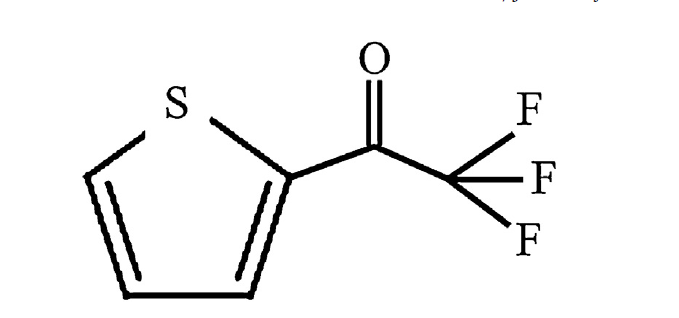
Fig. 1.
Molecular structure of electrolyte additive: 2-(Trifluoroacetyl)thiophene.
3. Results and discussion
LSV curves of electrolytes with and without TFPN additive are presented in Fig. 2. The TFPN-containing electrolyte displays an initial oxidation potential at around 3.4 V, while the decomposition voltage of the baseline electrolyte is approximately 4.4 V. This result suggests TFPN can be oxidized at lower potential before the decomposition of the common used electrolyte components. The initial voltage profiles of the LiCoO2 cathode with the baseline electrolyte and the electrolyte containing different amounts of the TFPN additive are displayed in Fig. 3(a), which are collected at 0.1 C in the voltage range from 3.0-4.4 V. The baseline electrolyte cell delivers a specific capacity of 174.4 mA h g-1 with a coulombic efficiency of 96.6 %. The cells using the electrolyte containing 0.25 wt%, 0.5 wt% and 1.0 wt% TFPN display little difference in discharge capacity, while lower coulombic efficiency of 92.7 %, 88.1 % and 82.8 %, respectively. The initial coulombic efficiency decreases with the rising amount of additive, indicating more irreversible oxidation reaction of TFPN to form a cathode electrolyte interphase (CEI) during high voltage charge process. The cycling performance of LiCoO2/Li half cells with different electrolytes are shown in Fig. 3(b). It can be seen that the cell using the baseline electrolyte delivers a capacity of 57.9 mA h g-1 after 100 cycles at 0.5 C, which only retains 33.2 % of the initial discharge capacity. By contrast, the capacity retention of the cells using electrolytes with 0.25 wt%, 0.5 wt% and 1.0 wt% TFPN additive increases to 73.0 %, 90.6 % and 58.0 % after 100 cycles, respectively, suggesting the protective CEI film derived from oxidation products of TFPN can effectively suppress the further parasitic reactions between electrolyte and LiCoO2 cathode at high voltage. Among them, the cell with the electrolyte containing 0.5 wt% TFPN exhibits the best cycling performance, manifesting that the amount of additive should be optimized to achieve better performance. The insufficient TFPN in the baseline electrolyte leads to lower capacity retention due to incomplete surface coating, as well as thick surface film caused by more irreversible oxidation reaction with too much additive [20]. Therefore, the electrolyte containing 0.5 wt% TFPN is selected for the further discussion.
Fig. 2.
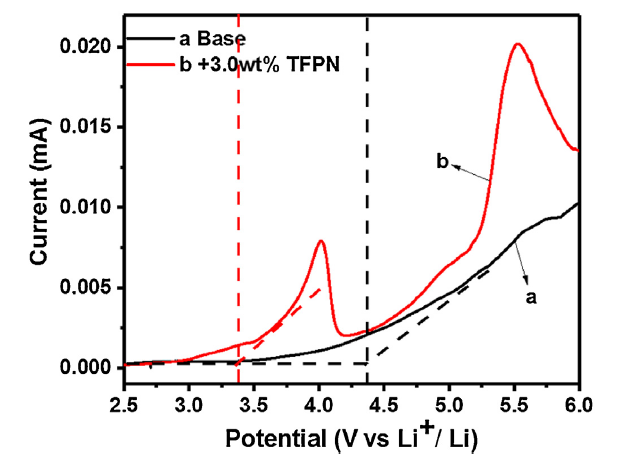
Fig. 2.
Linear sweep voltammograms of 1 mol L-1 LiPF6/EC + DEC (1/1, v/v) solutions with (a) no additive and (b) 3.0 wt% TFPN in stainless steel||Li metal cell (scan rate is 0.2 mV s-1).
Fig. 3.
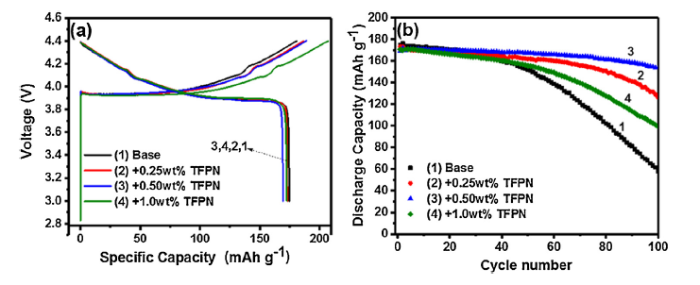
Fig. 3.
(a) Initial discharge curves and (b) cyclic performances of Li/LiCoO2 coin cells with 1 mol L-1 LiPF6/EC + DEC (1/1, v/v) solutions with no additive and 0.25 wt%, 0.50 wt%, 1.0 wt%, cut-off voltage of 3.0-4.4 V, initial 3 cycles at 0.1 C for activation, then cycle at 0.5 C.
The impedance measurements of the LiCoO2 electrodes are conducted to evaluate the effect of TFPN additive. Nyquist plots of LiCoO2/Li cells using electrolytes with and without TFPN additive after 20 and 100 cycles are shown in Fig. 4. There are two overlapped semicircles from high to medium frequencies in all the EIS spectra, corresponding to the resistance of CEI layer (RCEI) and charge transfer resistance (Rct), respectively [21]. It can be seen that the interphase resistance of the cell using electrolyte with or without TFPN are similar after 20th cycle (Fig. 4(a)). However, the cell using baseline electrolyte exhibits a rapidly enlarged semicircle from 20th to 100th cycle. The equivalent circuit diagram is displayed in Fig. 4(b) with the fitting data in Table 1. R0, R1 and R2 refers to the ohmic internal resistance of the cell, RCEI and Rct, respectively. The larger RCEI in the cell using baseline electrolyte indicates the development of thicker interphase film on the surface of LiCoO2 cathode. The smaller Rct of the cell with TFPN-containing electrolyte means that the LiCoO2 cathode with TFPN-addition electrolyte is more stable during charge/discharge process, benefiting for the cycling stability of the cell. Thus, the introduction of TFPN into baseline electrolyte can modify CEI layer on the surface of cathode when it charged to high potential. The results of EIS spectra are coincided with the cycle performance above, suggesting that the high-voltage LiCoO2 cathode is more stable in the cell with TFPN addition for long cycle life.
Fig. 4.
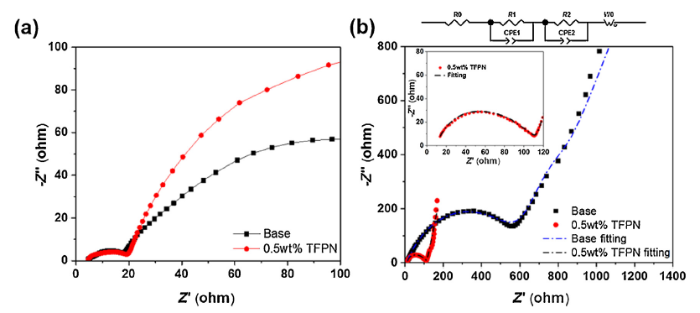
Fig. 4.
Electrochemical impedance spectra (EIS) of the LiCoO2/Li coil cells at the (a) 20th, (b) 100th and fitting curve using the equivalent circuit, with 1 mol L-1 LiPF6/EC + DEC (1/1, v/v) solutions with no additive and 0.50 wt% TFPN.
Table 1 Impedance parameters of LiCoO2 cycles in the baseline electrolyte and the baseline electrolyte with 0.5 wt% TFPN-addition after 100 cycles.
| Sample | R0 (ohm) | R1 (ohm) | R2 (ohm) |
|---|---|---|---|
| Baseline electrolyte | 6.72 | 77.7 | 554.7 |
| 0.5 wt% TFPN addition | 9.97 | 47.4 | 47.8 |
The surface morphologies of the pristine LiCoO2 and cycled LiCoO2 electrodes are observed by SEM (Fig. 5(a-c)). According to the images, there is a thick and inhomogeneous film on the surface of LiCoO2 cathode in the cell with the baseline electrolyte, because of the continuous decomposition of electrolyte in the high voltage range. Moreover, the LiCoO2 particle cannot maintain original complete structure, implying the development of pulverization along with the rising cycles. In contrast, the LiCoO2 particle in the cell using TFPN-containing electrolyte is unbroken and covered with a protective film. This uniform film can be observed by TEM with ~8 nm thick (Fig. 5(e)), thinner than the film on the surface of the LiCoO2 without the TFPN addition (Fig. 5(d)). That suggests that addition of TFPN can contribute to alleviate parasitic reactions and hinder decomposition of the electrolyte, protecting LiCoO2 electrode without increasing the resistance dramatically.
Fig. 5.
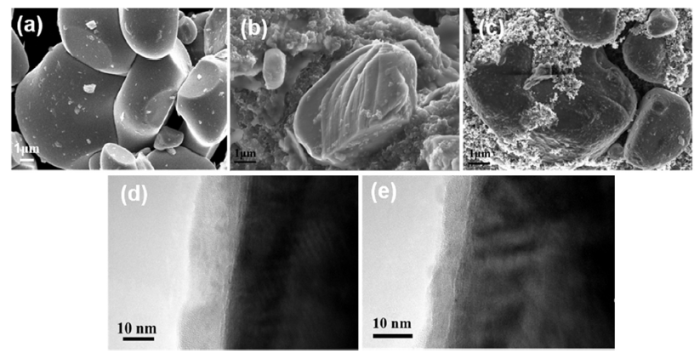
Fig. 5.
SEM images of (a) the pristine LiCoO2 and cycled LiCoO2 electrodes in (b) the base and (c) 0.50 % TFPN containing electrolytes. TEM images of cycled LiCoO2 electrodes using (d) 1 mol L-1 LiPF6/EC + DEC (1/1, v/v) solutions with no additive and (e) 0.50 wt% TFPN.
To further investigate the surface chemistry of cycled LiCoO2 cathode in the electrolytes with and without TFPN additive, XPS analysis is carried out. The spectra of C 1s, F 1s and S 2p are recorded and fitted (Fig. 6). The C 1s spectrum is fitted by four peaks at around 284.7, 286.5, 289.8 and 290.8 eV (Fig. 6(a)), corresponding to the C-C bond (carbon black), C-O bond, C=O bond (decomposition products of electrolyte, such as lithium alkoxides, lithium carbonates) and C-F bond (PVDF binder), respectively [22]. The proportion of peak area between C-O bond, C=O bond and C-C bond is calculated as 0.31:1.11:1.0 and 0.18:0.77:1.0 in the cell without and with TFPN addition electrolyte. The results manifest that there are less decomposition products of electrolyte in CEI film within the cell using TFPN-containing electrolyte, implying that the TFPN oxidation products protect LiCoO2 surface and hinder continuous decomposition of the electrolyte. The F 1 s spectrum of the film is observed with the binding energy at around 688.0 eV (C-F bond, PVDF) and 685.0 eV (decomposition products of LiPF6) [23,24] (Fig. 6(b)). The later can be fitted by two peaks: one at 684.5 eV corresponds to LiF, and the other one at 685.8 corresponds to LixPOyFz. The lower intensity of LiF peak in TFPN-containing electrolyte indicates that TFPN effectively declines the decomposition of lithium salt for long cycle. Besides, a new peak at 164.1 eV in S 2p spectra of cycled LiCoO2 in the electrolyte with TFPN (Fig. 6(c)), corresponding to the C-S (oxidation of thiophene group) [17], also confirms the electrochemically polymerization of additive to form a protective layer on the surface of LiCoO2, which prevents the oxidation of electrolyte solvents and LiPF6 at high voltage.
Fig. 6.
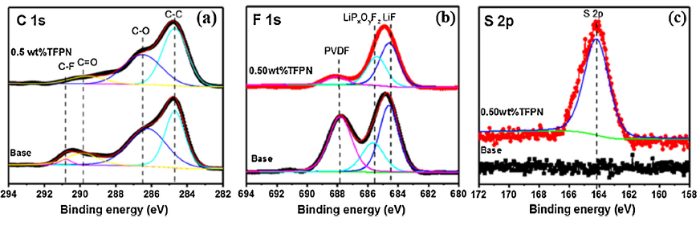
Fig. 6.
XPS spectra of the LiCoO2 cathodes in the electrolyte without additive and with 0.50 wt% TFPN collected after 100 cycles: (a) C 1s, (b) F 1s, (c) S 2p.
4. Conclusion
In order to alleviate continuous oxidation of electrolyte and severe structural degradation of cathode during high voltage operation, TFPN has been introduced as a functional additive to the electrolyte for improving the cycling performance of LiCoO2 at 4.4 V due to its preferential film-forming capability on the cathode surface. The EIS and XPS results exhibit that TFPN can modify the CEI film, decreasing the decomposition of both lithium salt and electrolyte solvent, reducing the interphase resistance for long cycle. Characterization of morphologies after cycled cathode shows that the thin and uniform CEI film in TFPN-containing electrolyte can also effectively suppress the structure degradation of LiCoO2. Therefore, after 100 cycles at 0.1 C, the capacity retention of Li/LiCoO2 cell is significantly enhanced from 33.2%-90.6% via the addition of 0.5 wt% TFPN into the baseline electrolyte. This work demonstrates that TFPN has prominent potential as functional additive for the development of high voltage and high energy density lithium ion batteries.
Acknowledgements
This research was financially supported by the National Natural Science Foundation of China (Nos.21676067, 51372060 and 21606065), the Fundamental Research Funds for the Central Universities (Nos. JZ2017YYPY0253, JZ2018HGBZ0138 and JZ2017HGTB0198), the Anhui Provincial Natural Science Foundation (No.1908085QE178) and the Opening Project of CAS Key Laboratory of Materials for Energy Conversion (No. KF2018003).
Reference
DOI
URL
PMID
[Cited within: 1]

Ultralong hierarchical vanadium oxide nanowires with diameter of 100-200 nm and length up to several millimeters were synthesized using the low-cost starting materials by electrospinning combined with annealing. The hierarchical nanowires were constructed from attached vanadium oxide nanorods of diameter around 50 nm and length of 100 nm. The initial and 50th discharge capacities of the ultralong hierarchical vanadium oxide nanowire cathodes are up to 390 and 201 mAh/g when the lithium ion battery cycled between 1.75 and 4.0 V. When the battery was cycled between 2.0 and 4.0 V, the initial and 50th discharge capacities of the nanowire cathodes are 275 and 187 mAh/g. Compared with self-aggregated short nanorods synthesized by hydrothermal method, the ultralong hierarchical vanadium oxide nanowires exhibit much higher capacity. This is due to the fact that self-aggregation of the unique nanorod-in-nanowire structures have been greatly reduced because of the attachment of nanorods in the ultralong nanowires, which can keep the effective contact areas of active materials, conductive additives, and electrolyte large and fully realize the advantage of nanomaterial-based cathodes. This demonstrates that ultralong hierarchical vanadium oxide nanowire is one of the most favorable nanostructures as cathodes for improving cycling performance of lithium ion batteries.

 WeChat


