Search for articles:
Yuchen Liu
Corresponding authors:
Received: 2019-09-14
Revised: 2019-10-9
Accepted: 2019-10-10
Online: 2020-04-01
Copyright: 2020 Editorial board of Journal of Materials Science & Technology Copyright reserved, Editorial board of Journal of Materials Science & Technology
More
Abstract
Perovskite stannates are promising semiconductors that are widely used in optoelectronic devices. Here, the composition dependent intrinsic point defects of stannate perovskites ASnO3 (A = Ca, Sr, Ba) are studied by first-principles calculations. The preferences of defects under stoichiometric and nonstoichiometric conditions are unsealed, meanwhile the charge states of each intrinsic defect varying with the change of electron Fermi energy are clarified. For stoichiometric BaSnO3 and SrSnO3, the Schottky defect complexes are predicted as the most stable defect structure, while the antisite defect complexes are the most stable one in CaSnO3. In nonstoichiometric ASnO3, excessive AO is beneficial to the formation of oxygen vacancies and A-Sn antisite defects in all ASnO3; while the Ca interstitial is another major defect existing in CaSnO3. In the case of SnO2 excess, the predominant defects are the Sn-A antisite defects and A vacancies. Since the functionality of these perovskite oxides is closely related to the types and concentrations of their point defects, the present results are expected to guide the future experiments to optimize the function of the perovskite oxides by tailoring the intrinsic defects through controlling the composition of AO and SnO2.
Keywords:
Perovskite oxides with general formula ABO3 are attracting great attentions owing to their excellent optical-electric and magnetic properties, such as pyroelectricity, piezoelectricity, ferroelectricity, antiferroelectricity and ferromagnetic etc [[1], [2], [3], [4]]. Therefore, perovskite oxides are regarded as suitable materials for widely engineering applications, for instance, insulating layers in dynamic random-access memories [5], ferroelectric thin-film structures [6], high-Tc superconductor substrates [7], and gate oxides [8]. Meanwhile, as a result of the ability of accommodating defects and low thermal conductivities, perovskite oxides also manifest the potential as the nuclear material and thermal barrier coating candidates [[9], [10], [11], [12]]. Especially, the alkaline earth metal stannates (ASnO3), owing to their wide band gap (∼3.0 eV), high visible light transmittance and proper conductivity, have been proposed to be applied as transparent conductive oxides (TCOs) [13,14].
Recently, scientists have revealed that perovskite stannates (ASnO3, A = Ca, Sr, Ba) with designed extrinsic defects by doping different elements will acquire excellent optoelectronic properties [[15], [16], [17], [18], [19]]. Lee et al. reported that La doped BaSnO3 has the high electron mobility (85-100 cm2 V-1 S-1) at room temperature, which guarantees its excellent electrical conductivity [20]. Liu et al. further found that the transmittance of the Ba1-xLaxSnO3 film exceeds 90 % in the visible light range when the doping ratio is in the range of 0-20 % and its metal-semiconductor transition depends on the dopant concentration [21]. Similar phenomena have also been observed in cases of Sb-doped SrSnO3 and Sb-doped BaSnO3 etc [15,16,18,19].
Meanwhile, the first principles calculations were performed on the TCO materials to uncover the underlying mechanisms of the point defects modified optical and electrical properties [15,16,[18], [19], [20], [21], [22], [23]]. Both intrinsic and extrinsic point defects have significant influences on the electrical and optical properties of TCO materials as they would bring extra energy levels in band gaps and enhance the concentration of free carriers in these materials [15,16]. King et al. found that the conductive electron concentration of CdO increases and then saturates accompanying with introducing intrinsic defects through He-ion irradiation [22]. The theoretical investigations on TCOs such as SnO2, In2O3, and Ga2O3 showed that their oxygen vacancies all present negative-U characteristics and are stable in the two plus and neutral charge states [[23], [24], [25], [26], [27], [28], [29], [30]]. In the case of perovskite stannates, Wang et al. revealed that the metal dopants of La, Sn and Nb obviously adjust their conductivity and optical properties [31]. The point defects play a predominate role on the acquired properties of the perovskites and have been a focus of semiconductor relevant investigations. However, the complexity of the concentration and diversity on their intrinsic defects still remains unsystematic, which, as the basis of the defect interaction, has invisible but nonnegligible influence on the defect behaviors.
The influence of intrinsic defects on the properties of these materials is also uncovered by available reports. Xi et al. studied the formation energy dependent site preferences for oxygen vacancies and their migration pathways, which are supportive for their behaviors under irradiations [32,33]. Nunn et al. found that the dielectric constant of the BaSnO3 film with nonstoichiometric Ba to Sn ratio is larger than that of the stoichiometric one, of which the origin is attributed to the cation vacancies by first principle calculations [34]. The CaSnO3 containing a plenty of oxygen vacancies was prepared by Li et al., in order to improve its photocatalytic performance and accelerate the production of superoxide radicals [35]. Using first principles calculations, Hines et al. found that oxygen vacancies are more stable than holes in stannates [36]. Furthermore, in the cases of SrSnO3 and BaSnO3, defect electrons are found to be less stable comparing to cationic vacancies [36]. Considering different chemical potential environments, Liu et al. systematically studied the intrinsic point defect complexes of SrTiO3 using the first principles calculations, and they proposed that the properties of SrTiO3 can be optimized by controlling the non-stoichiometric composition of SrO and TiO2 [37]. Similarly, the intrinsic defects of yttrium silicates [38] and LiNbO3 [39] are also clarified to be linked to different chemical conditions. Until now, the types and concentrations of possible native defect complexes for stannates in stoichiometric and non-stoichiometric compounds are not clear yet.
Here, we implement comprehensive investigations focusing on the intrinsic defect structures of perovskite stannates ASnO3 (A = Ca, Sr, Ba). Firstly, the defect formation energies of isolated defects are calculated. Then, the types and concentrations of the predominant defect complexes under stoichiometric and non-stoichiometric ASnO3 are quantitatively predicted. This study aims to provide a comprehensive understanding of the mechanism of charged point defect complexes in stannate perovskites and to guide future experimental materials design by controlling their intrinsic point defects.
The present density functional theory (DFT) [40,41] calculations were performed using Vienna Ab Initio Simulation Package (VASP) code [42]. The generalized gradient approximation (GGA) [43] of Perdew-Burke-Ernzerh for solids (PBESOL) [44] was selected as the exchange-correlation function. The plane wave cutoff was set to 400 eV. The computations were calculated with 3 × 3 × 3 supercell for BaSnO3 (135 atoms) and 3 × 3 × 1 supercell for SrSnO3 and CaSnO3 (180 atoms). The k-point mesh for BaSnO3, SrSnO3 and CaSnO3 were 2 × 2 × 2, 2 × 2 × 4, and 2 × 2 × 4, respectively. Spin polarization was considered in all calculations. The crystal structures were optimized until the force on each atom was smaller than 5 × 10⁻³ eV/Å.
The defect formation energies, Ef, were evaluated as [45]:
$ E_{f}= E_{d}-E_{p}+\sum\ n_{i}μ_{i}+q(ΔE_{F}+E_{VBM}) $ (1)
where Ed and Ep correspond to the energies of the supercell with and without point defects, respectively; ni is the number of atoms being removed or added and μi is the corresponding chemical potential; q is the charge state of the defect. EVBM and ΔEF are the energy levels corresponding to the valance band maximum (VBM) and the Fermi energy measured from the VBM, respectively. ΔEF is the position of Fermi energy in the band gap, Eg, Eg = Ep (-1) + Ep (+1) - 2 Ep (0), where -1, +1 and 0 are the charge states. As the well-known deviation in the DFT calculation of the band gap, the calculated band gap for BaSnO3, SrSnO3 and CaSnO3 are 0.64 eV, 1.68 eV and 2.00 eV, respectively, being smaller than their corresponding experimental values of 3.10 eV, 4.10 eV and 3.87 eV [[46], [47], [48]]. In order to eliminate the influence of the deviation on the point defect formation energies, a constant energy shift, ΔEg, (in this case, BaSnO3, SrSnO3 and CaSnO3 are 2.46 eV, 2.42 eV and 1.87 eV, respectively) is added to the conduction states so as to match the experimental values [49,50]. For an isolated defect, the acceptor-like and deep donor-like defects follow VBM and their energy levels do not change, but the shallow donor-like defect energy levels are moved up to the same amount as the band gap since they follow the conduction-band minimum (CBM) change [49,50].
The thermodynamic transition level of a defect between charge states q and q',εq/q',corresponds to the Fermi energy at which the formation energies for charge states q and q, are equal. When measured from the VBM, the thermodynamic transition level is given by:
$ε(q/q')=\frac{E^{q}_{f,VBM}-E^{q'}_{f,VBM}}{q'-q}$ (2)
where $E^{q}_{f,VBM}$ represents the defect formation energy for charge state q. The position of the thermodynamic transition level given in Eq. (2) corresponds to the ionization energy of a defect, i.e., the acceptor or donor energy [37].
The chemical potential μi of each element is always restrained by the various conditions relating to the thermodynamic stability of ternary ASnO3. The chemical potential limitation of stoichiometric ASnO3 (A = Ca, Sr, Ba) is expressed as: [51]
$μ_{A}+μ_{Sn}+3μ_{O}=μ_{AsnO_{3}}$ (3)
In addition, the chemical potential of each element in its simple reference substances presents the upper limit of its chemical potential in the perovskite stannate. The reference substances are A (A = Ca, Sr, Ba) and Sn solids, together with the molecular oxygen (O2). These restrictions are formulated as:
$μ_{A}≤μ^{bulk}_{A}$ (4.1)
$μ_{Sn}≤μ^{bulk}_{Sn}$ (4.2)
$μ_{O}≤μ^{O_{2}}_{O}$ (4.3)
Meanwhile, neither AO (A = Ca, Sr, Ba) nor SnO2 separates form bulk ASnO3, which is expressed by:
$μ_{A}+μ_{O}≤μ_{AO}$ (5.1)
$μ_{Sn}+2μ_{O}≤μ_{SnO_{2}}$ (5.2)
Using above equations, the chemical potential areas of the single phase ASnO3 are defined and the chemical potential dependent defect formation energies can be investigated.
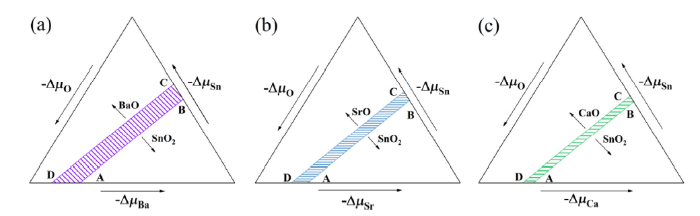
The calculated lattice constants of the relaxed structures are: (1) a = 4.19 Å (The experimental one is 4.12 Å) for BaSnO3; (2) a = 5.77 Å (5.71 Å), b = 5.86 Å (5.70 Å) and c = 8.18 Å (8.07 Å) for SrSnO3; (3) a = 5.57 Å (5.51 Å), b = 5.78 Å (5.66 Å) and c = 8.00 Å (7.88 Å) for CaSnO3, being consistent with experimental values [46,47,52]. After comprehensively considering all chemical potential constraints mentioned above, the ternary phase diagrams of ASnO3 are shown in Fig. 1. These chemical potential diagrams depict the regions of the stable ASnO3 single phases, defined by the quadrangle ABCD and restricted by the Sn, O2, AO and SnO2 precipitation lines. The points A, B, C and D, correspond to Sn- & SnO2-rich, O- & SnO2- rich, O- & AO-rich, and Sn- & AO-rich precipitate phase boundaries, respectively. The values of chemical potentials at corner points for A, Sn and O are given in Table 1.
Fig. 1. Chemical potential diagram of (a) BaSnO3, (b) SrSnO3, (c) CaSnO3, where in the quadrangle ABCD is stable area of ASnO3.
Table 1 Chemical potentials (-μA, -μSn, -μO) of A, Sn and O at the corner points, as A, B, C and D in
| ASnO3 | A = Ba | A = Sr | A = Ca | ||||||
|---|---|---|---|---|---|---|---|---|---|
| -μBa | -μSn | -μO | -μSr | -μSn | -μO | -μCa | -μSn | -μO | |
| A: Sn-&SnO2-rich | 3.59 | 0 | 3.69 | 3.81 | 0 | 3.69 | 4.02 | 0 | 3.69 |
| B: O-&SnO2-rich | 7.28 | 7.38 | 0 | 7.50 | 7.38 | 0 | 7.74 | 7.38 | 0 |
| C: O-&AO-rich | 5.93 | 8.73 | 0 | 6.70 | 8.17 | 0 | 7.20 | 7.93 | 0 |
| D: Sn-&AO-rich | 1.56 | 0 | 4.37 | 2.60 | 0 | 4.10 | 3.23 | 0 | 3.96 |
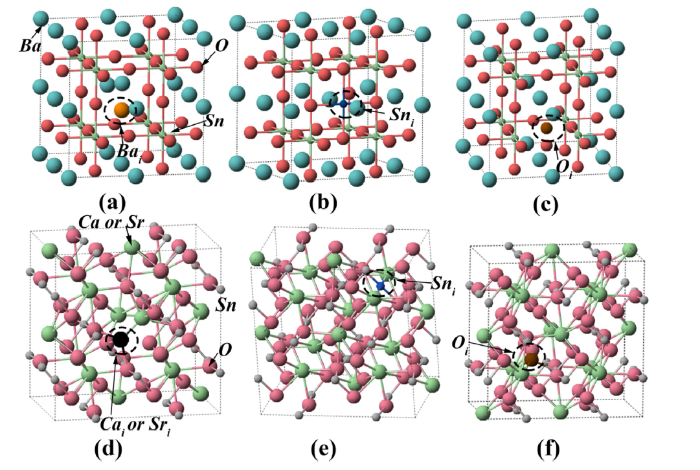
Crystalized in Pm$\bar{3}$m symmetry, the structural configurations of vacancies (VO, VSn and VBa) and cation antisite defects (BaSn and SnBa) in BaSnO3 are unique and readily identified. For SrSnO3 and CaSnO3 with Pbnm space group, the structures of atomic vacancies (VSn and VBa) and cation antisite defects (BaSn and SnBa) are also exclusive. As there are two kinds of oxygen atoms in the SrSnO3 and CaSnO3, the VO types with the lower formation energy ((0.4287, 0.5715, 0.5390) for SrSnO3 and (0.4343, 0.5670, 0.5567) for CaSnO3) are adopted. The structures of interstitial configurations (Ai, Sni and Oi, where i refers to interstitial) of ASnO3 are more complex. By calculating the defect formation energies in all possible interstitial positions as described in Refs. [28,38], the final interstitial positions with the lowest value in each species are determined. For BaSnO3 (Fig. 2(a-c)), both Ba and O favor the split-interstitial configuration along the <100> direction, with two atoms sharing a single lattice site. However, the Sn interstitial occupies a bridge site between two Ba atoms along a channel and in-plane with four nearest neighboring Sn and/or O atoms. SrSnO3 and CaSnO3 share the same interstitial configurations as shown in Fig. 2(d and e). The oxygen forms a split-interstitial configuration along <001> direction, while the Sr(Ca) forms a split-interstitial configuration along the <110> direction. The Sn interstitial occupies a bridge site between two Ca atoms along a channel and in-plane with four nearest neighboring Sn atoms.
Fig. 2. Interstitial configurations of cubic perovskite BaSnO3 with (a) Bai (orange ball), (b) Sni (blue ball) and (c) Oi (brown ball), orthorhombic perovskite SrSnO3 and CaSnO3 with (d) Sri or Cai (black ball), (e) Sni (blue ball) and (f) Oi (brown ball).
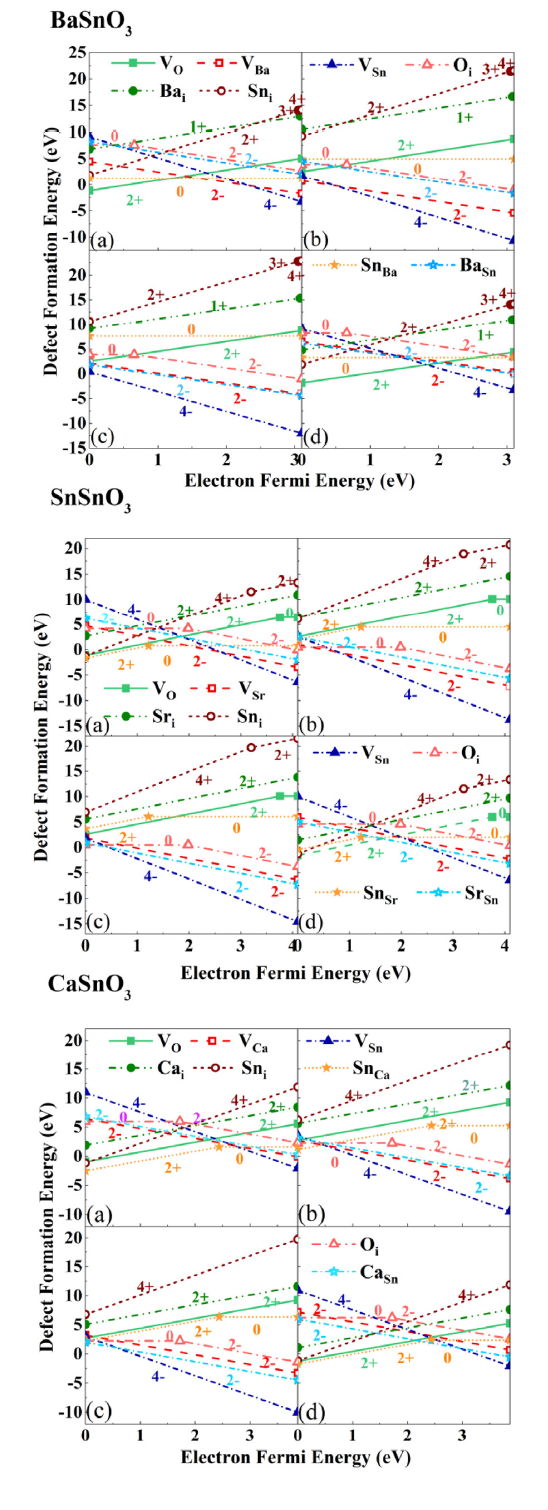
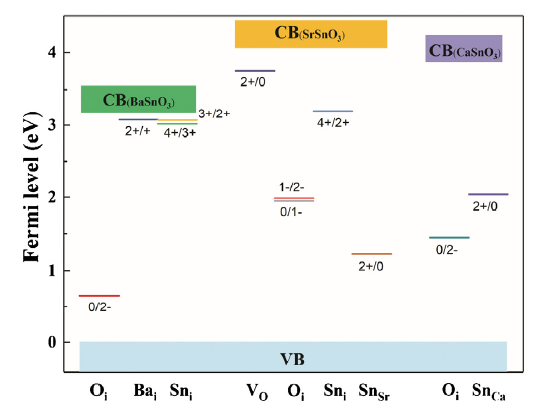
Then, the formation energies of all isolated point defect types with different charge states in ASnO3 are calculated using Eq. (1), in which the influence of the Fermi level on the formation energies of each defect has been considered. The zero point for Fermi level is set at the VBM. The chemical potential diagrams of BaSnO3, SrSnO3 and CaSnO3 are shown in Fig. 1. At all points in the ABCD quadrangle, the defect formation energy is located between the maximum and minimum values for each defect species at points A, B, C, and D. The electron Fermi energy dependent defect formation energies of ASnO3 at points A, B, C and D are calculated and shown in Fig. 3. Furthermore, the thermodynamic transition levels for the point defects of ASnO3 are displayed in Fig. 4. All thermodynamic transition energies are measured based on the VBM. For BaSnO3, the thermodynamic transition energy for Oi from 0 to 2- is at 0.66 eV, and that of Bai from 1+ to 2+ is at 3.08 eV. The Sni express two charge transitions, which are (4+/3+) at 3.05 eV and (3+/2+) at 3.07 eV. For SrSnO3, the (2+/0) transition of VO occurs at 3.76 eV. In the case of Oi, the (0/1-) and (1-/2-) transitions occur at 1.98 eV and 2.00 eV, respectively. The charge transition energy levels of Sni from 4+ to 2+ and SnSr from 2+ to 0 are at 3.20 eV and 1.22 eV, respectively. In the case of CaSnO3, there are two kinds of point defects with charge transitions, which are the (0/2-) transition occurring at 1.44 eV for Oi and the (2+/0) transition at 2.04 eV for SnCa.
Fig. 3. Electron Fermi level dependent defect formation energies for charged isolated point defects under (a) Sn- & SnO2-rich, (b) O- & SnO2- rich, (c) O- & AO-rich, and (d) Sn- & AO-rich conditions.
Fig. 4. Thermodynamic transition levels of Oi, Bai and Sni for BaSnO3, VO, Oi, Sni and SnSr for SrSnO3, Oi and SnCa for CaSnO3.
It has been reported that the nominally charged defects are the ground state defect structures [37,39,53]. In experiments, the nominally charged defects always appear in the form of defect complexes because of the charge neutrality limitation. According to the classic model for native point defects, the mechanism of defect complexes is described by Frenkel, Schottky and cation antisite defects in materials. For all compounds, the formation energies of all nominally charged (denoted as C-defect complexes) defect complexes are calculated and all results are listed in Table 2. For BaSnO3, the sequence of formation energies is Schottky < O Frenkel < Cation Antisite < Sn Frenkel < Ba Frenkel. For SrSnO3, the sequence is Schottky < Cation Antisite < O Frenkel < Sr Frenkel < Sn Frenkel, while it is Cation Antisite < Schottky < O Frenkel < Sr Frenkel < Sn Frenkel in the case of CaSnO3. Interestingly, the formation energies of the Schottky defect complexes are always relatively low and therefore must be significant for these compounds. In both SrSnO3 and CaSnO3, antisite defects are also the dominant defect structures as their low formation energies. Furthermore, the formation energies of oxygen Frenkel defect complexes are not significantly unreachable, indicating their possible appearance in these materials, especially at high temperatures.
Table 2 Native defect complex mechanisms and their formation energies (Ef in eV per defect), where nominally charged isolated point defects are denoted as C-defect complexes.
| C-defect complex | Ef(eV) | ||
|---|---|---|---|
| Ba | Sr | Ca | |
| 0↔$V^{2-}_{A}$+$V^{4-}_{Sn}$+$3V^{2+}_{O}$+ASnO3 | 2.02 | 2.28 | 2.91 |
| $A^{0}_{A}$↔$V^{2-}_{A}$+$V^{2+}_{i}$ | 5.64 | 3.73 | 4.17 |
| $Sn^{0}_{Sn}$↔$V^{4-}_{Sn}$+$Sn^{4+}_{i}$ | 5.50 | 4.37 | 4.89 |
| $O^{0}_{O}$↔$V^{2+}_{O}$+$O^{2-}_{i}$ | 3.85 | 3.52 | 3.95 |
| $A^{0}_{A}$+$Sn^{0}_{Sn}$↔$A^{2-}_{Sn}$+$Sn^{2+}_{A}$ | 5.04 | 2.29 | 2.15 |
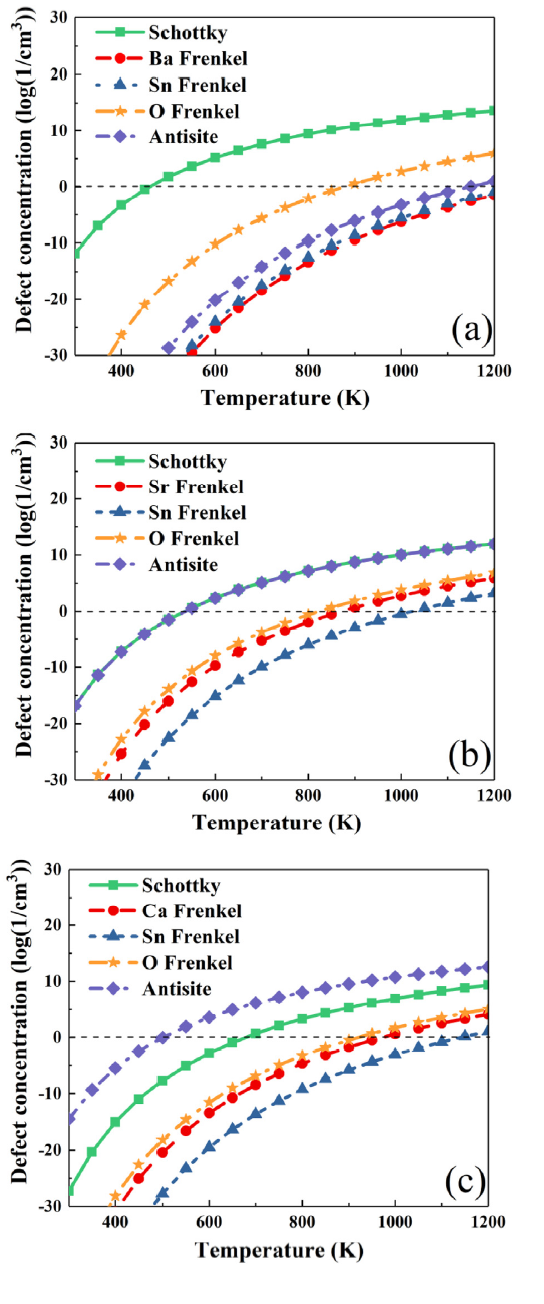
Based on the calculated formation energies (Table 2), the concentration of each native defect complex can be calculated using the Arrhenius formula as follows:
$C_{d}=N_{site}N_{config}exp(-E_{f}/(k_{B}T))$ (6)
where Nsite and Nconfig are the numbers of sites per unit volume and of equivalent configurations for the defect, kB is the Boltzmann constant and T is the temperature. Fig. 5(a-c) depicts the calculated temperature dependent concentrations of various defect complexes of ASnO3 (A = Ca, Sr, Ba). The concentrations of all kinds of defect complexes would increase with the temperature enhancement. Obviously, Schottky type is the predominant point defect structure and the O Frenkel pairs also exist in BaSnO3, while the concentration of others are less than 1 cm-3 even at 1000 K. In SrSnO3 and CaSnO3, the concentrations of Schottky and cation antisite defects are both at a high level, meanwhile the O and Sn/Ca Frenkel pairs may also appear at the same time, especially in the high temperatures over 1000 K. However, the concentration of Sn Frenkel pairs reaches the very low level as a result of their high formation energies. Therefore, it can be concluded that the defect complexes (including Schottky and O Frenkel pairs in BaSnO3, Schottky and cation antisite defects in SrSnO3 and CaSnO3) with relatively low formation energies are more likely to have the dominative proportion in defects and thus have practical implications in experiments. However, other defects presenting higher formation energies would unlikely proliferate under equilibrium experimental conditions.
Fig. 5. Temperature dependent concentrations of various charged native defect complexes of (a) BaSnO3, (b) SrSnO3 and (c) CaSnO3.
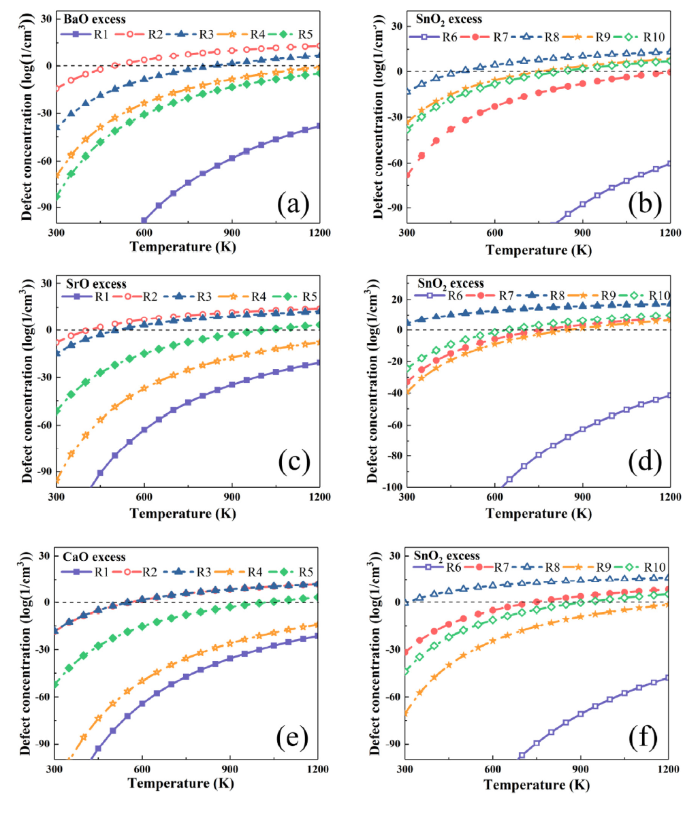
The types of existing point defect complexes are also influenced by the compositions of the ternary compounds [37]. In experiments, the nonstoichiometric compounds may often be obtained as a result of the experimental uncertain and thus the modification of the native point defect complexes is natural. In the case of the experimental synthesis of perovskite stannates ASnO3 (A = Ca, Sr, Ba), the composition of the two binary reactants, i.e. AO and SnO2, play a key role. The chemical potentials of elements in the cases of the AO excess and the SnO2 excess are clarified by the lines of CD and AB in Fig. 1, respectively. Here, taking two possible nonstoichiometric mechanisms into account, i.e. the AO excess and the SnO2 excess, the defect complexes in nonstoichiometric ASnO3 are studied. The defect formation reactions are shown in Table 3, together with their respective reaction enthalpies (∆H) that are the energy discrepancy of the compounds/defects between the right and left sides of each reaction. Using these reaction enthalpies, the temperature dependent concentrations of the defects in each reaction are provided in Fig. 6 for a quantitative description.
Table 3 Reaction enthalpies (∆H in eV) of ASnO3 nonstoichiometric mechanisms under AO- (line CD in
| Nonstoichiometric mechanisms | ΔH(eV) | |||
|---|---|---|---|---|
| AO-rich | A = Ba | A = Sr | A = Ca | |
| AO↔$A^{2+}_{i}$+$O^{2-}_{i}$ | (R1) | 14.33 | 10.05 | 10.23 |
| AO+$\frac{1}{2}Sn^{0}_{Sn}$+$\frac{1}{2}O^{0}_{O}$↔$\frac{1}{2}$ASnO3+$\frac{1}{2}V^{2+}_{O}$+$\frac{1}{2}A^{2-}_{Sn}$ | (R2) | 2.17 | 1.75 | 2.39 |
| AO+$\frac{1}{3}Sn^{0}_{Sn}$↔$\frac{1}{3}$ASnO3+$\frac{1}{3}A^{2-}_{Sn}$+$\frac{1}{2}A^{2+}_{i}$ | (R3) | 3.66 | 2.17 | 2.37 |
| AO+$Sn^{0}_{Sn}$+$2O^{0}_{O}$↔ASnO3+$V^{4-}_{Sn}$+$2V^{2+}_{O}$ | (R4) | 5.45 | 6.98 | 8.51 |
| AO+$\frac{1}{3}Sn^{0}_{Sn}$↔$\frac{1}{3}$ASnO3+$\frac{1}{3}V^{4-}_{Sn}$+$\frac{2}{3}A^{2+}_{i}$ | (R5) | 6.24 | 4.34 | 4.40 |
| SnO2-rich | ||||
| SnO2↔$Sn^{4+}_{i}$+$2O^{2-}_{i}$ | (R6) | 19.60 | 15.02 | 16.51 |
| SnO2+$\frac{1}{2}A^{0}_{A}$↔$\frac{1}{2}$ASnO3+$\frac{1}{2}Sn^{2+}_{A}$+$\frac{1}{2}O^{2-}_{i}$ | (R7) | 5.37 | 3.25 | 3.17 |
| SnO2+$\frac{2}{3}A^{0}_{A}$↔$\frac{2}{3}$ASnO3+$\frac{1}{3}Sn^{2+}_{A}$+$\frac{1}{3}V^{2-}_{A}$ | (R8) | 2.11 | 1.03 | 1.31 |
| SnO2+$A^{0}_{A}$+$O^{0}_{O}$↔ASnO3+$V^{2-}_{A}$+$V^{2+}_{O}$ | (R9) | 3.30 | 3.62 | 5.48 |
| SnO2+$\frac{2}{3}A^{0}_{A}$↔$\frac{2}{3}$ASnO3+$\frac{2}{3}Sn^{4+}_{i}$+$\frac{2}{3}V^{2-}_{A}$ | (R10) | 3.60 | 2.74 | 3.90 |
Fig. 6. Temperature dependent concentrations of various defect complexes under AO-rich and SnO2-rich conditions for (a, b) BaSnO3, (c, d) SrSnO3, (e, f) CaSnO3.
After analyzing all the reaction enthalpies collected in Table 3, the nonstoichiometry induced main defect structures for these three compounds can be reached as:
(1) For BaSnO3, the values of ΔH are in order of R2 < R3 < R4 < R5 < R1 when the BaO is excess. So, the $V^{2+}_{O}$ and $Ba^{2-}_{Sn}$ corresponding to R2 become the predominant defect species. The ΔH of R3 is the second lowest among all ΔH values and therefore its products, $Ba^{2-}_{Sn}$ and $Ba^{2+}_{i}$, would be the second widespread defects. However, the other reactions R1, R4 and R5 are very unlikely due to their high ΔH. Under the condition of the SnO2 excess, the values of ΔH are in order of R8 < R9 < R10 < R7 < R6. Therefore, the predominant defects are the R8 related defects of $Sn^{2+}_{Ba}$ and $V^{2-}_{Ba}$-. At the same time, as the ΔH values of R9 and R10 are close and also relative low, their reaction products, $V^{2-}_{Ba}$, $V^{2+}_{O}$ and $Sn^{4+}_{i}$, may also exist in this material. Besides, the reactions R6 and R7 are unlikely because of their very high ΔH (19.60 eV and 5.37 eV, respectively).
(2) For SrSnO3, in the case of SrO excess, the ΔH values are in order of R2 < R3 < R5 < R4 < R1. So, the predominant defect structures are $V^{2+}_{O}$ and $Sr^{2-}_{Sn}$ (R2), while $Sr^{2-}_{Sn}$ + $Sr^{2+}_{i}$ (R3) and $V^{4+}_{Sn}$ + $Sr^{2+}_{i}$ (R5) may also appear as a result of their relative low ΔH. However, the ΔH values of reactions R1 and R4 are very high, so that these related defects unlikely occur. When SnO2 is excess, the values of ΔH are in order of R8 < R10 < R7 < R9 < R6. The reaction R8 has the lowest ΔH, so $Sn^{2+}_{Sr}$ and $V^{2-}_{Sr}$ are the predominant defects. Moreover, $Sn^{4+}_{i}$ and $V^{2-}_{Sr}$ will also be significant defects as the second low ΔH of R10. Besides, R7 and R9 may proceed more or less but R6 is unlikely.
(3) For CaSnO3, when CaO is excess, the values of ΔH are in order of R3 < R2 < R5 < R4 < R1. The reactions R2 and R3 have similarly low ΔH s and therefore $V^{2+}_{O}$ + $Ca^{2-}_{Sn}$ and $Ca^{2-}_{Sn}$ + $Ca^{2+}_{i}$ are the predominant defects. The occurrence possibility of other reactions which have high ΔH values is negligible. In the case of SnO2 excess, the values of ΔH are in order of R8 < R7 < R10 < R9 < R6. The R8 has the lowest ΔH and therefore the $Sn^{2+}_{Ca}$ and $V^{2-}_{Ca}$ are the predominant defects. The ΔH values of reaction R7 and R10 are also relatively low, indicating the greater possibility of $O^{2-}_{i}$ and $Sn^{4+}_{i}$ appearance. However, the reactions R6 and R9 are unlikely because of their high ΔH values.
The composition of ASnO3 plays a key role in the types and concentrations of their intrinsic point defects. All the predominant defect structures that are the defect complex types owing the firstly and secondly low formation energies in each composition are as collected in Table 4. For BaSnO3, the reaction enthalpies of defect complexes are low and very similar in both BaO and SnO2 excess cases (as shown in Table 3), but different defect structures are generated. Comparing to stoichiometric BaSnO3, $Ba^{2+}_{i}$ and $Ba^{2-}_{Sn}$ appear under BaO excess but $Sn^{2+}_{Ba}$ and $V^{2-}_{Ba}$ occur under SnO2 excess. At the same time, $V^{2+}_{O}$ always exists more or less in both stoichiometric and nonstoichiometric BaSnO3. The existing $V^{2+}_{O}$ is beneficial to the reduction of the thermal conductivity and the enhancement of the electronic conductivity, promoting its application as transparent conducting semiconductors in optoelectronic devices [54,55]. Similarly, the defect types also can be modified by controlling the AO to SnO2 ratio in the cases of SrSnO3 and CaSnO3 as indicated by Table 4. Being differently with BaSnO3, the reaction enthalpies of defect complexes under SnO2 excess are much lower than those under SrO and/or CaO excess. It means that these two materials can accommodate larger SnO2 deviation than SrO/CaO in experiments. In all, the predominant defect complexes change under different conditions, which do provide us the possibility of the defect structure tailoring through modifying the synthetic composition of these materials.
Table 4 Predicted predominant defect structures in stoichiometric and nonstoirchiometric ASnO3 (A = Ba, Sr, Ca), where the defect complex owing the minimum formation energy is in bold.
| ASnO3 | Stoichiometry | AO excess | SnO2 excess |
|---|---|---|---|
| A = Ba | VBa2-+VSn4-+$3V^{2+}_{O}$ | $V^{2+}_{O}$+BaSn2- | SnBa2++VBa2- |
| $V^{2+}_{O}$+$O^{2-}_{i}$ | $Ba^{2-}_{Sn}$+$Ba^{2+}_{i}$ | $V^{2-}_{Ba}$+$V^{2+}_{O}$ | |
| A = Sr | VSr2-+VSn4-+$3V^{2+}_{O}$ | $V^{2+}_{O}$+SrSn2- | SrSn2++VSr2- |
| $Sr^{2-}_{Sn}$+$Sr^{2+}_{Sr}$ | $Sr^{2-}_{Sn}$+$Sr^{2+}_{i}$ | $\frac{1}{3}Sn^{4+}_{i}$+$\frac{2}{3}V^{2-}_{Sr}$ | |
| A = Ca | CaSn2-+SnCa2+ | CaSn2-+$Ca^{2+}_{i}$ | SnCa2++VCa2- |
| $V^{2-}_{Ca}$+$V^{4-}_{Sn}$+$3V^{2+}_{O}$ | $V^{2+}_{O}$+$Ca^{2-}_{Sn}$ | $\frac{1}{2}Sn^{2+}_{Ca}$+$\frac{1}{2}O^{2-}_{i}$ |
The intrinsic point defects in the stoichiometric and nonstoichiometric stannate perovskites (ASnO3; A = Ca, Sr, Ba) were comprehensively studied employing the first-principles calculation. The chemical potential diagrams are constructed. Then the types and concentrations of favorable defect as well as their interconnected evolutions have been deduced considering the external environments. By calculating the formation energies of different charges with various isolated intrinsic point defects, it can be found that the charge state of Sni (4+/3+/2+), Bai (2+/1+) and Oi (0/2-) in BaSnO3, Oi (0/1-/2-), Sni (4+/2+), VO (2+/0) and SnSr (4+/2+) in SrSnO3 and Oi (0/2-) and SnSr (2+/0) in CaSnO3 varies with the change of electron Fermi energy, while other defects prefer their nominal charge states over the entire band gap.
Furthermore, investigations in this work uncover the defect preferences of perovskite stannates (ASnO3; A = Ca, Sr, Ba)under stoichiometric and nonstoichiometric conditions: The dominant defect complexes in stoichiometric BaSnO3, SrSnO3 and CaSnO3 are Schottky defect ($V^{2-}_{Ba}$ + $V^{4-}_{Sn}$ + $3V^{2+}_{O}$), Schottky defect ($V^{2-}_{Sr}$ + $V^{4-}_{ n}$ + $3V^{2+}_{O}$) and antisite defect ($Sr^{2-}_{Sn}$ + $Sn^{2+}_{Sr}$), and antisite defect ($Ca^{2-}_{Sn}$ + $Sn^{2+}_{Ca}$), respectively. In the nonstoichiometric cases, the AO excess is beneficial to the formation of $V^{2+}_{O}$ and $A^{2-}_{Sn}$ in all ASnO3 compounds. Meanwhile, there also may be considerable amounts of $A^{2-}_{Sn}$ and $A^{2+}_{i}$ defects in SrSnO3 and CaSnO3. Being differently, $Sn^{2+}_{A}$ and $V^{2-}_{A}$ are the predominant defect complexes in the SnO2 excess environment. The calculation results are supposed to inspire the intrinsic defect controlling for the specific defect corresponding properties, so as to accelerate their commercial applications as optic-electronic semiconductors.
This work was supported financially by the National Natural Science Foundation of China (Nos. 51602188 and 51972206), the Program for Professor of Special Appointment (Eastern Scholar) by Shanghai Municipal Education Commission (No. TP2015040) and the Science and Technology Committee of Shanghai (No. 19010500400).

 WeChat
/
| 〈 |
|
〉 |