Search for articles:
Huijun Liu , Ying Wang
Corresponding authors:
Received: 2019-01-3
Revised: 2019-02-21
Accepted: 2019-02-28
Online: 2020-01-15
Copyright: 2020 Editorial board of Journal of Materials Science & Technology Copyright reserved, Editorial board of Journal of Materials Science & Technology
More
Abstract
A simple method to synthesize high-content ternary carbide Ti3AlC2 nanoparticles from Ti, Al, and C starting elemental powders without ball milling in NaCl‒KCl molten salt was reported. The effects of mass ratio of the salt to starting materials, temperature, reaction time, and Al molar ratio on preparation of Ti3AlC2 were investigated. The Ti3AlC2 formation is dramatically influenced by temperature and mass ratio of the salt to raw materials: a higher temperature and higher mass ratio of the salt to raw materials are more preferable for Ti3AlC2 powder formation. Homogenous Ti3AlC2 powder with particle size of ˜100 nm is synthesized by 3Ti/Al/2C starting elemental powders in NaCl‒KCl molten salt at 900 °C for 10 h, 950 °C for 5 h, or 1000 °C for 2 h, respectively, when the mass ratio of the salt to 3Ti/Al/2C starting materials is 10:1.
Keywords:
Titanium aluminum carbide Ti3AlC2, as one of the layered ternary carbides known as the MAX phase, has attracted increasing attention in recent years owing to its combination of excellent properties of metals and ceramics [1], such as good electrical and thermal conductivity, easy machinability, excellent thermal shock resistance, low frictional coefficient, high thermal stability and high-temperature oxidation resistance [[2], [3], [4]]. Especially, Ti3AlC2 exhibits some abnormal compressive plasticity at room temperature compared with normal ceramics [5]. Therefore, it can be a most potential material for various functional and structural applications, such as structural material for high temperature, heat exchanger for nuclear power station, electric contact materials, and so on. Additionally, Ti3AlC2 is also a raw material for Ti3C2 preparation [[6],[7]], which is a member of the family of two-dimensional (2D) layers of transition metal carbides called “MXene” and has shown great promise in Li-ion batteries [[8], [9], [10]], pseudo-capacitors [[11], [12], [13], [14]], support for catalysts [15], and conductive reinforcement/additives to polymers applications [16]. Hence, the large-scale fabrication of ultrafine Ti3AlC2 powder becomes more and more important.
Since Ti3AlC2 bulk materials have been firstly synthesized by Pietzka and Schuster by sintering cold-compacted powder mixtures of Ti, TiAl, Al4C3 and C at 1300 °C in pure hydrogen for 20 h [1], various methods have been attempted to synthesize Ti3AlC2 bulk materials such as pressureless sintering [[17],[18]], spark plasma sintering [[19],[20]], hot isostatic pressing [21], self-propagating high-temperature synthesis [22], high-energy ball milling [23], and so on [[24], [25], [26]]. However, there are few works reported on the preparation of Ti3AlC2 powders [[27], [28], [29]]. Li et al. [30] synthesized ternary layered compound Ti3AlC2 powder with high purity by a rapid heating method at 1350 °C holding for 60 min. Ai et al. [31] synthesized the nearly pure Ti3AlC2 powder by pressureless calcining process using Sn as an additive at 1350 to 1500 °C. Nevertheless, the particle size of Ti3AlC2 powder prepared by these methods is always from a few microns to dozens of micron range due to high synthesis temperature, which may negatively affect its applications in some fields [32]. Hence, it is very necessary to develop a novel process to synthesis nano-scale or micro-nano Ti3AlC2 powder with high dispersibility at a moderate condition.
In fact, molten salt method has attracted increasing interest in recent years due to its low-temperature synthesis of nanosized carbide [[33], [34], [35]]. Up to now, Ti3SiC2 and Cr2AlC have also been successfully synthesized by molten salt method [[36],[37]]. However, the mixture of the salt and raw materials needs to be firstly ball-milled for a long time (16-24 h), and then synthesized by the above mentioned methods. In addition, the particle size of the prepared Ti3SiC2 and Cr2AlC MAX phases is also larger than a few microns. Therefore, the objective of this work is to report on synthesis of nano-scale Ti3AlC2 powder by a modified molten salt method using Ti, Al, and C as raw materials without ball milling at a relatively low temperature.
Ti, Al (supplied by Beijing Xing Rong Yuan Technology Co., LTD., 325 mesh, purity >99.8%), and acetylene black powders (Tianjin day first Century Chemical Industry Co. Ltd, average particle size of 30-50 nm, purity >99.9%) were used as starting materials without ball milling in this study. An eutectic NaCl‒KCl (supplied by Tianjin Kemiou Chemical Reagent Co., Ltd. analytical grade≥99.5%) molten salt was used as reaction medium, which was dried under vacuum at 300 °C for 24 h to remove residual water. Starting materials with molar ratio of 3Ti/Al/2C were weighed and mechanically mixed at mass ratios of the dried salt to starting materials of 1:1 and 10:1 in an alumina crucible. After that, the crucible was placed in the bottom of a vertical tubular stainless steel vessel with an inside diameter of 110 mm and a height of 600 mm placed inside a vertical tube furnace. Then, the vessel was heated to the target temperature at a rate of 6 °C min-1 and held for different time under a flowing argon atmosphere. After reaction, the chamber was naturally cooled to room temperature. Then the sample was ultrasonically rinsed with boiling deionized water several times to remove the solidified salt. Finally, the sample was dried at 80 °C for 10 h.
The X-ray diffraction (XRD, PANalytical X’Pertpro) with Cu target Kα radiation was carried out to identify the phase constituents of the samples. The microstructure and morphology of the sample were characterized by field-emission scanning electron microscopy (FE-SEM, FEI FP 2031/11 inspect F) coupled with energy dispersive X-ray spectrometer (EDX, Oxford) and high resolution transmission electron microscopy (HRTEM, JEM-2100 F, JEOL, Tokyo, Japan) and selected-area electron diffraction (SAED).
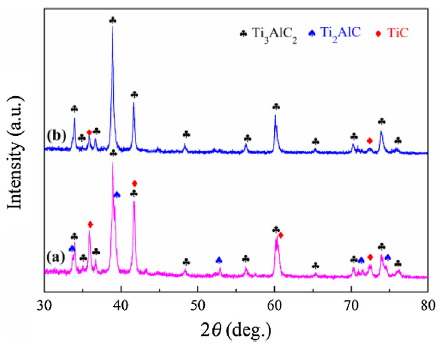
Fig. 1 presents XRD patterns of samples synthesized at mass ratio of eutectic NaCl‒KCl salt to 3Ti/Al/2C starting elemental powders of 1:1 and 10:1 at 950 °C for 5 h. The result shows that the desired Ti3AlC2 and a large amount of Ti2AlC and TiC impurities are obtained when equal mass ratio of the salt to raw materials was used as shown in curve a. However, when the mass ratio of the salt to raw materials is increased to 10:1, the desired Ti3AlC2 and a few TiC are obtained as shown in curve b. To the best of our knowledge, the temperature of Ti3AlC2 powder synthesized in this work is far lower than that synthesized by traditional molten salt method [38]. In addition, the method is simpler and higher efficiency. This is because of the faster mass transport in liquid salt medium when higher mass ratio of the salt to raw materials is used, and hence reactions are faster and synthesis is completed at lower temperature and shorter time [[33],[39]].
Fig. 1. XRD patterns of samples synthesized at mass ratio of eutectic NaCl‒KCl salt to 3Ti/Al/2C starting elemental powders of (a) 1:1 and (b) 10:1 at 950 °C for 5 h.
The corresponding SEM images of samples synthesized at mass ratio of the salt to raw materials of 1:1 and 10:1 are shown in Fig. 2. Results indicate that mixture of Ti3AlC2 and Ti2AlC with particle size of 10-20 μm and some fibers are obtained at mass ratio of the salt to raw materials of 1:1 as shown in Fig. 2(a) and (c), respectively. However, Ti3AlC2 powder with an average particle size of ˜100 nm is successfully synthesized when the mass ratio of the salt to 3Ti/Al/2C starting materials is 10:1 as shown in Fig. 2(b). The fiber in Fig. 2(c) is also characterized by TEM and the result is shown in Fig. 2(d). The inset SAED pattern suggests that the fiber is TiC. This is in agreement with XRD results shown in Fig. 1. Furthermore, the particle size of Ti3AlC2 powder synthesized in this work is much smaller than that synthesized by traditional methods [[27], [28], [29]] and molten salt method [38]. Additionally, the modified molten salt method in this study is not sensitive to the sample scale of starting materials because the Ti3AlC2 powder is synthesized in a liquid phase; therefore, it can be used to synthesize Ti3AlC2 powder in a large-scale. Therefore, the mass ratio of the salt to 3Ti/Al/2C raw materials is chosen as 10:1 in the following study.
Fig. 2. SEM images of samples synthesized at the mass ratio of eutectic NaCl‒KCl molten salt to 3Ti/Al/2C powders of (a) 1:1 and (b) 10:1 at 950 °C for 5 h, (c) higher magnification micrograph of the fiber of area A in
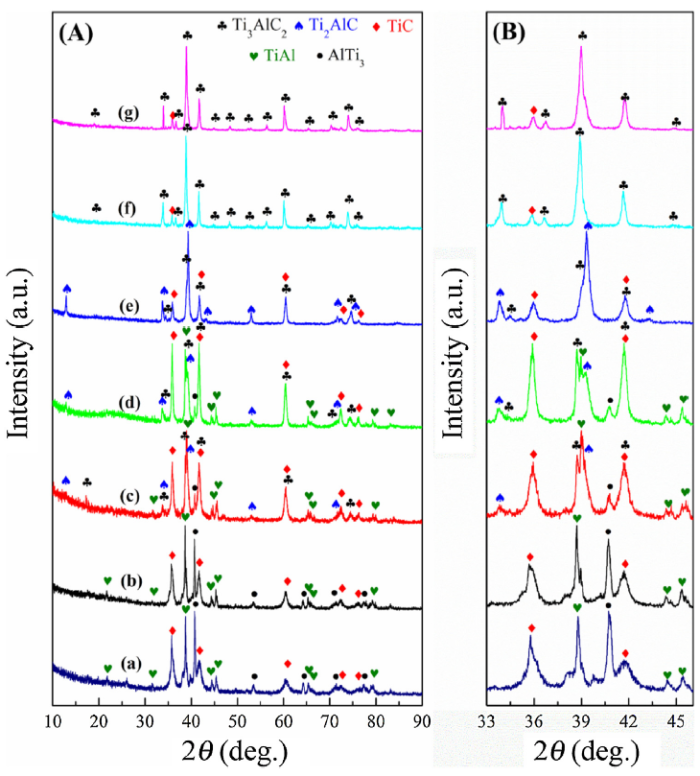
Fig. 3 shows XRD patterns and the detailed XRD patterns of samples synthesized at the mass ratio of the salt to 3Ti/Al/2C powders of 10:1 at temperature ranging from 700 to 1000 °C for 2 to 5 h. From Fig. 3 curve a and b, it can be seen that the TiAl, Ti3Al, and TiC phases are initially formed when the starting materials of Ti, Al and acetylene black are heated in NaCl‒KCl molten salt at 700 or 750 °C holding for 5 h. The absence of acetylene black in the product is due to the rinsing of boiled deionized water after reaction. As the temperature increases to 800 °C, the sample consists of TiAl, Ti3AlC2, Ti2AlC, TiC, and a small amount of Ti3Al phases as shown in detailed XRD patterns in Fig. 3(B). It is deduced that Ti3Al phase may react with C to form Ti3AlC2 and TiAl phase react with TiC to form Ti2AlC at 800 °C, respectively. As the temperature increases to 850 °C, the amount of TiAl and Ti3Al reduces while Ti3AlC2, Ti2AlC, TiC increases as shown in curve d. As the temperature further increases to 900 °C, the phases of TiAl and Ti3Al disappear, those of Ti3AlC2 and TiC are still observed, and Ti2AlC becomes the main phase as shown in curve e, which may be due to the more reaction between TiAl and TiC to form Ti2AlC phase. When the temperature reaches 950 °C, the desired Ti3AlC2 as the main phase and a few TiC as impurity phase are obtained as shown in curve f. It can be concluded that Ti2AlC phase further reacts with TiC phase to form Ti3AlC2. Therefore, Ti3AlC2 is successfully synthesized from 3Ti/Al/2C starting elemental powders without ball milling in NaCl‒KCl molten salt at 950 °C for 5 h.
Fig. 3. XRD patterns (A) and detailed XRD patterns (B) of samples synthesized at the mass ratio of the salt to 3Ti/Al/2C powders of 10:1 at different temperature for different times: (a) 700 °C, (b) 750 °C, (c) 800 °C, (d) 850 °C, (e) 900 °C, and (f) 950 °C for 5 h, (g) 1000 °C for 2 h.
Furthermore, when the temperature is elevated to 1000 °C just holding for 2 h, as shown in Fig. 3 curve g, the obtained sample is the same as that synthesized at 950 °C for 5 h. These evidences reveal that high-content Ti3AlC2 is synthesized at the mass ratio of the salt to 3Ti/Al/2C powders of 10:1 at 950 °C for 5 h or at 1000 °C for 2 h. In addition, the formation of the Ti3AlC2 is dramatically influenced by temperature and a higher temperature is more preferable for the preparation of Ti3AlC2 powder. More importantly, the temperature for Ti3AlC2 powder synthesized by this molten salt method is far lower than that synthesized by traditional methods [[27], [28], [29]]. This may be due to the eutectic NaCl‒KCl salt used as a liquid medium, which assists rapid diffusion of reactant species, and hence reactions are faster and synthesis is completed in significantly lower temperature [33].
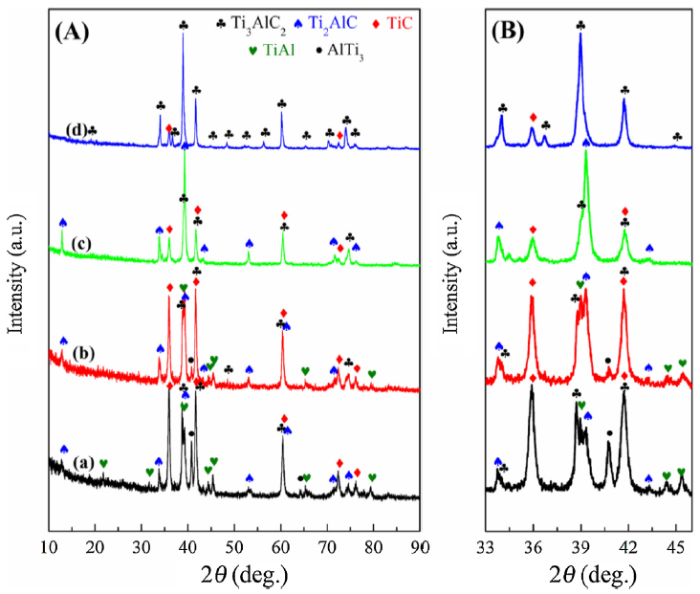
In order to obtain the optimal holding time at a relatively low temperature of 900 °C to synthesize Ti3AlC2 powder, the effect of holding time on formation of Ti3AlC2 is investigated by changing the holding time from 1 to 10 h. XRD patterns of samples synthesized from 3Ti/Al/2C starting elemental powders in NaCl‒KCl molten salt at 900 °C for different time are shown in Fig. 4. The results show that when starting materials are heated at 900 °C holding for 1 h, the sample is mainly composed of TiC, Ti3AlC2, TiAl, Ti2AlC, and a small amount of Ti3Al phase. As the holding time increases to 2 h, the amount of Ti3Al and TiC phases reduces while Ti2AlC increases as shown in the detailed XRD pattern in Fig. 4(B). As the holding time further increases to 5 h, the phases of TiAl and Ti3Al disappear and Ti2AlC becomes the main phase as shown in curve c. When the holding time reaches 10 h, the desired Ti3AlC2 as the main phase and a few of TiC as impurity phase are also obtained and shown in curve d. Therefore, the optimal holding time is 10 h for synthesizing Ti3AlC2 from 3Ti/Al/2C starting elemental powders in NaCl‒KCl molten salt at a relatively low temperature of 900 °C.
Fig. 4. XRD patterns (A) and the detailed XRD patterns (B) of samples synthesized at the mass ratio of the NaCl‒KCl molten salt to 3Ti/Al/2C powders of 10:1 at 900 °C for different times: (a) 1 h, (b) 2 h, (c) 5 h, (d) 10 h.
From the above analysis, it is concluded that the Ti3AlC2 powder is synthesized by 3Ti/Al/2C starting elemental powders in NaCl‒KCl molten salt at 900 °C for 10 h, 950 °C for 5 h, or 1000 °C for 2 h, respectively. In addition, the reaction path for the formation of Ti3AlC2 form 3Ti/Al/2C may be proposed as follows. Firstly, the Al melts and reacts with some Ti to form TiAl and Ti3Al intermetallic, and then, the carbon diffuses and attaches onto the surface of Ti, TiAl and Ti3Al species to form Ti2AlC, TiC and Ti3AlC2 at a higher temperature. Finally, the surplus Ti2AlC further reacts with TiC to form Ti3AlC2.
Due to TiC as impurity phase exists in the final products as shown in section 3.2 and 3.3, and it is also reported that Al may be deficiency due to its evaporation by the synthesis of the traditional methods [40]. Hence, increasing Al content in the starting powder may compensate the Al loss due to the high-temperature evaporation. Therefore, four sets of the starting elemental powders according to the Ti:Al:C molar ratios of 3:0.9:2, 3:1:2, 3:1.1:2, and 3:1.2:2 were well mixed with the dried NaCl‒KCl and then heating at 950 °C holding for 5 h, the corresponding XRD patterns and the detailed XRD patterns of samples obtained are shown in Fig. 5(A) and (B), respectively. The result reveals that with increasing Al molar ratio from 1.0 to 1.1, a certain amount of Ti2AlC as the new impurity is observed as shown in curve b and c. This suggests that excessive Al would facilitate the formation of Ti2AlC phase. In addition, the amount of Ti2AlC phase increases with the increase of Al content in the starting elemental powders as shown in Fig. 5 curve d. However, when insufficient Al was used in the starting elemental powders as shown in Fig. 5 curve a, large amounts of TiC and Ti2AlC phases as impurities and Ti3AlC2 as the main phase were obtained. Hence, The Al content in starting elemental powders would not facilitate the formation of Ti3AlC2. On the contrary, it reacts with TiC and enhances the formation of Ti2AlC. The result is different from that reported by Wang et al. [41] and Yang et al [42]. The reason are as follows, on the one hand, the melt point of eutectic NaCl‒KCl and Al are 657 and 660 °C, respectively; on the other hand, the density of Al is higher than NaCl‒KCl molten salt. Therefore, the liquid Al is under the molten salt and the evaporation of Al is prevented by the liquid molten salt when the temperature is above 660 °C. Additionally, TiAl and Ti3Al alloy even forms at 700 °C as shown in Fig. 1 curve a, which further prevents the evaporation of Al. Therefore, the optimal molar ratio of Ti:Al:C is 3:1:2 for synthesizing Ti3AlC2 powders in NaCl‒KCl molten salt.
Fig. 5. XRD patterns (A) and the detailed XRD patterns (B) of samples obtained at the mass ratio of the NaCl‒KCl molten salt to 3Ti/Al/2C powders of 10:1 at 950 °C for 5 h: (a) 3:0.9:2, (b) 3:1:2, (c) 3:1.1:2, (d) 3:1.2:2.
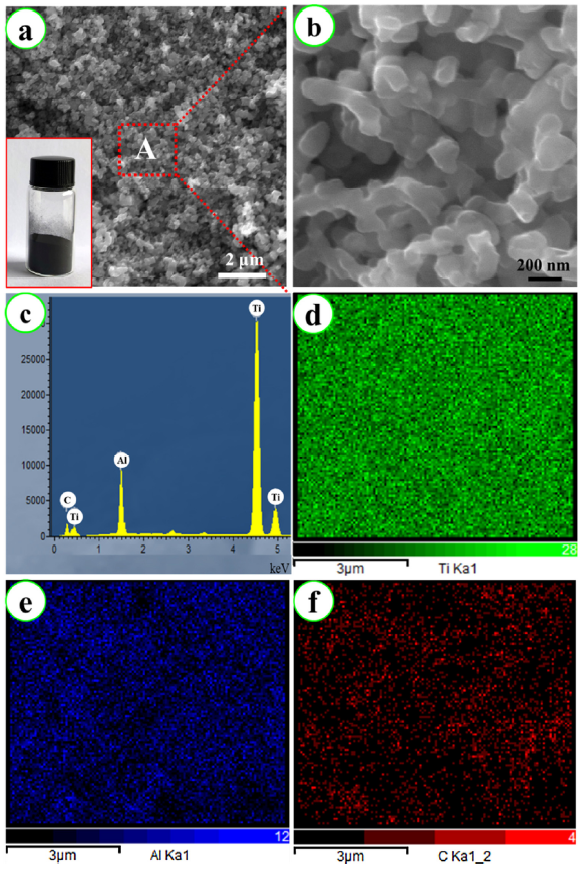
Fig. 6 shows the typical FE-SEM microstructure of Ti3AlC2 powder obtained from 3Ti/Al/2C starting elemental powders in NaCl‒KCl molten salt at 1000 °C for 2 h, and the corresponding XRD pattern is shown in Fig. 3 curve g. As shown in Fig. 6(a) and (b), it is observed that products are composed of homogeneous particles with a particle size ˜100 nm. An energy-dispersive X-ray spectroscopy (EDS) spectrum illustrates that only Ti, Al, and C elements are detected, further suggesting that Ti3AlC2 compound is synthesized as shown in Fig. 6(c). In addition, the elemental mapping analysis of Ti3AlC2 nanoparticles in Fig. 6(a) reveals that the element of Ti, Al and C are uniformly distributed in the sample obtained, as shown in Fig. 6(d), (e) and (f), respectively. Combined with the XRD results in Fig. 3 curve g, it is conformed that the homogeneous Ti3AlC2 nanoparticles are prepared by this molten salt method.
Fig. 6. (a) FE-SEM images of the prepared Ti3AlC2 powder from 3Ti/Al/2C starting elemental powders in NaCl‒KCl molten salt at 1000 °C for 2 h. The inset in (a) shows the digital photograph of a glass bottle filled with the obtained Ti3AlC2 powder. (b) Higher magnification micrograph from area A. (c) Energy-dispersive X-ray spectroscopy analysis result of area A in
The representative microstructure of the Ti3AlC2 nanoparticles obtained from 3Ti/Al/2C starting elemental powders in NaCl‒KCl molten salt at 1000 °C for 2 h is also characterized by TEM as shown in Fig. 7. The TEM images of Ti3AlC2 nanocrystallines show that the average size of Ti3AlC2 particles is approximately 100 nm as shown in Fig. 7(a) and (b). The inset in Fig. 7(a) shows the Tyndall scattering eff ;ect for the suspension of Ti3AlC2 nanoparticles in deionized water by shining a laser beam through the solution. This suggests that the Ti3AlC2 nanoparticle was a colloidal solution with high hydrophilicity and dispersibility. Furthermore, the typical layer structure of Ti3AlC2 powder is clearly seen in TEM and HRTEM images as shown in Fig. 7(c) and (d). The obvious lattice fringes reveal that the Ti3AlC2 is well-crystallined. The layered atomic stacking and the corresponding SAED pattern on the surface of the obtained Ti3AlC2 powder can also be clearly identified in the HRTEM image as shown in Fig. 7(e) and (f).
Fig. 7. TEM images (a, b) of the Ti3AlC2 powder obtained from 3Ti/Al/2C starting elemental powders in NaCl‒KCl molten salt at 1000 °C for 2 h. The inset in (a) shows the Tyndall scattering eff ;ect for the suspension of Ti3AlC2 nanoparticles in deionized water. (c) TEM and (d) HRTEM images of the typical layer structure on the cross-section of the obtained Ti3AlC2 powder in area A in
A simple, high efficiency and relatively low temperature process for high-content Ti3AlC2 nanoparticles preparation has been developed. Homogenous Ti3AlC2 powders with particle size of ˜100 nm was synthesized by 3Ti/Al/2C starting elemental powders in NaCl‒KCl molten salt at 900 °C for 10 h, 950 °C for 5 h, or 1000 °C for 2 h. Moreover, the Ti3AlC2 formation in NaCl‒KCl molten salt is dramatically influenced by temperature and mass ratio of the salt to raw materials: a higher temperature and higher mass ratio of the salt to raw materials are more preferable for Ti3AlC2 powder formation. While the Al content in the starting elemental powders would not facilitate the formation of Ti3AlC2 because there is no evaporation of Al in the liquid molten salt. The reaction path for the formation of Ti3AlC2 form 3Ti/Al/2C is summarized as follows. Firstly, the Al melts and reacts with some Ti to form TiAl and Ti3Al intermetallic, and then, the carbon diffuses and attaches onto the surface of Ti, TiAl and Ti3Al species to form Ti2AlC, TiC and Ti3AlC2 at a higher temperature. Finally, the surplus Ti2AlC further reacts with TiC to form Ti3AlC2.
This work is supported financially by the National Natural Science Foundation of China (No. 51501205).

 WeChat
/
| 〈 |
|
〉 |