Search for articles:
Xuejin Yang , Duan Li, Changwei Shao
Corresponding authors:
Received: 2019-03-25
Revised: 2019-03-31
Accepted: 2019-05-15
Online: 2019-12-05
Copyright: 2019 Editorial board of Journal of Materials Science & Technology Copyright reserved, Editorial board of Journal of Materials Science & Technology
More
Abstract
Wave-transparent ceramic matrix composites for the high temperature use should possess excellent oxidation resistance. In this work, Si3N4f/SiO2 composites with different fiber content were fabricated by filament winding and sol gel method. The oxidation resistance was investigated by tracking the response of flexural strength to the testing temperature. The results show that the flexural strength and toughness of the composites with fiber content of over 37% can reach high levels at around 175.0 MPa and 6.2 MPa m1/2, respectively. After 1 h oxidation at 1100 °C, the flexural strength drops a lot but can still reach 114.4 MPa, which is high enough to ensure the safety of structures. However, when the oxidation temperature rises to 1200-1400 °C, the flexural strengths continue to fall to a relatively low level at 50.0-66.4 MPa. The degradation at high temperatures is caused by the combination of over strong interfacial bonding, the damage of fiber and the crystallization of silica matrix.
Keywords:
Wave-transparent ceramic matrix composite is an important structural and functional material for the antenna window use. To ensure the safety and communication of radar system during the service at high temperature, such composite should possess good bearing capability, dielectric property, heat and oxidation resistance [1,2]. In recent years, silica fiber reinforced wave-transparent composites have been widely investigated because of their excellent mechanical and dielectric properties, but silica fiber encounters a problem of crystallization at over 1100 °C, which leads to a dramatic drop of strength [3,4]. In order to meet the application at more than 1100 °C, silicon nitride fiber has been proposed and widely studied. It is reported to be one of the most promising reinforcements for the high temperature use due to its good oxidation resistance and better thermal stability than silica fiber [[5], [6], [7], [8]].
In the past few decades, many research institutions have been devoted to the preparation and optimization of silicon nitride fibers [[9], [10], [11], [12], [13], [14], [15]]. TONEN corporation produced silicon nitride fibers (SNF) by pyrolysis of perhydropolysilazane [9]. The tensile strength can reach up to 2.2 GPa. The content of oxygen and carbon is less than 2.7% and 0.4%, respectively, which is necessary to ensure well thermal stability and dielectric property of fibers. However, the precursor is readily oxidized and hydrolyzed. This problem increases the difficulty of mass production. Instead, National University of Defense and Technology adopted polycarbosilane as a precursor and produced silicon nitride (KD-SN) fibers by nitridation technology [10]. KD-SN fibers share a similar composition with SNF. The tensile strength can reach up to 1.3-1.5 GPa. In spite of these progress on silicon nitride fibers, there is no silicon nitride fiber commercially available now, and there are few reports about the silicon nitride fiber reinforced composites. K. Sato et al. have ever prepared Si3N4f/SiNC composite and introduced a C-B-Si fiber coating to form borosilicate glass and seal oxygen-diffusion passes [16]. The results show that the as-prepared composites can maintain 60%-70% of their original strength even after 1250 °C oxidation for 100 h. J. Zhang et al. prepared Si3N4f/PyC/SiO2 composite via sol-gel method [17]. It is reported that the 1000 °C sintered composite performs well at high temperatures. The flexural strength at 1200 and 1400 °C can reach 118 and 61 MPa, respectively. Although the oxidation resistance of these composites is considerable, the existence of carbon has a negative influence on their dielectric properties. In order to retain the dielectric properties and improve the high-temperature performance, we fabricated Si3N4f/SiO2 composite by lowering the sintering temperature to 800 °C [18]. The prepared composites maintain a flexural strength of 210 MPa at 1200 °C, which is 128% of their original strength. But the oxidation time is limited to 600 s and the performance at higher temperatures is still unknown.
In the current work, Si3N4f/SiO2 composites with fiber content of 29 vol.%-45 vol.% were prepared. The aim was to investigate to influence of fiber content on the mechanical properties of composites. Oxidation temperature was increased to 1100-1400 °C, while the holding time was prolonged to 1 h. X-ray diffraction (XRD, D8 Advance) and Infrared spectrometer (IR, Frontier) were employed to study the composition change of composites. The fracture mode and failure mechanism were revealed by correlating the fracture surface to the macro flexural strength.
Near-stoichiometric silicon nitride fibers with low oxygen (3.66 wt.%) and carbon content (0.76 wt.%) were provided by the Ceramic Fiber Research Group of National University of Defense Technology, having a density of 2.3 g∙cm-3, a diameter of 12 μm and a tensile strength of 1.3 ± 0.2 GPa. Silica sol with a viscosity of ˜2.58 mPa∙s and a solid content of 25% was commercially available from Jia Shi Hong Wei Technology Co., Ltd., China.
To prepare Si3N4f/SiO2 composites with different fiber content, unidirectional Si3N4 fiber preforms with different laminates were firstly prepared by filament winding [18]. Secondly, the obtained preforms were solidified at 80 °C for 6 h to maintain the original shape, and then heated to 600 °C in air for 2 h to remove the organics on the fiber. Thirdly, the fiber preforms were evacuated and soaked in silica sol for 12 h, followed by which is another drying process at 80 °C for 6 h. After that, the dried preform was sintered at 900 °C for 1 h in N2, with the heating rate of 8 °C min-1. By repeating the above infiltration and sintering processes for 3-5 times, composites with relatively high density can be obtained. Oxidation of composites at 1100, 1200, 1300 and 1400 °C is conducted in a furnace with the heating rate of 8 °C min-1 and a holding time of 1 h.
The density and open porosity of composites were tested by Archimedes’ method. The composition was characterized by X-ray diffraction (XRD, D8 Advance) and Infrared spectrometer (IR, Frontier). Microstructures of the fracture surfaces were observed via scanning electron microscope (SEM, MAIA3 TESCAN). Flexural strength at room temperature of the as-prepared and oxidized composites was measured in a three-point test machine (WDW-100) with a span of 30 mm and crosshead speed of 0.5 mm∙min-1. The dimension of the samples for the bending test was about 35 mm × 4 mm × 3 mm. The fracture toughness was tested at the same machine using single edge notched beam method, with the span and crosshead speed of 20 mm and 0.1 mm∙min-1, respectively. The dimension of the samples for the toughness test was about 25 mm × 5 mm × 3 mm.
Fig. 1(a) plots the density and open porosity of Si3N4f/SiO2 composites. In general, for the weaves having high content of reinforcing fibers, the fiber distribution is relatively dense and the porosity is relatively low, which means that it may be difficult to introduce ceramic matrix into the fiber preform. However, as can be seen in Fig. 1(a), with the increase of fiber content from 29 vol.% to 45 vol.%, the density of composites increases linearly from 1.63 to 1.73 g∙cm-3, while the open porosity shows a downward trend, decreasing from 27.1% to 22.6%, correspondingly. In this regard, the high fiber content (<45 vol.%) may have not bad effect on the densification of composites. In addition, through the pycnometer method, we have got to know that the density of silicon nitride fiber is about 2.3 g∙cm-3, which is similar to that of silica matrix (2.2 g∙cm-3). Then, the theoretical density of the completely dense composites should be 2.2-2.3 g∙cm-3. Under this condition, we can calculate the total porosity of composites by comparing the theoretical and measured densities. The results show that the total porosity is close to the measured open porosity, which indicates that if there are any close pores in the composites, the amount will be also very small.
Fig. 1. (a) Density, open porosity and (b) pore size distribution of Si3N4f/SiO2 composites.
Apart from the porosity, the pore size distribution of composites was also characterized. It is apparent from Fig. 1(b) that there are mainly a number of nanopores with a diameter of 6-12 nm. Since the reinforcing fibers are unidirectional in this work, these small pores should not belong to the interbundle pores, but to the interfiber pores within the bundle or to the pores on the silicon matrix. Besides, it should be noted that after sintering process, all the composites experience varying degrees of expansion especially at the thickness direction. This is because there is no reinforcing fiber at the thickness direction, making the interlayer adhesion relatively weak. In comparison, the composite with 37 vol.% fibers experiences little change of shape, which will be selected to have a deeper investigation in the following parts.
As to the composition, because silica matrix and silicon nitride fiber are both in an amorphous state, there is no obvious characteristic peak in XRD spectra. Instead, IR spectroscopy was selected to study the composition in this work. As can be seen in Fig. 2, the characteristics of silicon nitride fiber are obvious, with the Si-H stretching mode at around 2128.9 cm-1, a broadened Si-N asymmetric stretching vibration at around 866.3 cm-1 and Si-N symmetric stretching vibration at 473.7 cm-1, respectively. As reported, the broadened Si-N asymmetric stretching vibration can be divided into three individual modes. The intensity of each mode is related to the nitrogen content and the neighbors of the Si element [19]. For the silica matrix, there are mainly three characteristic peaks, namely Si-O-Si asymmetric, symmetric stretching vibration and Si-O bending vibration at 1116.0, 805.2 and 470.1 cm-1, respectively. The weak absorption peak at 1632.2 cm-1 belongs to the bending vibration of H-OH [20]. As to the IR spectrum of composite, it is similar to that of the silica matrix. The major difference is the higher absorbance at the frequency range from 500-1000 cm-1, which is attributed to the Si-N stretching mode.
Fig. 2. IR spectra of silicon nitride fiber, silica matrix and Si3N4f/SiO2 composites with 37 vol.% fibers. Offsets have been applied for clarity.
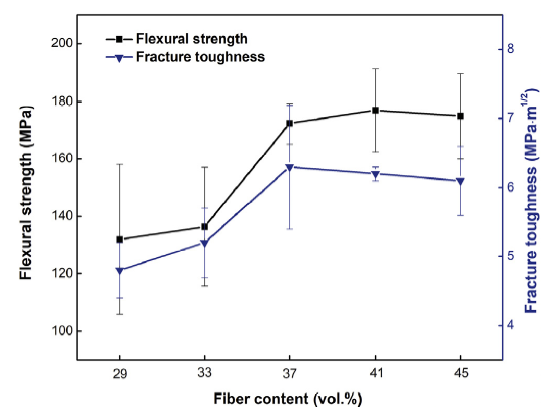
Fig. 3 shows the flexural strength and fracture toughness of Si3N4f/SiO2 composites as a function of fiber content. As can be seen, the flexural strength and fracture toughness experience a similar trend. When the fiber content is lower than 33%, the flexural strength gradually increases from 132.0 to 136.4 MPa while the toughness from 4.8 to 5.2 MPa m1/2. Once the fiber content is greater than 37%, the mechanical properties of composites get improved obviously, with the strength and toughness reaching high levels at around 175.0 MPa and 6.2 MPa m1/2, respectively. Basically, the mechanical properties of composites may be approximately linear with the fiber content, but the expansion of composites (except the composite with 37 vol.% fiber) makes the actual fiber content lower than the designed ones. As a result, the mechanical properties of the composites having more than 37 vol.% fibers share a similar level, while the difference between the composites with 33 vol.% and 37 vol.% fibers is relatively large.
Fig. 3. Flexural strength and fracture toughness of Si3N4f/SiO2 composites with different fiber content.
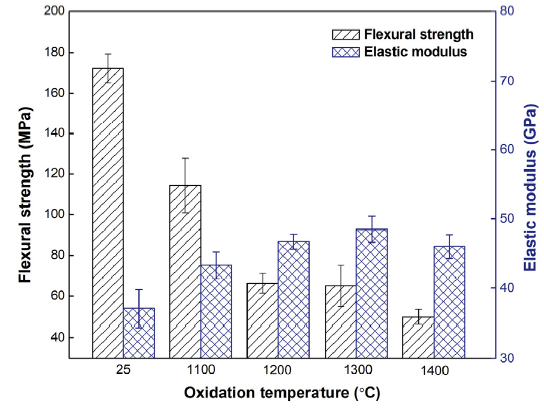
Silicon nitride fiber with good thermal stability and oxidation resistance was selected as reinforcement. The aim was to improve the high-temperature performance of composites. In this work, we investigated the oxidation resistance of composites by testing the flexural strength and modulus before and after heat treatment in air. The results are shown in Fig. 4. As can be seen, after 1 h oxidation at 1100 °C, the flexural strength drops dramatically but can still reach 114.4 MPa, which is high enough to ensure the safety of radar systems. As the oxidation temperature goes to 1200 and 1300 °C, the flexural strengths continue to decline to 66.4 and 65.1 MPa, respectively, indicating that the composites have seriously degraded. As to the performance at 1400 °C, the flexural strength is about 50 MPa, but it is worth noting that the falling range is only 15 MPa compared with that at 1200 and 1300 °C. Such similar performance, in turn, proves that the silicon nitride fiber may have been sintered into the silica matrix, under this condition the strengthening and toughening function of fibers are completely lost. Apart from that, the modulus of composites is completely contrast to the flexural strength. It shows a gradual increase from 37.1 to 48.5 GPa when the oxidation temperature is lower than 1300 °C and a slight drop to 46.0 GPa when it comes to 1400 °C. The increase of modulus should be attributed to the increasing density and interfacial bonding, which can promote the load transfer from the silica matrix to the silicon nitride fibers.
Fig. 4. Flexural strength and elastic modulus of the Si3N4f/SiO2 composite after oxidation at different temperatures. The fiber content is 37 vol.%.
In order to reveal the failure mechanism of composites, it is necessary to have a well understanding of the high-temperature performance of the reinforcing fibers. Previously, we have studied the tensile strength of silicon nitride fibers [7]. The results show that after 1 h heat treatment in air, Si3N4 fibers can maintain 93% of their original strength at 1100 °C and 79% at 1200 °C. When the oxidation temperature increases to 1300 °C, there is a significant degradation, with the strength retention being only 54%. As to the 1400 °C performance, the fiber strength is undetectable because the silicon nitride fiber has been seriously oxidized, making it impossible to pick out a single fiber for measurement. Based on the above data, the breaking strength of composites is theoretically predictable according to the following formula [21]:(1)σu=σfu*Vf1-1-βl/lc where σfu* and Vf stand for the in-situ fracture strength and volume fraction of fiber; β is the load transfer factor; l and lc represent the length of fiber and fiber pull out, respectively. Note that this equation is restricted to the composites with relatively weak interfacial bonding and weak matrix.
In this work, it is difficult to get the actual values of β and lc, so we simplify the above equation as follows:(2)σu=Cσfu*Vf where C is defined as contribution factor, from which we hope to give a basic insight into the contribution of fibers to the strength of composites. According to the simplified formula, we can calculate C values based on the actual strength of fiber and composites. It should be noted that for the composites oxidized at over 1200 °C, we can hardly find the fiber pull out at the fracture surface, meaning that the interfacial bonding is too strong or the fiber has totally degraded. Therefore, it is not suitable to apply the above formula on those composites with flat fracture surfaces. In this regard, Table 1 only lists the results of the composites with no oxidation and oxidation at 1100 °C. The 1200 °C oxidized sample is calculated just for comparison. From the calculated results, we can find that the contribution factor linearly decreases from 0.393 to 0.192, indicating that the silicon nitride fiber is gradually losing its strengthening and toughening functions.
Table 1 Contribution factor of the composites oxidized at different temperatures.
| Oxidation temperature (°C) | σu (MPa) | σfu* (MPa) | Vf (%) | C |
|---|---|---|---|---|
| none | 172.3 | 1200 | 37 | 0.393 |
| 1100 | 114.4 | 1116 | 37 | 0.281 |
| 1200 | 66.4 | 948 | 37 | 0.192 |
The typical characteristic for progressive fracture is fiber pull-out, while the feature for brittle composites is a relatively smooth fracture surface. In order to elucidate the fracture mode and degradation mechanism, the fracture morphology of the oxidized composites was observed by SEM. As can be seen in Fig. 5(a), the fracture surface of the 1100 °C oxidized composite is rough but the length of fiber pull-outs is relatively short. Nevertheless, it also indicates a progressive fracture mode. When the oxidation temperature increases to 1200 °C, the fracture surface is similar with that shown in Fig. 5(a). However, there are more pores between the fibers and micro-cracks appeared, which might be responsible for the decrease of flexural strength. As to the composites after oxidation at 1300 and 1400 °C, the fracture surfaces are quite smooth with extensive micro-pores appearing between the fibers. More importantly, the fiber-matrix boundary can be hardly distinguished, implying a strong interfacial bonding [22]. It seems that the silicon nitride fibers and silica matrix have been sintered into a bulk ceramic. Therefore, the fracture pattern of these two composites is a totally brittle one.
Fig. 5. Fracture surfaces of Si3N4f/SiO2 composites after oxidation at (a) 1100 °C, (b) 1200 °C, (c) 1300 °C and (d) 1400 °C. The fiber content is 37 vol.%.
Amorphous silica matrix can be converted to cristobalite at certain conditions, and its conversion rate is influenced by various factors, including the purity of silica, sintering atmosphere, sintering temperature, holding time and even the heating and cooling rate [23]. This kind of phase change should be prohibited for that the cristobalite has different densities and expansion coefficients with amorphous silica, which can lead to the generation of residual stresses and thus degrade the mechanical properties of composites. In order to determine whether the silica matrix has transformed to cristobalite, XRD and IR were employed in this work. Fig. 6(a) plots the XRD patterns of the as-prepared and oxidized composites. It can be seen that the as-prepared, 1200 and 1300 °C oxidized composites maintain in an amorphous state, but the 1400 °C oxidized composite exhibits obvious features for cristobalite. Apart from the XRD results, the IR spectra can also convince the generation of cristobalite at 1400 °C. As can be seen from Fig. 6(b), when the oxidation temperature is lower than 1300 °C, all the IR spectra are similar to that of the as-prepared composite, except for that the H_OH bending vibration and Si-H stretching mode gradually vanish. As to the composite oxidized at 1400 °C, there is also not features for H_OH and Si-H, but the characteristic peak for the cristobalite, namely the Si-O out-of-plane bending vibration, appears at around 62.5 cm-1 [20]. This phenomenon confirms the formation of cristobalite, which is in good agreement with the XRD results.
Fig. 6. (a) XRD patterns and (b) IR spectra of Si3N4f/SiO2 composites oxidized at different temperatures for 1 h.
Si3N4f/SiO2 composites with different fiber content were fabricated by filament winding and sol gel method. The oxidation resistance of composites was investigated. The main conclusions are drawn as follows:
(1) Si3N4f/SiO2 composites with over 37 vol.% fibers display well mechanical performance, with the flexural strength and toughness reaching up to around 175.0 MPa and 6.2 MPa m1/2, respectively.
(2) 1100 °C oxidized composite performs well with a flexural strength of 114.4 MPa, but when the oxidation temperature increases to 1200-1400 °C, the flexural strengths drop a lot to a relatively low level at 50.0-66.4 MPa.
(3) The degradation of composites is due to the strong interfacial bonding, damage of silicon nitride fibers and the crystallization of silica matrix.
We gratefully acknowledged the financial support from the National Natural Science Foundation of China (Grant No. 51702361) and the Natural Science Foundation of Hunan Province (Grant No. 2017JJ3353).

 WeChat
/
| 〈 |
|
〉 |