

Flexural Strength and Weibull Analysis of Bulk Metallic Glasses
[Jijun Zhang1, 2 , Diana Estévez1, 2 , Yuan-Yun Zhao1, 2 , Lishan Huo1, 2 , Chuntao Chang1, 2  , Xinmin Wang
1, 2 , Run-Wei Li1, 2 ]
, Xinmin Wang|
|

 , Xinmin Wang
The flexural strength reliability of bulk metallic glasses (BMGs) plates is analyzed using Weibull statistics. The Weibull modulus ( m) and characteristic strength (σ0) of the Zr48Cu45Al7 BMG are 34 and 2630 MPa, respectively, which are much higher than the values of fine ceramics ( m < 30, σ0 < 1600 MPa). In particular, the m values obtained by flexural strength and compressive strength statistics of the Mg61Cu28Gd11 BMG are 5 and 33, respectively, indicating that the m values of BMGs are test method dependent, and only the m values obtained by flexural strength statistics can be used to make a convincible comparison with those of ceramics.
As a new kind of quasi-brittle material, most bulk metallic glasses (BMGs) usually suffer a strong tendency for shear localization during deformation and macroscopic brittle failure at ambient temperature, which limits their applications as structural materials[1, 2, 3, 4]. Recently, Weibull statistics have been employed to perform reliability analyses of compressive fracture strength in various BMGs[5, 6, 7, 8]. For example, the Weibull modulus (m) of the compressive fracture strength of Mg-Zn-Ca BMG rods (Φ 1.9 mm × 4 mm) and Zr-Cu-Al BMG rods (Φ 1.5 mm × 3 mm) have been measured to be 30-40 and 73.4, respectively [5-6. However, it is well documented that Weibull analysis has been applied to evaluate the reliability of the flexural strength of ceramics and/or oxide glasses by bending tests with specified sample dimensions (for example, 3 mm × 4 mm × 40 mm or 2 mm × 4 mm × 20 mm) [9, 10, 11] In such testing conditions, the Zirconia-based ceramics possesses a striking uniformity in m values, which varies from 5 to 20, while the m values of Alumina-based ceramics and Feldspathic porcelains are scattered in a relatively wider scope of 3 to 30 and 5 to 30, respectively [12, 13, 14, 15, 16, 17, 18, 19, 20, 21, 22]. Due to the differences in sample size (or shape) and test methods, we cannot therefore make a direct comparison of strength reliability by Weibull statistics between BMGs and ceramics, nor we can illustrate their corresponding merits for a particular application. In this sense, it is crucial to investigate the reliability of the flexural strength of BMG plates through bending tests and make a convincing comparison with that of ceramics. However, to our knowledge, the reliability of the flexural strength of BMG samples analyzed by Weibull statistics has not been reported in any BMG materials.
In this work, Zr48Cu45Al7 BMG (Dc = 8 mm) and Mg61Cu28Gd11 BMG (Dc = 12 mm) with high glass-forming ability were selected to prepare fully amorphous plates with dimensions of 3 mm × 4 mm × 40 mm for three point bending test (3-PBT) [23, 24]. We found that the m value and characteristic flexural strength (σ 0) of the Zr48Cu45Al7 BMG plates are much higher than the values of fine ceramics (ceramics with high m and σ 0 values). However, contrary to the high m value for Mg61Cu28Gd11 BMG rods obtained by compressive strength statistics (m = 33), the Mg61Cu28Gd11 BMG plates show extremely low m value by flexural strength statistics (m = 5). These results indicate that the m values of BMGs are test method dependent and only the ones obtained by flexural strength statistics can be used to make a convincible comparison with ceramics.
Amorphous plates (3 mm × 4 mm × 40 mm) with the compositions of Zr48Cu45Al7 and Mg61Cu28Gd11 were produced by copper mould suction casting. Each surface of the samples was polished to be parallel to the longitudinal axis of the specimens. The 3-PBT was performed at room temperature with an Instron testing machine under a constant loading strain rate of 0.5 mm/min. The span length (L) of the test samples was 30 mm. At least 30 plates of each BMG were tested. The flexural strength (σ f) values were obtained based on the formula: σ f = 3FL/2bd2, where F is the breaking load, b is the width of specimen, and d is the thickness of specimen. In addition, uniaxial compression test of Mg61Cu28Gd11 BMG rods was performed with a constant strain rate of 1 × 10⁻⁴ s-1. The rods were 3.5-4.0 mm in length and ~1.9 mm in diameter, providing a nominal aspect ratio of ~2:1. The fracture surface and side surface morphology of the test samples were investigated by scanning electron microscopy (SEM).
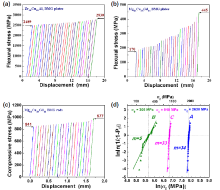
Fig.1(a) shows the scatter in the values of the flexural strength σ f for Zr48Cu45Al7 BMG plates. The σ f values exhibit surprisingly high uniformity lying within a remarkably narrow range of 2489 to 2830 MPa, with a variation of only ± 7% of the mean strength value (2660 MPa). In contrast, the σ f values for Mg61Cu28Gd11 BMG plates have a larger scatter in a range of 170 to 445 MPa (Fig.1(b)), with a variation of ± 45% from its average value (308 MPa). Fig.1(c) also displays 25 compression stress-strain curves of the Mg61Cu28Gd11BMG rods. The compression fracture strength σ f shows a narrow distribution range of 841 to 977 MPa, with a variation of ± 6% from its mean value (896 MPa)[25]. Similar results have also been observed in the previous studies for Mg66Zn30Ca4 (785 MPa ± 10%) and Mg71Zn25Ca4 (712 MPa ± 6%) BMG rods, respectively[6].
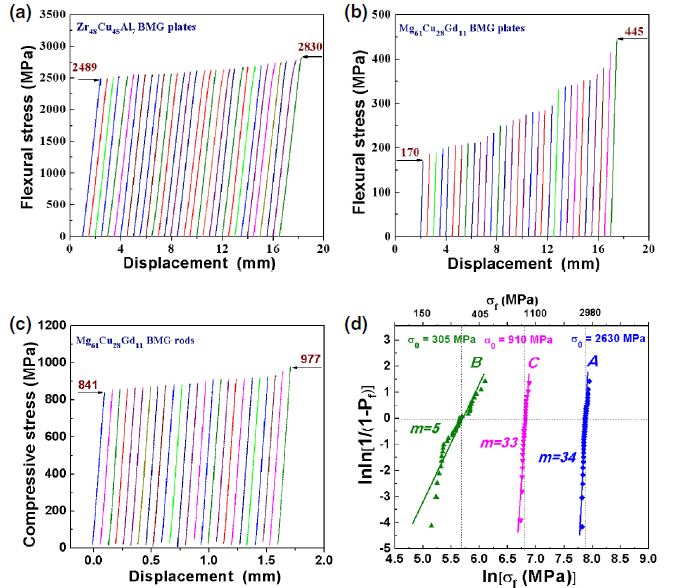 | Fig.1 Stress-displacement curves of the as-cast BMGs samples: (a) Zr48Cu45Al7 BMG plates; (b) Mg61Cu28Gd11 BMG plates; (c) Mg61Cu28Gd11 BMG rods; (d) Weibull plots of fracture strength (σ f) for Zr48Cu45Al7 BMG plates (line A, flexural strength), Mg61Cu28Gd11 BMG plates (line B, flexural strength) and Mg61Cu28Gd11 BMG rods (line C, compressive strength). |
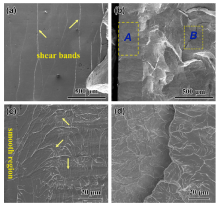
Fig.2 shows the SEM images of a typical Zr48Cu45Al7 BMG plate after 3-PBT test. The formation of several shear bands on the tensile side of the sample indicates that the Zr48Cu45Al7 BMG plate has undergone obvious plastic deformation through the formation of multiple shear bands prior to failure (Fig.2(a)). As for the cross-section of fracture surface, a smooth region of about 15 µ m in width (Fig.2(c)) can be observed in the shear offset part at the tensile side of the fracture surface (region A in Fig.2(b))[26]. Near the smooth region, the core-vein pattern (marked by arrows in Fig.2(c)) shows two typical features, i.e., round core and veins radiating out from the central point, which has been typically observed in the tensile fracture surfaces of BMG samples [27, 28]. However, in the central part of the fracture surface, which is corresponding to the overloaded region, a rough zone caused by a significant crack bifurcation is observed (around region B inFig.2(b)), indicating that the advancing crack prior to failure is slowed down in this region. Furthermore, zooming in the rough zone, randomly distributed dimple patterns associated with local viscous flow are present (Fig.2(d)), which is a feature often observed in less-brittle BMGs [3, 29].
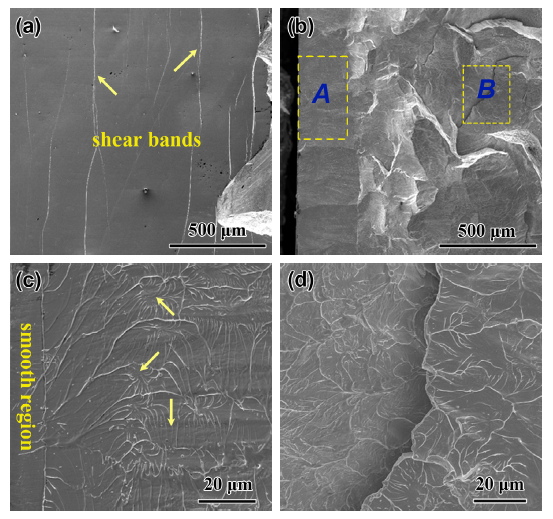 | Fig.2 Flexural fracture surface of a typical Zr48Cu45Al7 BMG plate: (a) side view; (b) cross-section view; (c and d) magnified images of area A and B labeled in (b). |
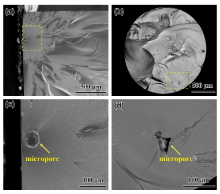
Fig.3(a, b) shows the typical SEM micrographs of the flexural and compressive fracture surfaces of the Mg61Cu28Gd11 BMG plates and rods, respectively. For these two samples, the fracture surface consists of large, smooth, flat areas, suggesting that shear propagated in an unimpeded fashion over rather large distances[30, 31, 32]. Fig.3(c, d) displays the magnified images for the area inside the box in Fig.3(a, b), respectively. As can be seen from these images, micro-pores in the size of ~50 µ m are present and radial marks that radiate outward from the origin of the crack are observed, indicating that the failure of the Mg61Cu28Gd11 BMG samples is flaw-sensitive in both bending and compressive tests.
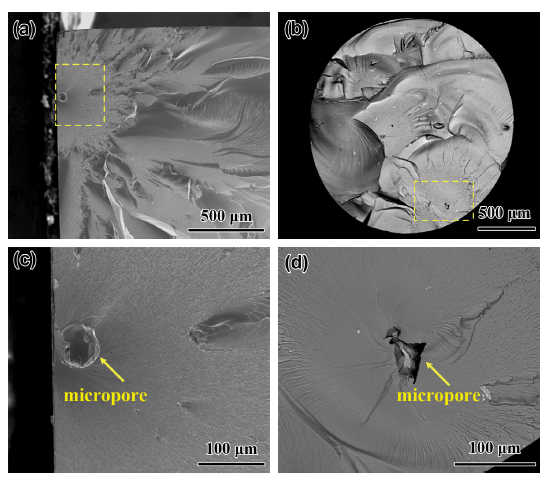 | Fig.3 (a) Flexural fracture surface morphology of the Mg61Cu28Gd11 BMG plate; (b) compressive fracture surface morphology of the Mg61Cu28Gd11 BMG rod; (c and d) magnified images of the micro-pores in (a) and (b), respectively. |
The variability of σ f in the present as-cast BMG plates and rods was analyzed using the Weibull statistical method. The Weibull equation describes the fracture probability Pf for a given uniaxial stress σ , where σ 0 is a scaling parameter, referred as a characteristic strength defined as the stress at which the Pf is 63.2%, m is the Weibull modulus and V is the normalized volume of the tested sample. The parameter σ u denotes the stress at which there is zero probability of failure and is usually taken to be zero[33]. The probability of failure, Pf, was calculated using the equation [34, 35, 36]:
Pf=1-exp{-Vm[(σ -σ u)/σ 0]} (1)
Pf, i=(i-0.5)/n (2)
where n is the total number of the samples tested and i is the sample rank in ascending order of failure stress. These results were then plotted in the usual double logarithmic form of the Weibull expression:
lnln⌊1/(1-Pf)⌋=lnV+mln(σ -σ 0)-mlnσ 0(3)
By fitting a straight line to lnln[1/(1 - Pf)] as a function of lnσ , the Weibull modulus m is simply obtained from its slope and the scaling parameter σ 0 can be determined from the intercept.
Fig.1(d) shows the resulting two-parameter Weibull plots of lnln[1/(1 - Pf)] vs. lnσ for the data in Fig.1(a-c). A linear regression fits the data sets, resulting in two-parameter Weibull modulus (m) of 34, 5 and 33, and deriving the scaling parameter (σ 0) to 2630 MPa, 305 MPa and 910 MPa for Zr48Cu45Al7 BMG plates, Mg61Cu28Gd11 BMG plates and Mg61Cu28Gd11 BMG rods, respectively.
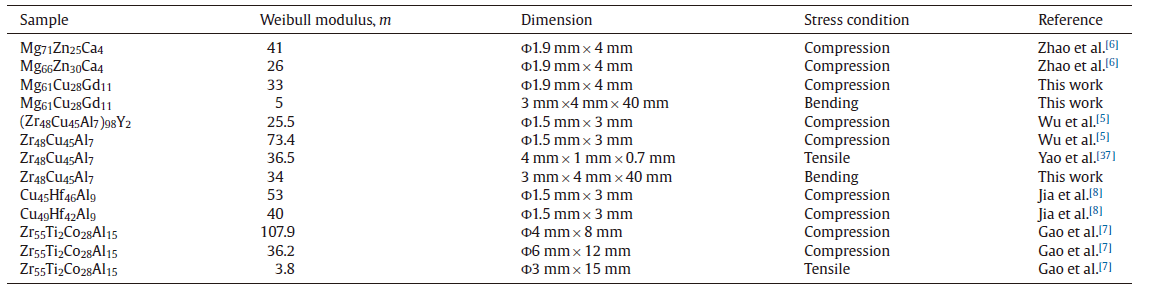
Table 1 presents the data obtained in this study together with recently published data employing Weibull statistics in BMG samples[5-8] [37]. As can be seen, the reliability of the fracture strength of BMG samples is test method and sample size- dependent. In general, a higher m value can be obtained in smaller test samples and/or under compressive load, while a smaller m value can be obtained in larger test samples and/or under tensile load. This is because the smaller the size of the sample is, the fewer are the defects (or flaws). Moreover, the stress under compressive load is less sensitive to defects (or flaws) than that under tensile load. Therefore, smaller m values were obtained from Weibull statistics of flexural strength in Zr48Cu45Al7 BMG and Mg61Cu28Gd11 BMG plates. In addition, the Weibull statistics analysis of flexural strength data also showed that MG plates deformed via shear band formation ( Fig.2) usually having higher m values, while in other plates the failure was due to the development of cracks and defects ( Fig.3) often exhibiting lower m values. Such behavior can be understood by taking into account that the MG plates deformed via shear band usually failed at a stress around their flexural yield strength (σ f) value. Since σ f is a constant at a given test condition, a higher flexural strength reliability (or m value) can be obtained in this case. On the other hand, due to the variation of size and distribution of cracks or defects, brittle MG plates usually failed at a stress far beyond their flexural yield strength resulting in a lower flexural strength reliability (or m value).
 | Table.1 Summary of Weibull modulus, sample dimensions and stress condition of several BMGs |
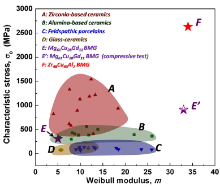
In order to make a direct comparison of mechanical reliability by Weibull modulus (m) between BMGs and ceramics, a plot of characteristic stress (σ 0) versus m values for Zr48Cu45Al7 BMG plates and Mg61Cu28Gd11 BMG plates is shown in Fig.4. The plot also shows several typical ceramic plates (including Zirconia-based ceramics, Alumina-based ceramics, Feldspathic porcelains and glass-ceramics) with similar sample dimensions and under bending conditions [12, 13, 14, 15, 16, 17, 18, 19, 20, 21, 22]. As labeled by star E in Fig.4, the Mg61Cu28Gd11 plates have extremely low Weibull modulus (m = 5), only comparable to the lower bound of Zirconia-, Alumina-based ceramics and Feldspathic porcelains, but significantly lower than that of fine ceramics (15 < m < 30) and Zr-based BMG (m = 34). On the other hand, although the value of σ 0 of the Mg61Cu28Gd11 BMG (σ 0
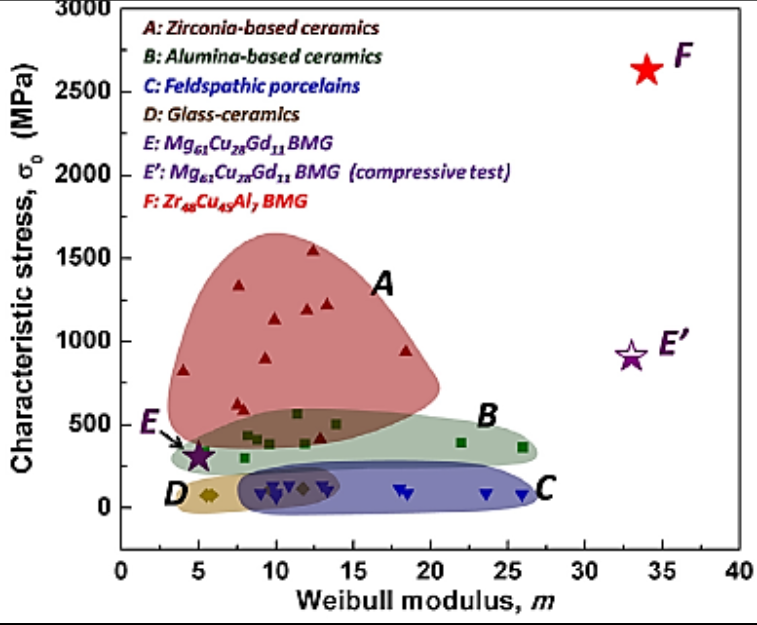 | Fig.4 Characteristic stress (σ 0) vs Weibull modulus(m) of Zirconia-based ceramics (A) [12, 13, 14, 15, 16, 17], Alumina-based ceramics (B) [17, 18, 19, 20], Feldspathic porcelains (C) [12, 15, 19, 21], glass-ceramics (D) [12, 15, 22], Mg61Cu28Gd11 BMG(E and E𠈙), and Zr48Cu45Al7BMG (F). (A)-(F): date (flexural strength) obtained in bending tests, (E'): date (compressive strength) obtained in compression tests. |
In particular, Fig.4 also shows the plot of σ 0 versus m of Mg61Cu28Gd11 BMG rods measured by compressive test (as marked by star E'). The Mg61Cu28Gd11 BMG rods display relatively high value of characteristic compressive stress (σ 0 = 910 MPa) and Weibull modulus (m = 33). Without considering the differences in the test methods and the types of fracture strength (compressive strength vs. flexural strength), it seems that the Mg61Cu28Gd11 BMG has much higher mechanical properties and reliability than fine ceramics. In fact, as shown by E and E', the m values of BMGs are test method dependent and thus the above conclusion is misleading. In this sense, we investigated the reliability of the flexural strength of BMGs through 3-PBT. Such investigation allows us to make a convincing comparison with ceramic materials and to further understand the mechanical properties of BMGs.
The flexural strength reliability of the Zr48Cu45Al7 and Mg61Cu28Gd11 BMG plates was analyzed by Weibull statistics. The Weibull modulus (m) of the Zr48Cu45Al7BMG plates is 34, which is much higher than that of fine ceramics. While the m value of the Mg61Cu28Gd11 BMG plates is 5, indicating that the Mg61Cu28Gd11 BMG is a typical brittle material. It was also found that the reliability of the fracture strength of BMG samples is test method and sample size dependent. In general, a higher m value can be obtained in smaller test samples or (and) under compressive load, while a smaller m value can be obtained in larger test samples or (and) under tensile load. Furthermore, only the m values obtained by flexural strength statistics of BMGs can be used to make a convincible comparison with the m values of ceramic materials.
The authors have declared that no competing interests exist.
| [1] |
|
| [2] |
|
| [3] |
|
| [4] |
|
| [5] |
|
| [6] |
|
| [7] |
|
| [8] |
|
| [9] |
|
| [10] |
|
| [11] |
|
| [12] |
|
| [13] |
|
| [14] |
|
| [15] |
|
| [16] |
|
| [17] |
|
| [18] |
|
| [19] |
|
| [20] |
|
| [21] |
|
| [22] |
|
| [23] |
|
| [24] |
|
| [25] |
|
| [26] |
|
| [27] |
|
| [28] |
|
| [29] |
|
| [30] |
|
| [31] |
|
| [32] |
|
| [33] |
|
| [34] |
|
| [35] |
|
| [36] |
|
| [37] |
|