

High Temperature Phase Transitions of Graphene Oxide Paper from Graphite Oxide Solution
[Yan-Jia Liou, Wu-Jang Huang*  ]
]
]
|
|


Graphene oxide paper (GOP) can be prepared through simplified filtration of a graphite oxide solution. It possesses similar properties to graphene. In this study, the graphite oxide solution was synthesized from commercial graphite by means of Hummer's method. It corresponds to the dried GOP that was prepared by deposition on a cellulose filter. It is found that the mesophase of the dried graphene oxide papers obtained from the graphite was thermotropic hexagonal columnar liquid crystal. Its higher temperature transitions were found at 80 °C, 150 °C and 170 °C-180 °C. Therefore, it could be used for thermal storage and conductive materials in the future.
Graphene is a kind of monolayer graphite with higher electron and hole mobility than silicon, high heat conductivity and special optical properties. Therefore, it shows potential for new materials, such as a semiconductor. Graphene can be used in a transparent conductive oxide thin film process[1] or serve as solar cells[2], [3], [4] and [5] or a super capacitor. Many manufacturing methods of graphene have been proposed, such as chemical vapor deposition[6], chemical reduction of graphene oxide[7] and the exfoliation method[8] and [9]. In some studies of graphene, researchers have used a combination method with ozone exposure and annealing temperatures at 530 K to produce graphene from highly oriented pyrolytic graphite[10].
Graphite oxide and graphene oxide (GO) are both precursors of the production of graphene materials. Their structures are similar to graphene, but the surface of graphene oxide is bonded with hydroxyl radicals[11]. Therefore, it can be applied as dye-sensitized solar cells[12], a super capacitor[13] or doped with polymer and metal materials to make nanocomposites. It can also be used in the degradation of dyes and heavy metals[14], [15], [16], [17] and [18]. The GO is obtained from oxidation processes of graphite materials. Generally, the oxidation processes of graphite are conducted by using strong oxidants or acid liquid. In some studies, researchers have used graphite powder in dry air (the water content < 2 ppm) as an oxidant and conducted heating to produce GO[19].
Since liquid crystal (LC) has flow, crystallization and special photoelectric properties, it can be used in displays, navigation systems and view finders. The molecular structure of LC contains nematic, smectic, cholesteric, discotic, thermotropic LC and reentrant LC[20] and [21]. Common LC materials are alkenyl, phenyl-cyclo hexane or a symmetrical structure of polymers. In several studies, graphene and graphene oxide (GO) have been reported to possess a discotic nematic LC phase in suspended solutions[22], [23], [24] and [25]. However, almost no literature has ever been reported on the property of thermal phase transitions of GO in a solid phase, for example graphite oxide paper made from graphite. In this study, we investigated home-made graphene oxide paper (GOP) on its mesophase transition temperature and tried to identify the LC phase in the mesophase state of the GOP. Therefore, we would like to report on the property of phase transitions of the material.
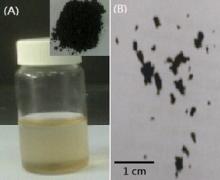
A graphene oxide solution (GOS) was used as synthesized using oxidation of commercial graphite using a wet-type oxidation process, called Hummer's method. H2SO4 and H3PO4 in a ratio of 9:1 and then, 2.25 g of KMnO4 were added into the above mixed acid solution. Next, 0.375 g of graphite powder was added to the oxidant and heat-treatment was performed at 50 ° C for 24 h. After cooling, 3 mL of H2O2and 200 mL of H2O were added into the cooled solution. Then, the above mentioned solution underwent centrifugation at 3000 r/min, and the sediment was collected. Next, the sediment was added to 200 mL of 30% HCl followed by centrifugation again. The steps were repeated until the sediment was dissolved and uniformly dispersed in the solvent (as shown in Fig. 1(A)). The GOP was prepared simply by filtration of the GOS using a No. 1 paper filter (as shown in Fig. 1(B)), and the thickness was about 0.1-0.5 nm.
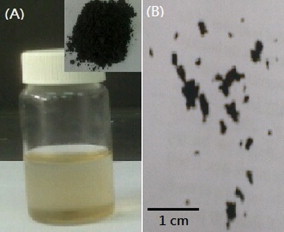 | Fig. 1 Photos of (A) commercial graphite powder and as synthesized GOS and (B) GOP. |
In order to analyze the properties of the products, scanning electron microscopy (SEM) as well as energy dispersive spectrometry (EDX) was used to analyze the structure and exterior of different samples (S-3000N, HITACHI, Japan). Fourier transform infrared spectrometry (FTIR) was used to analyze the functional groups of the samples (Vector22, Bruker, Germany). The parameters of this instrument were a scanning time of 128 times, with a wave number of 4000 to 400 cm− 1. X-ray diffraction (XRD) was used to analyze the lattice structure (D8 Advance, Bruker, Germany). The scan angles were from 10° to 80° (2θ ). Differential scanning calorimetry (DSC) was used to analyze the thermology transitions of the samples (DSC-822, Mettle Toledo, Switzerland). The scan temperatures were 30 ° C-260 ° C; the heating rate was 20 ° C/min; the holding temperature was 30 ° C for 60 min and the carrier gas (N2) flow rate was 50 mL/min.
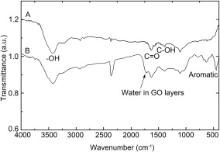
shows the FTIR spectra of commercial graphite and GOP. When the peak was between 3850 and 3745 cm− 1, it corresponded to the amide groups. The peak at 3500 cm− 1 corresponded to a -OH stretching vibration motion. The peak at 2950 cm− 1 corresponded to -CH2-. When the peak was at 2250 cm− 1, it corresponded to the peak for absorbed CO2 molecules. The range between 1700 and 1630 cm− 1 corresponded to a CO stretching vibration motion, and the range between 1200 and 1000 cm− 1 corresponded to C-O and C-OH stretching vibration motions. The peaks at 1397 cm− 1corresponded to a -CH3 stretching vibration motion, while the peaks of 1450, 878, 650 and 590 cm− 1corresponded to the aromatic groups.
 | Fig. 2 FTIR spectra of (A) commercial graphite and (B) as synthesized GOP. |
As a result, there was an obvious decrease in the intensities of the amide groups, aromatic groups and -CH2- and -CH3 stretching vibration peaks. In contrast, there was an obvious improvement in the intensities of -OH, C=O and C-OH and C-O stretching vibration peaks in GOP compared with graphite. The phenomenon resulted from the surface of the carbon materials being bonded with large oxygen-containing groups during the oxidation processes, and the oxidant procuring graphite lattice defects and a deamination effect. When the peak was at 1725 cm− 1, it corresponded to the peak of graphite oxide layers in a stretching vibration motion.
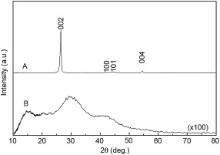
illustrates the XRD patterns of the samples. From XRD analysis we can see that the peaks at around 2θ degree of 26° (d002), 41° (d100), 44° (d101), 54° (d004) and 78° (d110) corresponded to the classical hexagonal crystals [6] and [26]. The peaks (d002, d100 and d101) of the samples had an obvious decrease in intensities due to the disintegration of graphite crystals caused by the oxidation process. Therefore, the crystals of graphene oxide were formed at around 2θ degree of 14° , 16° , 19° and 29° . The XRD pattern of the GOP showed a good crystalline and was quite different from the graphite. It was very similar to the XRD pattern of the orthorhombic crystal of polydiphenyl siloxane (PDPhS) [27]. PDPhS also possessed a conformational disorder transition followed by a thermal-tropic hexagonal columnar liquid crystal phase transition [28].
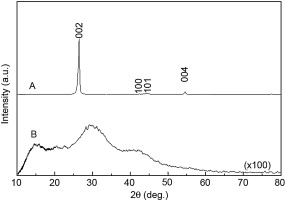 | Fig. 3 XRD patterns of (A) commercial graphite and (B) as synthesized GOP. |
Many studies have suggested that the dried GOS of graphite from acid digestion was followed by a sonic treatment. This was also very similar to the XRD pattern of the graphite and the hexagonal crystal. At room temperature, the XRD patterns of dried GOS of graphite using the Hummer's method were somehow very similar to the XRD pattern in the hexagonal columnar liquid crystal phase. At room temperature, the X-ray patterns of dried graphene oxide papers were obtained in a thermal-tropic hexagonal columnar phase. Therefore, GO should be classified as one of the discotic liquid crystal molecules (Table 1).
 | Table 1 Common mesophase for several rigid molecules |
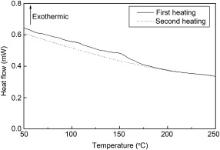
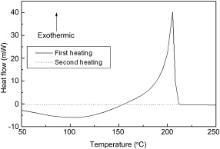
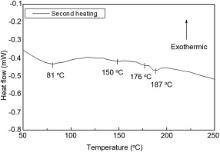
Fig. 4, Fig. 5 and Fig. 6 illustrate the DSC curves of the samples. From the results we see that the heating of the commercial graphite powder at 130 ° C and 170 ° C resulted in glass transition in the first heating temperature (Tg). An endothermic peak was produced when the GOP was at 100 ° C, while an exothermic peak was produced at 205 ° C by the first heating. In the second heating, higher temperature transitions were found at 80 ° C, 150 ° C and 170 ° C-180 ° C. Therefore, from the results we find that the obtained GOP has mesophase transitions.
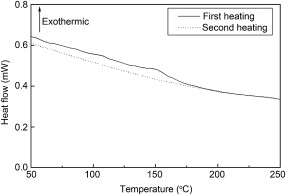 | Fig. 4 DSC curve of commercial graphite powder. |
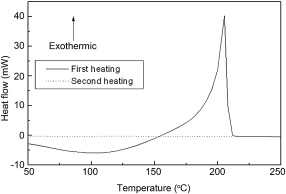 | Fig. 5 DSC curve of as synthesized GOP. |
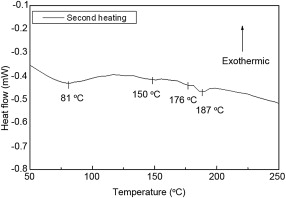 | Fig. 6 DSC curve of expanded 2nd heating curve of the synthesized GOP. |
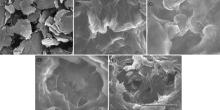
shows the SEM image of the purchased graphite powder and homemade GOP sample. The commercial graphite product had a thin plate stacked structure. When the oxidation process was used to produce GOP, the graphite sheets melted at the edges and deposited a formation of thin folding flakes, and the morphology was significantly changed after its mesophase transitions of the GOP sample were annealed at 360 ° C. Based on the SEM morphology, we found the mesophase transition of GOP would actually be a hexagonal columnar liquid crystal phase. In order to identify the stability of the mesophase of GOP, prolonged annealing at 360 ° C for 1 h and 72 h was performed on the GOP samples.
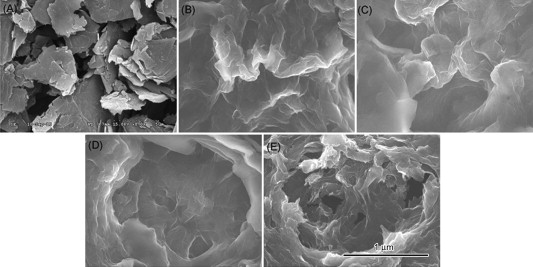 | Fig. 7 SEM images of (A) commerce graphite and (B) as synthesized and (C) after annealed at 80 ° C, (D) 160 ° C and (E) 360 ° C of GOP for 10 min. |
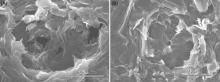
As shown in Fig. 8, it is found that the mesophase crystal layer is formed completely at high temperatures, and the change in crystal size is significant without a change in the annealing time. Therefore, the crystal stacking of a GOP mesophase is very fast, and this phenomenon is also consistent with the property of thermo-tropic hexagonal columnar liquid crystals.
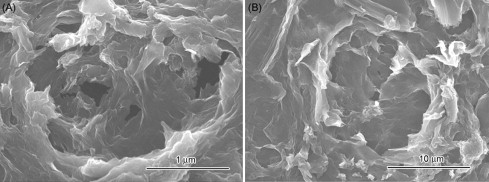 | Fig. 8 SEM image of after annealing at 360 ° C of GOP for (A) 1 h and (B) 72 h. |
From our results, it is found that the GOS was a high-dispensability solution. The GOP is made from a simplified filtration of graphite oxide. The mesophase crystal layer is formed completely at high temperatures, and the change in crystal size is significant without changing the annealing time. The crystal stacking of the GOP mesophase is very fast, and this phenomenon is also consistent with the property of thermotropic hexagonal columnar liquid crystals. At room temperature, the XRD patterns of dried graphene oxide papers obtained from the graphite were found to be in a columnar phase; while it was in a thermal-tropic hexagonal columnar phase when obtained from commercial graphite. Its higher temperature transitions were found at 80 ° C, 150 ° C and 170-180 ° C. Therefore, it can be used as thermal storage and conductive materials in the future.
The authors have declared that no competing interests exist.
| [1] |
|
| [2] |
|
| [3] |
|
| [4] |
|
| [5] |
|
| [6] |
|
| [7] |
|
| [8] |
|
| [9] |
|
| [10] |
|
| [11] |
|
| [12] |
|
| [13] |
|
| [14] |
|
| [15] |
|
| [16] |
|
| [17] |
|
| [18] |
|
| [19] |
|
| [20] |
|
| [21] |
|
| [22] |
|
| [23] |
|
| [24] |
|
| [25] |
|
| [26] |
|
| [27] |
|
| [28] |
|